
Guides
Workshop tools and their functions
Workshop tools fall into seven jobs: measuring and marking, cutting, shaping and smoothing, drilling and boring, fastening, holding, and finishing, with stationary machines (table saw, bandsaw, jointer, planer, drill press, lathe, mill) doing the same jobs faster and more accurately. In a garage the question is which ones fit: a table saw wants a 14 to 16 ft stock lane, a drill press fits a 19-1/2 x 12 in footprint, and a lathe or mill adds 294 to 432 lb of weight.
What are the main workshop tools and what do they do?
A workshop tool is anything that helps you measure, cut, shape, join, hold or finish material. There are hundreds, but they fall into a short list of jobs, and the jobs are the same whether you work in wood, metal or plastic. Learn the jobs first and the tools sort themselves out. This page covers the jobs, gives examples in each, says what the garage adds to the decision, and links to the pages that go deeper. It does not rebuild the reference charts (drill sizes, tap sizes, socket sizes, torque) that WorkshopCalc already has.
| Job | Hand tools | Power tools | Stationary machines |
|---|---|---|---|
| Measure and mark | Tape, square, rule, marking gauge | Laser, digital angle finder | Digital caliper, dial indicator |
| Cut | Handsaw, utility knife, hacksaw | Circular saw, jigsaw, miter saw | Table saw, bandsaw, lathe |
| Shape and smooth | Plane, chisel, file, rasp | Router, sander, grinder | Jointer, planer, drum sander |
| Drill and bore | Brace, hand drill | Cordless drill, impact driver | Drill press, mill/drill |
| Fasten | Hammer, screwdriver, wrench | Impact driver, nailer | Welder (joins metal) |
| Hold | Clamps, vise | Magnetic holders | Machine vises, work tables |
| Finish | Brush, scraper, rag | Spray gun, random orbit sander | Spray booth, wide-belt sander |
Measuring and marking tools
Every job starts with a measurement, and every error starts with a bad one. A tape measure, a combination square and a marking knife or sharp pencil cover most work. A digital caliper reads small dimensions to the resolution on its listing; the HARDELL 6 in digital caliper is the example in our catalog. Calipers measure thickness, inside and outside diameters and depths, and they are the first precision tool in a machine shop. A magnetic base dial indicator set, such as the Fowler magnetic base and dial indicator set, checks runout and alignment on a lathe, a mill or a table saw blade.
Layout tools turn a drawing into lines on the work: squares, straightedges, scribes, dividers and center punches. For long cuts, a straightedge and a clamp guide beat eyeballing. A rule of thumb: measure twice, mark once with a fine line, and cut on the waste side of the line. The saw takes up a width called the kerf, and ignoring it is the most common beginner error.
In a garage, measuring tools live in drawers, away from dust and moisture. Steel rules and squares rust, and a caliper dislikes dust and drops. A small rolling chest or a locking drawer keeps them in good order; see best tool chest for a garage shop.
Cutting tools and machines
Cutting divides stock into parts. Hand saws (crosscut, rip, back, coping) are quiet, cheap and need no power. Portable power saws (circular saw, jigsaw, reciprocating saw) are fast and go to the work. Stationary saws do the same cuts with a fixed blade and a table, which makes them more accurate and repeatable.
- Table saw. Rips boards to width and crosscuts with a miter gauge or sled. It is the center of most woodshops. The lane for 8 ft stock is about 14 to 16 ft, the reason a one-car garage struggles. Compare the options in best table saw for a garage shop. The Grizzly G0771Z lists a table of 40-1/2 x 27 in and 30 in right rip; the G1023RL lists a 40 x 27 in table and 32 in right rip, 14 A at 240V.
- Miter saw. Makes accurate crosscuts and angles. Compact, on a stand or a bench. See the miter saw station fit sheet.
- Bandsaw. Cuts curves and resaws thick boards into thin ones. The Grizzly G0555 lists a 13-1/2 in throat and 6 in resaw; see best bandsaw for a garage shop.
- Lathe. Cuts by spinning the work against a tool. Wood lathes turn bowls and spindles; metal lathes turn shafts and threads. See the machine shop start guide.
- Cutting metal. A hacksaw, an angle grinder with a cutoff wheel, a bandsaw and a plasma cutter such as the ARCCAPTAIN 55A plasma cutter cut metal at different speeds and costs.
Shaping and smoothing tools
Shaping removes material to bring a part to size and surface. Hand tools (planes, chisels, files and rasps) give control and leave a fine surface. Power tools (routers, sanders, grinders) are faster and noisier.
- Jointer. Flattens one face and squares one edge. A 6 in benchtop jointer like the Grizzly G0945 lists 1/8 in depth of cut and a table of 6-1/4 x 30 in, footprint 9-1/2 x 19-1/2 in. Alternatives are the WEN JT630H and Cutech 40160HB.
- Thickness planer. Brings a board to a uniform thickness after the jointer has flattened one face. The DEWALT DW735X and WEN PL1326 are benchtop planers. See best planer and jointer.
- Router and router table. Cuts edge profiles, grooves and joinery. The BOSCH RA1181 benchtop router table holds a router upside down.
- Sanders. A random orbit sander such as the DEWALT DWE6423 5 in smooths surfaces; an oscillating edge and spindle sander such as the Ridgid EB4424 shapes curves; a drum sander smooths wide panels.
- Grinders. A bench grinder such as the DEWALT DW758 8 in sharpens tools; an angle grinder such as the Metabo HPT 4-1/2 in cuts, grinds and cleans metal.
Sanding and grinding make dust and sparks. Plan collection and fire safety around them; see dust control with a car in the shop and garage shop fire safety.
Starter tools that cover every job


Prices change often; the button shows today's price on Amazon.
Amazon and Grizzly, side by side
Each card shows an Amazon pick and a Grizzly Industrial pick for the same job.
Benchtop drill press
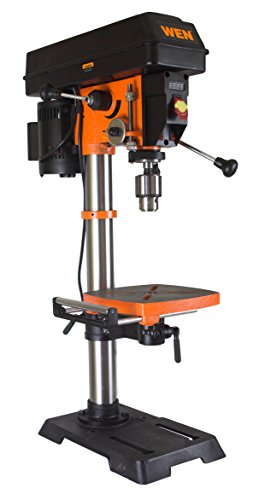
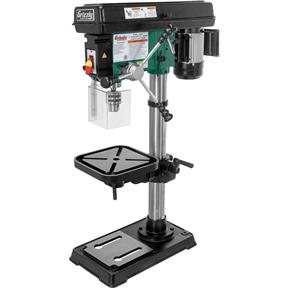
Both are benchtop drill presses on a 120V cord. The Grizzly lists a 15 in swing with an LED light and laser guide; the Amazon pick is a 12 in size at a lower entry cost.
14 in bandsaw

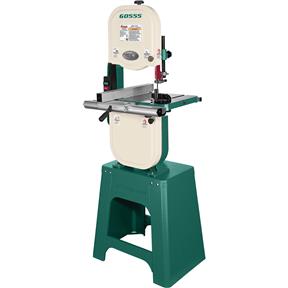
Both are 14 in, 1 HP saws that run on 120V. The Grizzly saw is the established cast-iron-table pick; the Amazon pick is dual-voltage and ships to your door.
8 in bench grinder

Both are 8 in bench grinders with work lights. Neither needs more than a 120V outlet; pick on price and the wheel guards you like.
Woodworking vise

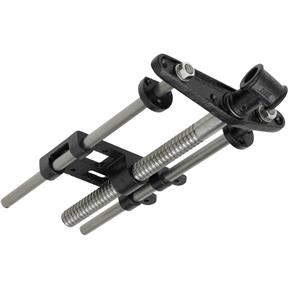
The Amazon vise is a basic front vise; the Grizzly cabinetmaker vise is the better-rated step up if you do fine joinery.
Prices change often and Grizzly runs sales, so the buttons show current prices.
Drilling, boring and fastening
Holes come from a hand drill, a cordless drill or a drill press. A cordless drill and impact driver set, like the DEWALT 20V MAX drill and impact driver kit, covers most holes and screws in a garage. A drill press holds the bit square to the table and the depth repeatable. The Grizzly T34608 benchtop drill press lists a 15-1/4 in swing, 12 speeds, a 10-9/16 in square table, a 19-1/2 x 12 in footprint and a height of 42 in; the WEN 12 in, WEN 10 in and Klutch 13 in floor models are alternatives. A drill press vise such as the PONY 4 in holds small work. For a mill or lathe, holes get more accurate. See benchtop versus floor drill press.
Fastening joins parts: hammers and nails, screwdrivers and screws, wrenches and bolts, nailers and staples, glue, and welding for metal. A pneumatic nailer needs a compressor; a brad nailer is about 0.3 CFM and a framing nailer 2.2 CFM at 90 PSI in our sizing convention (see what size air compressor for a garage). An impact wrench such as the DEWALT 20V MAX cordless impact wrench spins nuts and bolts for auto work without a compressor. Welding fuses metal; the YESWELDER 140A, 205A and ARCCAPTAIN 200A are multi-process machines on 110V/220V. See MIG versus flux core and fire safety for the precautions.
Holding tools: vises, clamps and benches
Holding tools are the quiet heroes. You cannot cut, plane or drill accurately if the work moves. Clamps (bar, parallel, pipe, spring) hold glue-ups and fences; the JORGENSEN 36 in parallel bar clamps and the BESSEY K Body REVO kit are examples. A vise holds the work to the bench: a woodworking vise such as the IRWIN 6-1/2 in or the Grizzly H7788 cabinetmaker's vise for joinery, and a metal vise such as the Nakkaa 5 in or the Grizzly T33818 for heavy work. See vises and clamps for a garage workbench.
The bench itself is a holding tool. A flat, rigid surface at the right height is worth more than a drawer of gadgets; see workbench height and workbench size for a one-car garage. Pegboard, a tool chest and a wall cabinet hold the tools themselves.
Finishing, safety and support tools
Finishing covers brushes, rags, scrapers, sprayers and sanders, and protective coatings on wood and metal. A compressor with a spray gun gives a smooth finish but takes 8 CFM and a fire plan. Safety is the support tool for everything else: safety glasses (NoCry clear), hearing protection (DECIBEL DEFENSE 37 dB NRR), a respirator (3M 6291 or GVS Elipse P100), gloves where appropriate (not near rotating parts), a fire extinguisher (Kidde 1-A:10-B:C) and first aid.
Support tools make the shop run: dust collection, an air filter, lighting, a shop vacuum, a mobile base, a stool (WEN pneumatic rolling stool) and a creeper for auto work (Pro-LifT mechanic creeper). Each has its own page on this site: dust collection, lighting and mobile bases.
Which tools does a garage change?
A garage changes three things about the tool list. It limits floor space, so every stationary machine has to earn its footprint; the layout calculator tests it. It limits power, so 240V machines need a circuit before they arrive; the workshop amps calculator counts the load. And it shares the space with a car, so machines on mobile bases and fold-down benches beat fixed ones. In a 12 x 20 ft bay with a sedan, only 3 ft behind the bumper is free; in a 12 x 22 ft bay it is 5 ft.
A sensible buying order for a beginner is hand tools and measuring tools, then a cordless drill and impact driver, then one stationary saw, then a drill press, a bench grinder and a shop vacuum, then jointer and planer, then dust collection. The beginner woodshop setup and the beginner machine shop setup put prices on that order by tier.
A starter list by budget tier
A tool list is more useful when it is ordered. The buy cards and the setups pages carry the price bands, and this order follows what most garage shops need first.
- Tier 1, hand tools and safety. Tape measure, combination square, utility knife, hammer, screwdrivers, adjustable wrench, handsaw, a set of clamps, safety glasses, ear protection and a fire extinguisher. This covers most repairs and small projects.
- Tier 2, cordless and a bench. A drill and impact driver kit, a circular saw or jigsaw, a random orbit sander, a vise, a bench and a shop vacuum. This turns hand work into project work.
- Tier 3, one stationary machine. A table saw, a drill press, a bench grinder or a miter saw, whichever fits your work and your floor. Pick one and learn it before you add another.
- Tier 4, the second set. Jointer and planer for milling, a bandsaw for curves, a router table, a dust collector and an air filter.
- Tier 5, specialist. A lathe, a mill, a welder, a compressor and tools for the trade you chose.
At each tier, check the garage first: floor, power, noise and the car. The setups turn the tiers into complete packages by trade, with beginner, intermediate and expert versions and a reason for each. And read the page for the machine before you buy it; each has a fit sheet that computes whether it fits your bay. For reference charts that apply to hand tools and fasteners, such as drill, tap and socket sizes, use WorkshopCalc.
Get the garage shop planning checklist
One printable page: measure the bay, count the circuits, list the machines, check the floor. Plus a few short emails, then a couple a month at most.
Unsubscribe anytime. You can also just read the checklist on this site.Frequently asked questions
What are the basic tools every workshop needs?
A tape measure, a combination square, a hammer, screwdrivers, a set of wrenches, a handsaw, clamps and a vise, plus a cordless drill and impact driver. Safety glasses, ear protection and a fire extinguisher come before any machine.
What does a table saw do?
It rips boards to width and, with a miter gauge or sled, crosscuts them. It is the center of most woodshops and needs a stock lane of about 14 to 16 ft for 8 ft boards, which is the reason it is hard in a one-car garage.
What is the difference between a jointer and a planer?
A jointer flattens one face and squares one edge of a board. A thickness planer then makes the opposite face parallel to the first and brings the board to a uniform thickness.
What does a drill press do that a hand drill cannot?
It holds the bit square to the table and sets a repeatable depth, which gives straighter, more accurate holes. A vise holds small work safely under the bit.
Which workshop tools need 240V?
Motors over about 2 HP, big heaters and many welders. A 3 HP cabinet saw like the Grizzly G1023RL lists 14 A at 240V; most benchtop machines run on 120V.
This page is researched guidance, not professional electrical, engineering or safety advice. Circuits, loads and clearances depend on your house, your service and your town: have a licensed electrician confirm any wiring, and check local code and each manufacturer's manual before you act.
