
Guides
How to start a garage machine shop
Start a garage machine shop with a benchtop lathe, a mill/drill, a drill press, a bench grinder and a heavy bench, all of which run on 120V. The Grizzly G0602 lathe is 432 lb on a footprint of about 47-1/2 x 12-1/2 in, and the G0704 mill/drill is 372 lb with its stand, so the floor, not the budget, sets the limit. A 22 x 22 ft garage fits the full package with a 60 A subpanel to ask an electrician about.
What do you need to start a machine shop in a garage?
You need four things: floor that can carry the weight, 120V power on more than one circuit, a plan for chips and oil, and a way to measure. Machines come after those, because a lathe on a wobbly bench or a mill on an overloaded circuit is a frustration, not a hobby. A garage machine shop is a different animal from a woodshop: the machines are heavy and slow, the work is small, dust is replaced by chips and cutting fluid, and precision depends on a rigid, level base more than on noise or bay size.
The typical starting set is a benchtop or small floor lathe, a mill/drill, a drill press, a bench grinder, a heavy bench with a vise and a set of measuring tools. All of it runs on 120V, which is why the trade is a good fit for garages without 240V. The 22 x 22 machine shop layout and the 12 x 22 one-car layout show the set placed in a real bay. The beginner, intermediate and expert setups price the three tiers.
Which machines go first, and why?
Buy in the order that each machine lets you make the next one's accessories. A drill press and a bench grinder come first because they do real work immediately and cost the least. Then the lathe, because turned parts are the base of most small projects. The mill comes last because it is the heaviest, the most demanding on setup and the one where tooling costs add up.
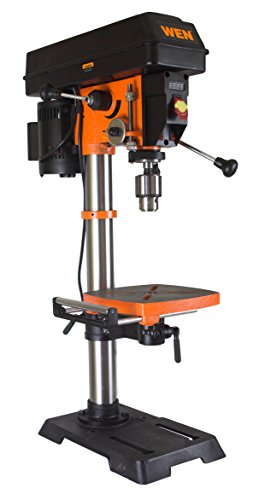
- Drill press. The Grizzly T34608 lists a 15-1/4 in swing, 12 speeds, a 10-9/16 in square table, 5.3 A and a footprint of 19-1/2 x 12 in at 42 in tall, at 127 lb. The WEN 12-inch is the lower-cost alternative, and a PONY 4 in drill press vise holds work to the table safely.
- Bench grinder. The DEWALT DW758 8 in and the JET 8 in with LED lights and a coolant tray both run on a standard outlet; the Grizzly G0865 is the same size with LED lights. A grinder sharpens tool bits, which is what keeps a lathe cutting cleanly.
- Lathe. The Grizzly G4000 lists an 8-3/4 in swing, 19 in between centers, 3/4 HP, 9 A, 294 lb and a 16 x 37 in footprint. The G0602 lists a 9-1/2 in swing, 22 in between centers, 1 HP, 13.6 A and 432 lb on a 47-1/2 x 12-1/2 in footprint. The VEVOR 7 x 14 in is the lighter entry; its listing gives a 550 W, variable speed motor with a digital display.
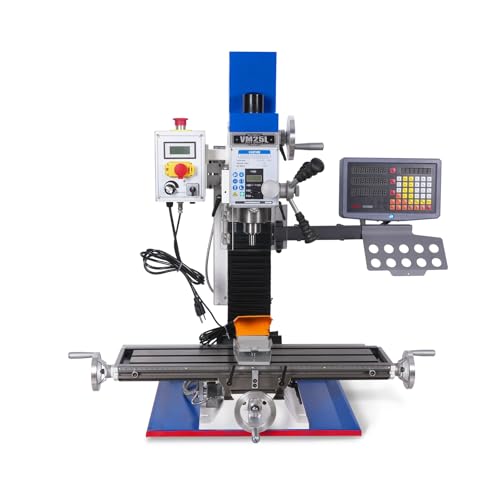
- Mill/drill. The Grizzly G0704 lists an R-8 spindle, a table of 7-1/16 x 26-5/8 in, 18-7/8 in of table travel, 1 HP, 12 A and 372 lb with the stand. On Amazon, the Mechmaxx 1.5 HP 7 x 27-1/2 in and the INTBUYING 7 x 27-1/2 in are the same class. Read the footprint on the listing; the briefs here do not give one for the G0704.
Check each machine in the G4000 fit sheet, the G0602 fit sheet and the G0704 fit sheet before you order. They compute the footprint, the circuit and the weight against your bay. The best benchtop lathe and mill for a garage machine shop compares the tiers.
Can your garage floor carry a lathe and a mill?
Mostly, yes, but check. A 400 lb machine on a bench stands on a few square inches of leveling foot or a footprint around 4 ft by 1 ft, which is a modest load for a residential garage slab of 4 in or more. The risks are not the total weight. They are cracked or patched slab sections, slab edges and control joints under a leg, and floors that slope. Look at where each machine will stand. If a leg lands on a crack, move it or spread the load with a steel or plywood plate.
Slope matters more than weight. A lathe and mill need to be level to cut straight, and a garage slab slopes toward the door. Use the machine's leveling feet or shims under the bench, and recheck after a month, because a machine can settle as the stand takes its load. Never rely on a mobile base for a machine that cuts. A bench-mounted lathe needs a bench that does not rack: a steel or thick hardwood bench, anchored to the wall or the slab if the listing allows. The Grizzly T10157 workbench with an oak top on steel legs and the VEVOR 72 in hardwood bench both target heavy loads; check each listing for its rating and compare it against the machine weight plus tooling plus yourself leaning on it. See metalworking bench for a garage machine shop.
If the car must still sleep in the bay, keep the heavy machines against the back wall and do not stack them in the car's walk-around. A sedan leaves about 3 ft behind the bumper in a 12 x 20 ft bay and about 5 ft in a 12 x 22 ft bay, so a machine shop in a one-car garage is a shop that fits that strip or a shop where the car lives outside.
Machines and measuring tools to start with


Prices change often; the button shows today's price on Amazon.
Amazon and Grizzly, side by side
Each card shows an Amazon pick and a Grizzly Industrial pick for the same job.
Benchtop metal lathe, entry
The Amazon lathe is a VEVOR 7 x 14; the Grizzly G4000 is a 9 x 19 with a 3/4 HP motor and 294 lb of cast iron. More lathe means more floor and more weight.
Benchtop metal lathe, step up
The Grizzly G0602 is a 10 x 22 with an enclosed gearbox and 432 lb of weight on a footprint of about 4 ft by 1 ft; the Amazon VEVOR 7 x 14 is the lightweight entry alternative.
7 x 27 mill/drill
Both are 7 x 27 class benchtop mills with an R-8 spindle. The Grizzly G0704 ships with a stand and a listed weight of 372 lb.
Benchtop drill press
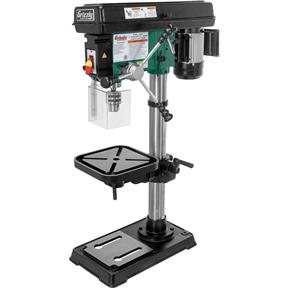
Both are benchtop drill presses on a 120V cord. The Grizzly lists a 15 in swing with an LED light and laser guide; the Amazon pick is a 12 in size at a lower entry cost.
8 in bench grinder
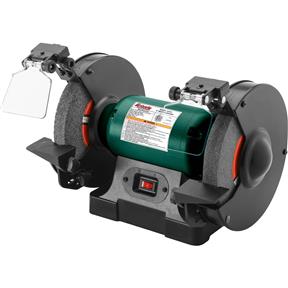
Both are 8 in bench grinders with work lights. Neither needs more than a 120V outlet; pick on price and the wheel guards you like.
5 in swivel bench vise
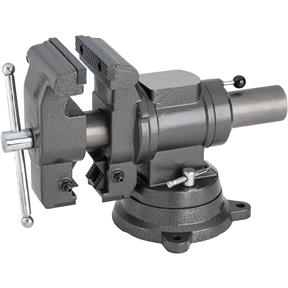
Both are 5 in vises with a 360 degree swivel base. The Grizzly one is a drop-forged industrial unit; the Amazon one is a lower-priced 5 in cast-iron vise.
Prices change often and Grizzly runs sales, so the buttons show current prices.
How much power does a machine shop need?
Less than a woodshop. Our subpanel sizing for the machine shop package that fits a 22 x 22 ft garage is 5 circuits, none at 240V, about 22 A of demand on a 240V-equivalent basis, and a 60 A subpanel to ask your electrician about. A single lathe at 9 to 13.6 A and a mill at 12 A each want their own 15 or 20 A, 120V circuit if you run them close together. The drill press at 5.3 A and the grinder share a third circuit. Lights share a fourth, and the bench power strip a fifth. See the machine shop amps page and the workshop amps calculator.
Two motor facts matter. Starting current is higher than running current, and lathes and mills with variable-speed electronics can be sensitive to a sagging supply. Do not run them from a long, thin extension cord; use a circuit as close as you can, and check any cord in the voltage drop calculator. A clamp meter such as the Klein CL120 shows what a machine actually draws, and an outlet tester such as the Klein RT210 confirms the outlet is wired right. NEC Table 430.248 and Table 310.16 are the sources for motor circuits; have a licensed electrician confirm the circuits and the subpanel. For background see how many amps for a garage workshop.
Chips, coolant and cleanliness
A machine shop does not make dust, it makes chips, and chips are sharp, hot and everywhere. Steel chips from a lathe can fly several feet, and fine swarf sticks to oil and gets tracked into the house. Plan for them: a chip tray under the lathe, a splash guard, a magnet or a brush for fine swarf, and a mat or flooring that is easy to sweep. Rubber and anti-fatigue mats such as the Vergo 15/16 in industrial mat help your back, but oily chips and mats are a slip risk, so keep the mat clear at the operator spot and sweep every session. For fixed coverings, see garage shop flooring and the best garage shop floor covering roundup.
Cutting oil and way oil are the other half. Keep them in labeled, closed containers, and store oily rags in a covered metal can; oily rags are a classic fire cause. Cast-iron surfaces and ways rust fast in a humid garage, so wipe them with oil after use and consider a dehumidifier. Boeshield T-9 is sold for tools and machinery. See garage shop moisture and rust.
Wear safety glasses (NoCry clear safety glasses) every time, keep long hair, sleeves and jewelry away from rotating parts, and never use a glove near a spinning chuck. Ear protection is a good habit on a grinder. A first-aid kit and a fire extinguisher, such as the Kidde 1-A:10-B:C, go at the door.
Measuring and tooling: the part people underbuy
A machine is only as accurate as its measuring. A 6 in digital caliper reads to the resolution on its listing and is the first purchase. A magnetic-base dial indicator set like the Fowler magnetic base and black dial indicator set checks runout, aligns a vise and sets up a part in a chuck. Add a small steel rule, a square, a center punch and a deburring tool.
Lathe tooling is where cost accumulates. An indexable set like the Joogto 21-piece 3/8 in shank kit lists seven tool holders with inserts, and it is a way to start without grinding every bit. Check that the shank size matches your lathe's tool post before you buy; the listing gives the size and your machine's manual gives the post. Mill tooling (end mills, collets, clamps, parallels) is bought as you need it, and the cost often exceeds the cost of the mill within a year. Buy a few quality end mills, not a hundred cheap ones.
For work holding, a bench vise at the bench is useful: the Nakkaa 5 in swivel vise is a 5 in ductile cast-iron vise, and the Grizzly T33818 is a 5 in drop-forged 360-degree swivel vise. See vises and clamps for a garage workbench. For generic reference charts (drill sizes, tap sizes, torque) use WorkshopCalc rather than rebuilding them here.
A layout that still lets the car in
In a one-car bay, the machine shop is a back-wall shop. Put the heavy bench along the 12 ft back wall with the lathe and mill on it, the drill press on the side wall and the grinder at the end of the bench, and keep the 30 in walk-around, the 18 in at the ends and the 24 in apron. In a 12 x 22 ft bay with a sedan, that leaves about 5 ft behind the nose. In a 12 x 20 ft bay it leaves 3 ft, which is not enough for an operator zone, so the car goes outside while you work. In a two-car 22 x 22 ft bay, one bay is for the car and the other holds the shop with room for a bench, the lathe, the mill and a materials rack.
Keep the machine shop away from woodworking dust. Wood dust and metal chips do not mix, and fine dust on an oiled way becomes abrasive paste. If you do both, put the metal machines on the opposite side of the bay from the dust-making machines, and wipe or cover them. A mixed layout is shown in the 24 x 24 mixed layout. For heating and humidity, see the best garage workshop heater and best dehumidifier pages: cold makes oil thick and metal brittle, and wet makes it rust.
Get the garage shop planning checklist
One printable page: measure the bay, count the circuits, list the machines, check the floor. Plus a few short emails, then a couple a month at most.
Unsubscribe anytime. You can also just read the checklist on this site.Frequently asked questions
Can you have a machine shop in a garage?
Yes. Benchtop lathes, mills and drill presses run on 120V and fit a one- or two-car bay. Check the slab, the circuits, local rules and your insurance, and plan for chips, oil and a level, rigid bench.
What machines do I need to start a machine shop?
A drill press, a bench grinder, a benchtop lathe and a mill/drill, plus a heavy bench, a vise and measuring tools. Buy the drill press and grinder first, the lathe second and the mill last.
How much does a benchtop metal lathe weigh?
The Grizzly G4000 lists 294 lb and the G0602 lists 432 lb. The weight with its stand or bench, tooling and you leaning on it is what the floor and bench must carry.
Do I need 240V for a garage machine shop?
Not for benchtop machines. The Grizzly G4000, G0602 and G0704 list 120V motors at 9, 13.6 and 12 A. Each wants a circuit with room for its load; an electrician confirms the circuits and any subpanel.
How do I keep a machine shop from rusting in a garage?
Wipe ways and tables with oil after use, run a dehumidifier in damp weather, store machines under covers and keep the garage out of big temperature swings where possible.
This page is researched guidance, not professional electrical, engineering or safety advice. Circuits, loads and clearances depend on your house, your service and your town: have a licensed electrician confirm any wiring, and check local code and each manufacturer's manual before you act.
