
Guides
What size air compressor for a garage
Size an air compressor by CFM at 90 PSI, not by tank gallons. Trim nailers need about 0.8 CFM, tire inflation about 1.1, auto wrench work about 3.1, spray painting about 11.2, sanding and grinding about 13 and a full auto shop about 19.3 CFM, each after a 30 percent margin. Under about 4 CFM a 6 to 20 gallon 120V unit works; above about 10 CFM you want a 60 to 80 gallon, 240V compressor.
What matters more: CFM or tank size?
CFM matters more. CFM (cubic feet per minute at a stated pressure) is how much air the pump delivers continuously. Tank gallons are only a buffer: a bigger tank lets a high-demand tool run longer before the pump has to catch up. A big tank on a small pump is a compressor that runs a long time to refill and then cannot keep up with a sander. A small tank on a pump that matches the tool is fine. The mistake most people make is buying on the gallon number and the horsepower on the box, which are marketing figures, rather than the CFM at 90 PSI on the data plate or the listing.
The method is short. List the air tools you will run. Find each tool's CFM at 90 PSI from the tool's own rating plate or manual. For tools that run only in short bursts (impact wrenches, nailers, blow guns) multiply by a duty factor. For tools that run continuously (sanders, grinders, spray guns) use the full figure. Add the biggest tool and the duty-weighted rest, then add a 30 percent margin. That is the CFM your compressor should deliver at 90 PSI, and it is what the air compressor CFM calculator computes for you.
The constants on this site are conventions used in the trade, labeled as such: a 1/2 in impact wrench 4 CFM at a 0.25 duty factor, a 3/8 in air ratchet 3 CFM at 0.25, a die grinder 4 CFM at full duty, a dual-action sander 6 CFM at full duty, a cut-off tool 5 CFM at 0.5, a blow gun 2.5 CFM at 0.25, a brad nailer 0.3, a framing nailer 2.2, a paint spray gun 8 CFM at full duty and tire inflation 1 CFM. Your tool's rating plate wins over any of these numbers.
Worked examples for garage work
| Kind of work | Tools | CFM at 90 PSI (with margin) | Compressor |
|---|---|---|---|
| Tires and blow-off | Inflation, blow gun | 1.1 | 6 to 20 gal, 120V |
| Trim carpentry | Brad nailer, framing nailer | 0.8 | 6 to 20 gal, 120V |
| Auto wrench work | Impact, ratchet, blow gun | 3.1 | 6 to 20 gal, 120V |
| Spray painting | Spray gun, blow gun | 11.2 | 60 to 80 gal, 240V |
| Sanding and grinding | DA sander, die grinder | 13.0 | 60 to 80 gal, 240V |
| Full auto shop | All of the above together | 19.3 | 80 gal or larger, 240V, 5 HP |
Each row is a computed page: tires and blow-off, nailers and trim, auto wrench work, spray painting, sanding and grinding and the full auto shop. Notice what the table says. Most garage jobs sit in the first three rows, and a 6 to 20 gallon 120V compressor handles them. The jump comes with continuous tools: a spray gun or a DA sander uses CFM that a small compressor cannot sustain, and a pancake unit running flat out keeps cycling, overheating and still falling behind.
When is 120V enough, and when do you need 240V?
A 120V garage circuit is normally 15 or 20 A. A compressor on 120V is practically limited to about 1.5 to 2 HP of real motor, because anything bigger draws more than a 20 A circuit can feed. NEC Table 430.248 puts a 2 HP single-phase motor at 24 A at 115V and 12 A at 230V, so a true 2 HP motor on 120V is already above a 20 A circuit, and a 3 HP motor at 34 A is far above it. That is why larger stationary compressors are sold as 230V units. Have a licensed electrician confirm the circuit you need.
The circuit for a 240V compressor depends on the motor. Using Table 430.248 and the 125 percent conductor rule (NEC 430.22) with NEC Table 310.16 copper at 60 C: a 3 HP motor draws 17 A at 230V, needs 21.3 A of conductor, a 25 A breaker and 10 AWG; a 5 HP motor draws 28 A, needs 35 A, a 35 A breaker and 8 AWG. The 3 HP circuit page and the 5 HP circuit page give receptacle and wire for each, and the 240V in a garage explained guide shows how to read the table. Compressor nameplates often show a locked-rotor or running current that differs from the motor table; the electrician reads the nameplate and the code together.
If you do not have 240V and do not want to run it, the trade-off is clear. Choose a 120V unit sized for your real tools, accept slower recovery on heavy ones, and avoid continuous tools. Buy a pancake or 20 gallon unit for nailers, tires and wrenches, and take sanding and spraying out of the garage plan. See 120V versus 240V air compressor for a garage.
Compressors by size


Prices change often; the button shows today's price on Amazon.
Amazon and Grizzly, side by side
Each card shows an Amazon pick and a Grizzly Industrial pick for the same job.
20-gallon quiet compressor
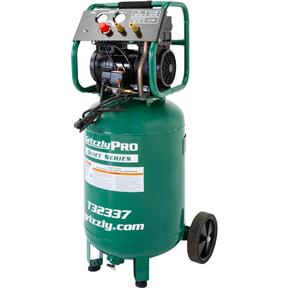
Both are oil-free, quiet-series 20-gallon compressors, so they are tolerable in an attached garage. Pick on the sale, the warranty path and the noise rating you can live with.
Prices change often and Grizzly runs sales, so the buttons show current prices.
Which compressor in which class?
The catalog on this site covers three classes, each labeled by the listing title.
- 6 gallon pancake. The CRAFTSMAN 6 gallon 150 PSI oil-free pancake and the Metabo HPT 6 gallon 200 PSI EC914S. Light, portable, easy to store, right for nailers, tire inflation and short wrench jobs. They cycle often under a heavier tool, and an oil-free pump is usually loud.
- 20 gallon, 120V. The Klutch 20-gallon, 2 HP, 120V and the California Air Tools 20020, 2.0 HP, ultra quiet and oil-free. A good step up for a hobby garage: longer run time between cycles, more capacity for an impact wrench. The Grizzly T32337 is a 20 gallon oil-free quiet series unit in the same class. Our fit sheet for a 20 gallon compressor shows what it takes in floor space and circuit.
- 60 gallon, 230V. The Campbell Hausfeld 60-gallon two-stage, 175 PSI, 230V and the DEWALT 60-gallon vertical stationary. For continuous tools and a full auto shop. They need a dedicated circuit, a corner to live in and a plan for the noise. See the 60 gallon fit sheet.
Specific CFM, decibel and weight figures are on each listing; read them against the sizing above before you buy rather than trusting the gallon number. Two units of the same tank size can have very different pumps. The best garage shop air compressor roundup ranks them by tier with the reasoning, and tells you who should not buy the expert unit.
How does the garage change the answer?
A garage adds three constraints that a dedicated shop building does not have: floor space, neighbors and temperature.
Floor space. A 60 gallon vertical tank stands about as tall as a refrigerator and takes a corner. In a 12 x 20 ft bay with a car parked, only about 3 ft behind the bumper is free, so a 60 gallon unit is realistic only in a 22 ft deep bay or a two-car garage. A 20 gallon unit fits the corner of the free strip. A pancake sits on a shelf. Work out where the unit lives before you decide the size, using how to store an air compressor in a garage.
Neighbors and family. A standard compressor is loud, and its motor starts without warning. Quiet-series units list a lower decibel level; a long hose from a compressor in a corner or a shed reduces what you hear. If you plan to run the compressor at night or on a shared wall, the placement decision matters more than the model. See garage shop noise and neighbors.
Temperature and moisture. A cold garage thickens oil and slows starts. A humid garage fills the tank with water faster, and the water ends up at the tool. A drain routine and an inline filter or separator are not optional in a damp garage, especially for spray painting, where water in the line ruins the finish.
Hose, fittings and pressure
A big compressor with a thin, long hose is a small compressor. Air tools are rated at the tool inlet, and a 1/4 in hose over 50 ft loses pressure on the way. A 3/8 in hose, such as the Goodyear 50 ft x 3/8 in hybrid hose, carries more air with less drop. A retractable reel such as the Flexzilla 3/8 in x 50 ft keeps it off the floor but add length only if you need it. Use fittings that match the hose bore; a 1/4 in coupler on a 3/8 in hose is a choke point.
Pressure is separate from flow. Most tools run at 90 PSI. The listed maximum pressure on a pancake (150 or 200 PSI) is only how high the tank fills; it does not change the CFM at 90 PSI. A 175 PSI two-stage compressor delivers more usable air at 90 PSI than its single-stage 150 PSI neighbor of the same horsepower, which is the real benefit of the second stage.
Set the regulator at the tool's rated pressure and never above the tool's maximum. Use a safety-rated hose and keep it away from heat and sharp edges. Wear eye protection whenever you use a blow gun, and never point compressed air at skin, which can force air into the bloodstream and cause an injury.
A short decision guide
- List the air tools. If it is nailers, tires and a blow gun: a 6 gallon pancake.
- If you add an impact wrench or ratchet for car work: a 20 gallon 120V unit.
- If you spray paint, sand or grind with air: a 60 to 80 gallon 240V unit, or switch those jobs to electric tools.
- If you run the full set of automotive air tools together: 19.3 CFM, an 80 gallon or larger 5 HP 240V unit and a 35 A, 8 AWG circuit to ask your electrician about.
- Check the floor, the circuit and the noise before you buy.
For a budget view, the garage shop budget planner prices a tiered package, and the intermediate garage auto shop setup shows a compressor in context with the rest of the shop.
Reading a compressor listing
Compressor listings are crowded with numbers. Here is how to read the ones that decide the sizing.
- CFM at 90 PSI. The number that matters. If the listing gives CFM only at 40 PSI, the usable figure at 90 PSI is lower, so look for the 90 PSI figure or ask the maker.
- Tank size. A buffer. Use it to judge how often the pump cycles under your biggest tool.
- Max PSI. How high the tank fills (150, 175, 200). It is not the pressure the tools run at.
- Horsepower. Often a peak figure and not a continuous one. Compare CFM instead.
- Voltage and amps. 120V or 230V, with the running current. This decides the circuit.
- Oil-free or oil-lubricated. Oil-free units are lighter and need less upkeep and are often louder; oil-lubricated pumps run quieter and last longer in heavy use but need oil checks.
- Noise. A decibel figure on the listing. Quiet-series units list a lower number.
- Duty cycle. How long the pump can run per hour. A continuous tool wants a high duty cycle.
- Weight and footprint. Check against the space you planned in the storage guide.
If a listing does not give the numbers, treat the missing data as a warning. We do not quote CFM, decibel or weight figures for the compressors in our catalog, because the listings carry them and our data does not; check the page for each unit before you decide. The 120V versus 240V comparison and the best garage shop air compressor roundup apply the sizing to products.
Get the garage shop planning checklist
One printable page: measure the bay, count the circuits, list the machines, check the floor. Plus a few short emails, then a couple a month at most.
Unsubscribe anytime. You can also just read the checklist on this site.Frequently asked questions
What size air compressor do I need for a home garage?
For nailers, tires and basic wrench work, a 6 to 20 gallon 120V unit that delivers about 4 CFM at 90 PSI is enough. For spray painting, sanding or grinding you need about 11 to 13 CFM and a 60 to 80 gallon 240V compressor.
Is a 20 gallon air compressor big enough for a garage?
It is enough for nailers, inflation and an impact wrench used in bursts. It is not enough for continuous tools such as a DA sander or a spray gun, which draw 6 to 8 CFM or more at 90 PSI.
Does tank size matter more than CFM?
No. CFM at 90 PSI is how much air the pump supplies continuously. The tank is a buffer. Buy on CFM and use the tank size to decide how often the pump cycles.
Can a 120V compressor run a 3 HP motor?
No. NEC Table 430.248 lists 34 A at 115V for a 3 HP single-phase motor, more than a 20 A circuit can carry. A 3 HP compressor is a 230V unit on a 25 A breaker and 10 AWG copper; have a licensed electrician confirm.
How big a compressor do I need for an impact wrench?
A 1/2 in impact wrench is rated around 4 CFM at 90 PSI in our convention, used in short bursts. A 20 gallon 120V compressor handles that for car work; check the wrench rating plate.
This page is researched guidance, not professional electrical, engineering or safety advice. Circuits, loads and clearances depend on your house, your service and your town: have a licensed electrician confirm any wiring, and check local code and each manufacturer's manual before you act.
