
Workbench
Workbench height for a garage shop
At 5 ft 10 in (70 in), your standing elbow is about 44 in. Set a workbench about 33 in high for heavy planing, chopping and vise work, 37 in for general assembly and machine work, and 43 in for precision layout and electronics. A comfortable bench depth is about 28 in, 40 percent of your height. If you do more than one kind of work, an adjustable-height bench avoids the compromise.
The rule behind the numbers
There is no single right bench height, because bench height depends on what your hands are doing. For hard work, such as planing, chopping and sawing with a hand tool, you want to put your body weight behind the tool, so the top is low: about 11 in below your standing elbow height, close to the palm of a relaxed hand. For general assembly and machine work, you want to see what you are doing without hunching, so about 7 in below the elbow. For fine work, such as layout, electronics, and setting up a lathe or a mill, you want your forearms level, so about 1 in below the elbow.
Standing elbow height is about 63 percent of your stature, an average from published human-body data. It is the number that makes the rest work, and it is a convention, not your exact measurement: for a better answer, stand relaxed in your shop shoes with your forearm level and measure from the floor to the underside of your elbow. The workbench height calculator does the arithmetic for your own height and your type of work.
The chart
| Your height | Elbow height | Heavy work | General work | Precision work |
|---|---|---|---|---|
| 5 ft 4 in (64 in) | 40.3 in | 29.3 in | 33.3 in | 39.3 in |
| 5 ft 7 in (67 in) | 42.2 in | 31.2 in | 35.2 in | 41.2 in |
| 5 ft 10 in (70 in) | 44.1 in | 33.1 in | 37.1 in | 43.1 in |
| 6 ft 1 in (73 in) | 46.0 in | 35.0 in | 39.0 in | 45.0 in |
| 6 ft 4 in (76 in) | 47.9 in | 36.9 in | 40.9 in | 46.9 in |
These are tops, not leg lengths. Add the thickness of an anti-fatigue mat if you stand on one (usually 3/4 to 1 in), and subtract a vise or a machine's own height if a machine sits on the bench: a benchtop drill press or lathe adds its own height to your working surface, so the bench under it is usually lower than your general height. A bench for a machine is set by the machine's operating height, not by your elbow.
Adjustable benches, mats and a stool


Prices change often; the button shows today's price on Amazon.
Amazon and Grizzly, side by side
Each card shows an Amazon pick and a Grizzly Industrial pick for the same job.
6 ft adjustable workbench
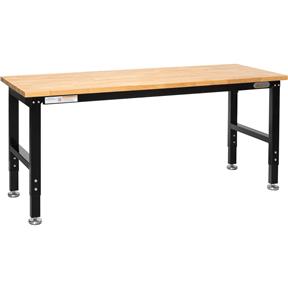
Choose the Amazon bench to keep spending down; choose the Grizzly bench when you run power tools on it every weekend and want the built-in outlets.
Hardwood-top workbench
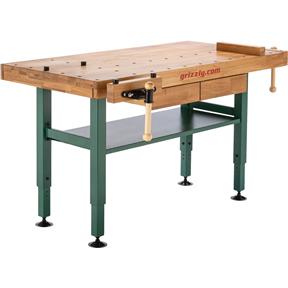
The Amazon bench is a height-adjustable hardwood top; the Grizzly bench is a fixed heavy-duty oak top on steel legs for a bench that never moves.
Prices change often and Grizzly runs sales, so the buttons show current prices.
Which height for which garage job
- Woodworking with hand tools and a vise: the heavy-work height. Planing a board on a bench that is too high wears out your shoulders.
- Assembly, glue-ups, finishing and general projects: the general-work height.
- Auto and small engine work on parts: the general-work height; a creeper or a stool handles the lower jobs.
- Layout, soldering, electronics and instruments: the precision height, and good light: see the lighting calculator.
- Benchtop machines (drill press, grinder, planer): the machine's own operating height: set the bench so the work sits at your elbow.
If you do more than one, buy an adjustable-height bench. The listings in our catalog include a 70 in bench and a 72 in bench with adjustable height, and the Grizzly T34010 and T34011 are adjustable heavy-duty benches with outlets. An adjustable bench costs more than a fixed one but removes the argument.
Depth, and what a car does to it
A comfortable reach from a standing position is about 40 percent of your height: 28 in at 5 ft 10 in. That is why most garage benches are 24 to 30 in deep. Deeper benches need a reach tool or a step, and a bench deeper than about 36 in becomes a storage shelf where things disappear. In a garage that also holds a car, depth is often the constraint: a sedan parked in a 12 x 20 ft bay leaves 3 ft behind the front bumper, so a 24 in bench does not fit with an aisle in front of it, and a 12 in deep wall shelf does. Check yours with the park-the-car calculator, and see workbench size for a one-car garage.
Making an existing bench the right height
- Too low: raise it on riser blocks under the legs or add a layer of plywood or a laminated top. Leg risers are a one-hour job.
- Too high: shorten the legs only after you are sure: it cannot be undone. A rubber mat lowers your effective height, but it also raises you.
- A bench for two people: choose the height of the shorter person and give the taller person a mat.
Whatever the height, check the load rating and the wall or floor anchoring of the bench: a bench for vise work wants to be bolted to a wall stud or loaded with its own weight. A bench rated to 2000 lb on its listing is rated for the bench, not for the wall behind it.
Measure your own elbow height in five steps
The 63 percent figure is a population average, and your arms may be longer or shorter than it assumes. A five-minute measurement beats the chart.
- Put on the shoes you wear in the shop. A thick work boot adds close to an inch.
- Stand relaxed against a wall with your upper arm hanging and your forearm bent level, palm down, as if you were resting it on a counter.
- Have someone mark the wall at the underside of your elbow, or put a masking-tape flag there.
- Measure from the floor to the mark. That is your standing elbow height. At 5 ft 10 in the average is 44 in.
- Subtract 11 in for heavy work, 7 in for general work or 1 in for precision work. If you stand on a mat, subtract the mat thickness too: 15/16 in for the Vergo mat and 0.9 in for the FEATOL mat by their titles.
Write the three results on a piece of tape and stick it on the bench. A bench you can adjust, like the Betterhood 70 in, lets you set all three, and a fixed bench lets you pick the one that matches your main job. The workbench height calculator does the subtraction for you.
Worked examples: three garages, three benches
A 5 ft 4 in woodworker with a 12 x 22 ft one-car garage. Elbow height is about 40.3 in, so a bench for hand planing is 29.3 in, general work 33.3 in. A 36 in kitchen-counter-height bench is too high by almost 3 in for general work. Cut the legs of a flat-pack bench, or buy an adjustable-height one and set it at 33 in. The car leaves 5 ft behind the nose, so a 24 in deep bench with a 30 in aisle fits.
A 6 ft 1 in machinist with a two-car garage. Elbow height is about 46 in. A lathe with its own height (for example the Grizzly G4000 at a 16 x 37 in footprint) wants its spindle near the elbow, so the bench under it is set by the machine, not the chart. A vise bench at the heavy-work height is 35 in, and a layout bench at the precision height is 45 in. Two benches, set differently, beat one compromise. See metalworking bench for a garage machine shop.
A couple sharing one bench, 5 ft 4 in and 6 ft 1 in. General height differs by about 5.7 in. Set the bench for the shorter person, who cannot reach up, and give the taller person a mat and a bench top that is deep enough to lean on. Or buy an adjustable bench and take a minute to change it. A pneumatic stool such as the WEN 300 lb stool helps whoever is lower.
For a table-saw outfeed use, match the saw: the Grizzly G0771Z lists a 35-3/8 in table height and the G1023RL 34 in; a bench at that height doubles as outfeed support. See assembly table versus workbench.
Height for a bench that rolls, folds or stands on a mat
Three garage-specific adjustments change the numbers. Casters. A mobile base or caster set adds height, usually 3 to 5 in, so take that off the leg length: a bench whose top should be 37 in on a base that adds 4 in needs a 33 in frame. See rolling workbench for a garage. Fold-down benches. The hinge height sets the top height, so mark it with the bench folded down and level it with the legs locked; see fold-down workbench for a garage. Slope. A garage slab slopes toward the door by an inch or more over its depth, so the front legs of a bench are shorter than the back by the same amount, or the bench is shimmed. Measure the height at the spot where you stand, not at the wall.
One more adjustment is power. If you plan outlets on the bench wall, put them above the highest top position; see workbench with power outlets. And think about depth with height: a taller bench pushes the reach farther from your body, so see how deep should a garage workbench be.
Height checks you can do in your garage today
A few quick tests settle most height questions without a calculator. Try them at the bench you have.
- The forearm test. Stand at the bench and let your hands rest on the top with your elbows bent. If your shoulders rise toward your ears, the bench is too high. If you have to lean over to reach, it is too low. For general work, your forearms should slope slightly down to the work.
- The plane test. Put a board in the vise and make a few strokes with a hand plane. If you cannot get your body weight behind the tool, the bench is too high for heavy work. Drop it toward the heavy-work height of about 33 in at 5 ft 10 in.
- The detail test. Try threading a small screw or marking a fine line. If you hunch to see it, the bench is too low for precision work, or the light is poor. The precision height is about 43 in at 5 ft 10 in, and a clip light helps more than extra inches.
- The machine test. If a benchtop machine sits on the bench, stand at it and check where the table or spindle falls against your elbow. If it does not match, the machine, not the bench, needs a riser or a lower stand.
- The hour test. Work for an hour. Back, wrist or shoulder pain at the end of it is the final answer.
Garage-specific caution: do these tests on your real floor. A mat, a sloped slab or a pair of thick boots changes the answer by an inch or more. Light matters as much as height; a 4 ft LED over the bench makes a lower bench workable for detail, and the shop lighting calculator sizes the fixtures. Whatever you pick, write the number on the bench, so the next bench you buy or build starts from a measured figure. For benches that adjust, see garage workbench ideas.
Get the garage shop planning checklist
One printable page: measure the bay, count the circuits, list the machines, check the floor. Plus a few short emails, then a couple a month at most.
Unsubscribe anytime. You can also just read the checklist on this site.Frequently asked questions
What is the best height for a garage workbench?
For a 5 ft 10 in person, about 37 in for general work, 33 in for heavy hand-tool work and 43 in for precision work. An adjustable-height bench avoids the compromise.
How tall should a workbench be for my height?
Take 63 percent of your height for standing elbow height, then subtract 11 in for heavy work, 7 in for general work and 1 in for precision work.
Is 36 inches too high for a workbench?
36 in is a standard counter height and suits general work for someone about 5 ft 8 in. For heavy hand-tool work it is too high for most people.
How deep should a workbench be?
About 40 percent of your height is a comfortable reach: 28 in at 5 ft 10 in. Garage benches commonly run 24 to 30 in.
Should I buy an adjustable-height workbench?
If you do more than one kind of work, or two people of different heights share the bench, yes. They cost more than fixed benches and check the weight rating on the listing.
This page is researched guidance, not professional electrical, engineering or safety advice. Circuits, loads and clearances depend on your house, your service and your town: have a licensed electrician confirm any wiring, and check local code and each manufacturer's manual before you act.
