
Workbench
Metalworking bench for a garage machine shop
A metalworking bench has to carry a machine, not just tools: the Grizzly G4000 lathe lists 294 lb, the G0602 lists 432 lb and the G0704 mill/drill lists 372 lb with its stand. Use a rigid steel or thick hardwood frame rated well above the total, level it with shims on the sloped slab, anchor it to the wall or slab, and set the height from the machine, not your elbow.
A heavy-duty bench such as the Grizzly T10157 oak bench suits the vise and hand work.
What makes a bench right for metalworking?
Three things: it carries weight without flexing, it stays put, and it can be leveled. A woodworking bench can be a bit springy and a bit light and still do the job. A bench that holds a lathe or a mill cannot, because the machine's accuracy is only as good as what it sits on. A flexing bench changes the alignment of the ways and the table; a bench that creeps under cutting forces ruins a cut. The right bench is heavy, braced, anchored and level.
It also helps to separate two benches. The machine bench carries the lathe, the mill or the drill press and sits on its own stand. The work bench holds the vise, the layout work and hand tools. Combining them saves floor and costs accuracy. In a one-car garage you may have to combine them; in a two-car bay, separate them. See the garage machine shop start guide for the whole shop, and the 22 x 22 machine shop layout for where each sits.
Load math from the listings
Start with the machines. From the Grizzly briefs: the G4000 9 x 19 benchtop lathe lists 294 lb and a 16 x 37 in footprint; the G0602 10 x 22 lathe lists 432 lb and a 47-1/2 x 12-1/2 in footprint; the G0704 7 x 27 mill/drill lists 372 lb with its stand; the T34608 drill press lists 127 lb and a 19-1/2 x 12 in footprint. The Amazon alternatives list their weights on their pages, which we do not have in our data: the VEVOR 7 x 14 in lathe, the Mechmaxx mini mill and the INTBUYING mini mill.
| Item | Listed weight | Add tooling, stock, vise (allowance) | Bench rating target (x 2) |
|---|---|---|---|
| G4000 lathe | 294 lb | + about 50 lb | about 700 lb |
| G0602 lathe | 432 lb | + about 50 lb | about 960 lb |
| G0704 mill/drill (with stand) | 372 lb | + about 50 lb | on its own stand |
| T34608 drill press | 127 lb | + about 25 lb | about 300 lb |
The allowance column is our planning figure, not a listing number; adjust it to your tooling. Use a safety factor of 2 because a rated load assumes it is spread evenly, and a lathe puts its weight on its feet. Then check what the bench listing means by its rating: the Betterhood and Cammoo benches list 2,000 lb maximum loads, and that is a statement about the bench, which includes the top, so read how the rating is defined. For concentrated loads at the machine's feet, add a steel or thick plywood plate across the supports. The workbench size calculator checks the footprint, and the machine's fit sheet gives its numbers.
The frame: steel, hardwood and what to avoid
Steel is the natural frame: welded or bolted square tube, or a bench with a steel frame and a hardwood or steel top. The Grizzly T10157 is described as a heavy-duty oak bench with steel legs, and the VEVOR 72 in bench lists a hardwood worktop and adjustable height. Heavy hardwood works too, in thick legs and aprons, with mortise joinery or bolts.
What to avoid: a bench held together by thin sheet-steel legs and a particleboard top, with a rating you cannot verify; a bench with a shelf that deflects when loaded; and a bench on casters under a cutting machine. Machine benches belong on fixed feet or on leveling feet. If the bench has to roll, use a lift-and-lock base that sets the bench on solid feet when it is working. Ask whether the bench racks: push on it sideways with your hip, and if it moves, add diagonal braces or a plywood back and a bolted connection to the wall.
Make the top thick and flat. A 2 to 3 in hardwood or laminated top is stiffer and quieter than a thin one, and a 1/4 in steel plate over a plywood core is a durable surface for metal chips and oil. See garage workbench top ideas. Leave an overhang no larger than the machine allows, and keep the machine's weight over the legs.
Heavy benches, vises and measuring tools


Prices change often; the button shows today's price on Amazon.
Amazon and Grizzly, side by side
Each card shows an Amazon pick and a Grizzly Industrial pick for the same job.
Hardwood-top workbench
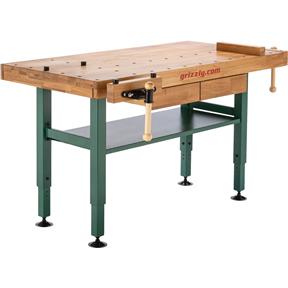
The Amazon bench is a height-adjustable hardwood top; the Grizzly bench is a fixed heavy-duty oak top on steel legs for a bench that never moves.
5 in swivel bench vise
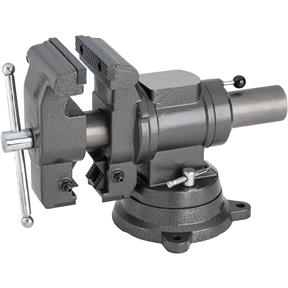
Both are 5 in vises with a 360 degree swivel base. The Grizzly one is a drop-forged industrial unit; the Amazon one is a lower-priced 5 in cast-iron vise.
Benchtop metal lathe, entry

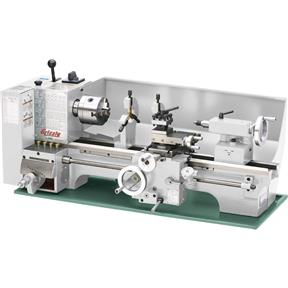
The Amazon lathe is a VEVOR 7 x 14; the Grizzly G4000 is a 9 x 19 with a 3/4 HP motor and 294 lb of cast iron. More lathe means more floor and more weight.
Benchtop metal lathe, step up
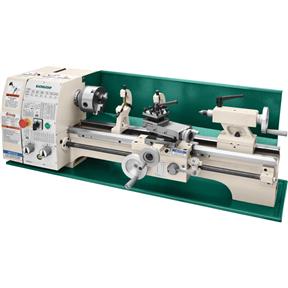
The Grizzly G0602 is a 10 x 22 with an enclosed gearbox and 432 lb of weight on a footprint of about 4 ft by 1 ft; the Amazon VEVOR 7 x 14 is the lightweight entry alternative.
Prices change often and Grizzly runs sales, so the buttons show current prices.
Height: set it from the machine
For a bench that holds a lathe or mill, the height is set by where the machine's spindle or table ends up relative to your elbow. A lathe is ideally at a height where the spindle centerline is about at your elbow, and a mill table or drill press table is a comfortable reach. Machines add their own height to the bench, so the bench is usually lower than a general-work bench. Our rule from the workbench height page sets elbow height at 63 percent of stature, 44 in at 5 ft 10 in, with the work 1 in below the elbow for precision work, 7 in for general work and 11 in for heavy work. Measure the machine's height from the listing (the T34608 drill press is 42 in tall at 19-1/2 x 12 in), subtract what you want from the elbow height and the answer is the bench height. See workbench height for a garage shop and the height calculator.
The vise bench is different: a vise holds the work, and you apply force down and sideways, so the bench is low (heavy-work height, about 33 in at 5 ft 10 in) and very rigid. A 5 in swivel vise such as the Nakkaa 5 in ductile cast iron vise or the Grizzly T33818 drop-forged swivel vise mounts to the front edge over a leg. See vises and clamps for a garage workbench.
Stand on a mat. The Vergo 15/16 in mat adds its thickness to your height, so subtract it from the bench height. Keep the mat clear of chips.
Leveling, anchoring and the sloped slab
A garage slab slopes to the door. Put a level on yours; an inch or more of slope over the depth is common. A machine bench has to be level in both directions, or at least the machine on it must be. Use the leveling feet, or shims under the legs, and recheck after a few weeks because a loaded stand settles. A lathe is leveled so the bed is not twisted, not for a bubble alone; use a precision level and a test cut. A dial indicator set like the Fowler magnetic base set shows runout and twist.
Anchoring is the second half. A bench that creeps under a cut ruins the cut. For a wall bench, bolt a ledger or a leg bracket to a stud; for a free-standing bench, add weight low (a plywood shelf with a load of steel stock or sand bags) or anchor the legs to the slab with concrete anchors, using the correct drill and fastener for your slab. Do not anchor into a slab crack or an expansion joint, and mind any radiant heat tubing or post-tension cables in a slab; post-tensioned slabs must not be drilled without locating the cables. Ask if you are unsure.
Isolate vibration. A rubber pad under a grinder or a drill press reduces noise and chatter; a lathe or mill wants rigid support, not rubber. For the neighbors, see garage shop noise and neighbors.
Chips, oil and rust on a metal bench
A metal bench lives in a mess of chips and oil. Plan the surface for it: a lip or a tray at the machine to catch chips, a drip pan under the vise and a way to sweep. Use a brush, not your hand, for chips. Oil-soaked rags are a fire risk and belong in a closed metal can; see garage shop fire safety. Wipe the machine and the bench with a light oil when you finish, and use an inhibitor such as Boeshield T-9 on bare steel in a humid garage. A dehumidifier helps; see garage shop moisture and rust.
Keep woodworking and metalworking apart. Wood dust on oily ways makes a paste, and metal chips in a wood vise ruin both. If you have both, put the metal bench in the opposite corner from the sander, cover the machines when you sand and clean thoroughly between jobs. Eye protection every time, and no loose sleeves, jewelry or gloves near the spindle.
Light the bench well. A machine bench benefits from task lighting at the spindle or the cut, on top of the ceiling lights; see how to hang lights.
Power and layout for the metal bench
The Grizzly lathes and mill list 120V motors: the G4000 at 9 A, the G0602 at 13.6 A and the G0704 at 12 A. Each wants its own 20 A circuit if you run more than one at a time; see workbench with power outlets and machine shop amps. Have a licensed electrician confirm the circuits.
In the bay, put the heavy bench on the back wall, away from the car's nose if the car stays; a sedan leaves 3 ft behind the bumper in a 12 x 20 ft bay and 5 ft in a 12 x 22 ft bay, which is a strip for a 12 to 24 in deep bench and no more. A machine shop in a one-car bay is a shop for the car outside. The 12 x 22 machine shop layout shows what fits, and the intermediate machine shop setup prices it. For products by tier, see best benchtop lathe and mill.
Build or buy: the decision for a machine bench
Buying a heavy bench is simple: pick one with a listed load rating well above your machine plus a safety factor, a rigid frame and a flat top, and check that it fits the bay. The Grizzly T10157 oak bench with steel legs and the VEVOR 72 in hardwood bench are the heavy-duty options in our data; the Betterhood and CAMMOO benches list 2,000 lb maximum loads, with the definition of the rating on each listing. If the rating does not state how the load is distributed, assume it is a distributed load across the top and not a point load under a lathe foot.
Building lets you size the bench to the machine. A common approach is a frame of 4 x 4 or 2 x 6 legs with 2 x 6 aprons and stretchers, a plywood or laminated top, and a lower shelf loaded with steel stock for mass. Or a welded steel frame from square tube, which is the natural choice if you have a welder (see welding table for a garage). Either way, size every joint for the weight: the lathe puts its weight on the feet, and the feet sit on the top, so the top must span between the supports without sagging, and the supports must go to the floor with no flex.
A stand that comes with the machine is another route. The Grizzly G0704 mill/drill lists 372 lb with its stand, so the stand is already part of the machine. Check whether the lathe you want sells with a stand or a cabinet; a purpose-made stand is often the best answer because the maker has tested the fit. Your electrician's circuit plan and the machine shop sizing are on the machine shop amps page.
Get the garage shop planning checklist
One printable page: measure the bay, count the circuits, list the machines, check the floor. Plus a few short emails, then a couple a month at most.
Unsubscribe anytime. You can also just read the checklist on this site.Frequently asked questions
What kind of bench do I need for a benchtop lathe?
A heavy, rigid bench rated above the lathe weight with a safety factor of 2: the Grizzly G4000 lists 294 lb and the G0602 lists 432 lb. Level it, anchor it and avoid casters under a cutting machine.
How high should a metalworking bench be?
Set it from the machine: the spindle or table should land near your elbow for precision work. A vise bench is low, about 33 in at 5 ft 10 in, and very rigid. Subtract any mat thickness.
Can I use a wooden workbench for a lathe or mill?
Yes if it is heavy, braced, rated above the machine weight with margin, and anchored. A thin or springy wooden bench changes the machine alignment and the cut.
How do I level a machine on a sloped garage slab?
Use the bench leveling feet or shims, check with a precision level and a dial indicator, and recheck after a few weeks. Anchor the bench so it cannot creep, and avoid drilling post-tensioned slabs without locating the cables.
Should a machine shop bench have casters?
Not under a cutting machine. If the bench must move, use a lift-and-lock base that sets the bench on solid feet when you work.
This page is researched guidance, not professional electrical, engineering or safety advice. Circuits, loads and clearances depend on your house, your service and your town: have a licensed electrician confirm any wiring, and check local code and each manufacturer's manual before you act.
