Guides
How many amps for a garage workshop?
A one-person garage workshop usually needs a 60 A subpanel; a shop with a welder, a 60 gallon compressor or a 3 HP collector and cabinet saw on 240V needs 100 A. Our layout engine sizes the woodshop, machine-shop and mixed packages that fit a 22 x 22 ft garage at 60 A, and the welding and auto packages at 100 A.
The method is to give each big machine its own circuit (a 3 HP motor draws 34 A at 115V or 17 A at 230V, NEC Table 430.248), count the largest load in full and half of the rest, add 125 percent, and round up to a standard subpanel. Have a licensed electrician confirm what your house service can carry.
Amps are the wrong first question, and the right one
"How many amps for a garage workshop?" has two honest answers because there are two different numbers. The first is the amps on each circuit: how big the breaker and wire have to be for each machine. The second is the amps on the whole shop: how big the subpanel and the feeder from the house have to be. The first comes from the machine and the NEC tables. The second comes from adding the machines with a diversity factor, since no one runs the saw, the collector, the compressor, the heater and the welder at once.
Most mistakes come from mixing them up. A 15 A table saw does not need a 15 A circuit: it needs a 20 A circuit, because a motor load is sized at 125 percent. A shop of ten 15 A tools does not need 150 A: it needs what you run together. This page walks through both, and the workshop amps calculator and the 240V circuit calculator do the arithmetic for your own list. As always, have a licensed electrician confirm.
Step 1: Amps per machine from the NEC motor table
The code sizes a motor circuit from NEC Table 430.248, full-load current for single-phase motors, not from the horsepower on the label or the amps on the nameplate. The values the site's calculators use:
| Motor | Amps at 115V | Amps at 230V |
|---|---|---|
| 1/2 HP | 9.8 | 4.9 |
| 1 HP | 16 | 8 |
| 1-1/2 HP | 20 | 10 |
| 2 HP | 24 | 12 |
| 3 HP | 34 | 17 |
| 5 HP | 56 | 28 |
| 7-1/2 HP | 80 | 40 |
| 10 HP | 100 | 50 |
Two rules follow. First, the branch circuit conductor is sized at 125 percent of that current (NEC 430.22), then matched to the next standard breaker (15, 20, 25, 30, 35, 40, 45, 50, 60, 70 A) and to copper from the 60 C column of NEC Table 310.16: 14 AWG at 15 A, 12 AWG at 20 A, 10 AWG at 30 A, 8 AWG at 40 A, 6 AWG at 55 A, 4 AWG at 70 A. Second, a 120V circuit tops out at 20 A in a normal shop, so a motor whose 125 percent value exceeds 20 A is a 240V motor. That puts the dividing line at 1-1/2 HP: 20 A at 115V times 1.25 is 25 A, already past a 20 A circuit. That is why a 1-1/2 HP collector is often a 240V machine, or a 120V one whose nameplate is lower than the table. A 2 HP motor needs 30 A at 120V by the table and 15 A at 240V.
Real machines list their own nameplate figures, and the machine's nameplate wins. The Grizzly G0860 collector is listed at 15 A on 120V, the G1028Z2 at 12 A on 120V or 6 A on 240V, the G0771Z hybrid saw at 15 A on 120V or 7.5 A on 240V, the G0555 bandsaw at 11 A on 120V or 5.5 A on 220V, the G1023RL cabinet saw at 14 A on 240V, and the G0441 cyclone at 22 A on 240V. The G0408 wide-belt sander lists a 10 HP main motor on 50 A at 220V. See 240V in a garage explained and, for the install, how to install a 240V outlet in a garage.
Step 2: Give each big machine its own circuit
The site's circuit planner follows a few plain rules. A machine on 240V gets a dedicated circuit sized at 125 percent of its running amps. A 120V machine at 10 A or more gets a dedicated 20 A circuit with 12 AWG copper and a NEMA 5-20R receptacle. A 120V machine whose 125 percent value exceeds 20 A is flagged for 240V. Small loads under about 10 A share bench circuits, grouped so each shared circuit stays near 12 A. For the 22 x 22 ft garage that gives:
| Package | Circuits | Connected 120V | Connected 240V |
|---|---|---|---|
| Woodshop (cabinet saw) | One 240V 20 A for the saw (12 AWG, NEMA 6-20R), five dedicated 20 A 120V circuits (bandsaw, collector, tool bench, miter station, compressor), one shared bench circuit | 76 A | 14 A |
| Machine shop | Dedicated 20 A circuits for the lathe, mill and compressor, two shared bench circuits | 59.9 A | 0 A |
| Welding and fab | 240V 40 A, 8 AWG, NEMA 6-50R for the welder cart, 20 A circuits for the compressor and the bench | 25.3 A | 30 A |
| Auto | 240V 35 A, 8 AWG for the 60 gallon compressor, one shared bench circuit | 5 A | 28 A |
| Mixed (car stays) | Four dedicated 20 A circuits (jobsite saw, bandsaw, tool bench, vac) and a shared bench circuit | 58 A | 0 A |
See the matching layouts for the machine lists: woodshop, machine shop, welding and fab, auto and mixed. Note that the engine's receptacle for a 35 A circuit is a 6-50R, which is the common 50 A device; the electrician matches the receptacle rating to the breaker and the machine's plug.
Step 3: From circuits to a subpanel: demand and diversity
If you add every machine's amps you get a huge number that no shop ever draws. The standard way to estimate the real load is a diversity factor. The site's planner converts everything to 240V-equivalent amps (120V loads count at half), counts the largest single load in full (a 240V load at twice its amps), counts half of the rest, multiplies by 125 percent, and rounds up to a standard subpanel size of 30, 60, 100 or 125 A, with at least 60 A when there are five or more circuits. That is a planning shortcut, not the NEC load calculation an electrician performs, but it tracks reality for a one-person shop. The results for a 22 x 22 ft garage:
| Package | Demand (240V-equivalent) | Subpanel suggested |
|---|---|---|
| Woodshop | about 40 A | 60 A |
| Machine shop | about 22 A | 60 A |
| Mixed | about 22 A | 60 A |
| Welding and fab | about 60 A | 100 A |
| Auto | about 56 A | 100 A |
By garage size, the woodshop package lands at 60 A in the 12 x 20, 12 x 22, 20 x 20 and 22 x 22 ft bays and at 100 A in the 24 x 24 and 32 x 24 ft bays, where a 3 HP cyclone is added on 240V. The small one-car machine shop and the mixed packages land at 30 or 60 A. The woodshop amps page, the welding amps page and the others show the 22 x 22 ft case in detail. Change the inputs in the calculator.
Add the heater and the mini-split. They are continuous loads that run when you do. A 4.5 kW heater at 240V draws 18.8 A and a 7.5 kW unit 31.3 A. Because a heater does not hide inside the diversity, add it to the demand before you choose the subpanel. See is a garage heater worth it and how to hang a garage heater.
Step 4: Can your house support it?
A subpanel is only as good as the service behind it. Your electrician will do a load calculation for the whole house under the NEC, usually from the main breaker rating (100, 150 or 200 A are common), the existing loads (range, dryer, water heater, air conditioner, heat pump, EV charger) and the new shop. Three outcomes are common: there is plenty of room and a 60 A feeder is straightforward; there is room for a smaller feeder (30 or 40 A) if you limit what runs together; or the service needs an upgrade. The planning number is the subpanel; the answer on capacity is the electrician's. Get a written load calculation if you can.
Feeder distance matters. A 60 A feeder to a garage 80 ft away may need a thicker conductor to keep voltage drop under about 3 percent (NEC Chapter 9 Table 8 values, used in the voltage drop calculator). The cost drivers are on cost to install a 240V outlet in a garage.
Step 5: How much do the lights and the outlets add?
Lighting is a small load next to the machines, and it is wise to give it its own circuit. A 22 x 22 ft garage needs about 47,500 lumens, roughly eleven 4,400-lumen LED fixtures at around 42 W each, which is under 500 W in total, about 4 A at 120V. The point of a separate lighting circuit is that a tripped saw does not leave you in the dark. General outlets above the bench on 20 A GFCI-protected circuits handle hand tools, chargers and the radio, and the cord reel and power strip loads on them add up. A heavy-duty strip such as the CCCEI 12 gauge surge protector and a DEWENWILS 12 AWG reel are fine for the bench, but not for a table saw. Do not run a saw and a vacuum from one extension cord; see the voltage drop calculator for how much a long thin cord loses.
Meters, panels and power distribution for a garage shop


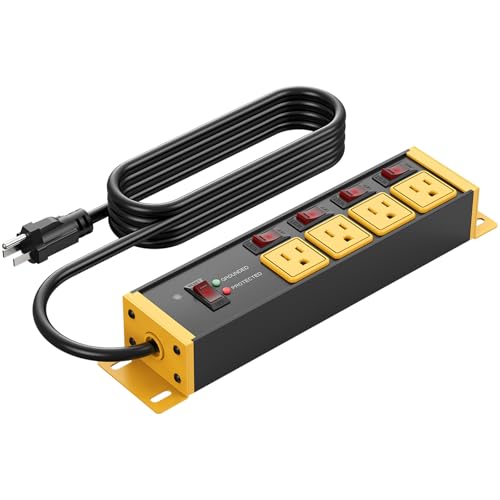

Prices change often; the button shows today's price on Amazon.
Amazon and Grizzly, side by side
Each card shows an Amazon pick and a Grizzly Industrial pick for the same job.
Hybrid table saw for a 120V garage

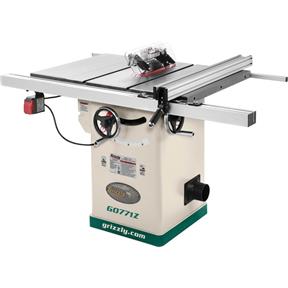
Both are 10 in saws in the 1-3/4 to 2 HP class. Pick Amazon for the SawStop contractor saw; pick Grizzly for an enclosed cabinet hybrid you can order direct and wire for 120V or 240V.
Cyclone dust collector for a one-man shop

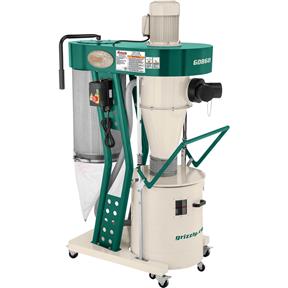
The Grizzly G0860 is a two-stage cyclone on 120V with a 1 micron canister; the Amazon pick is a bag-style 1 HP machine. The cyclone costs more and keeps the filter clean far longer.
Prices change often and Grizzly runs sales, so the buttons show current prices.
What to do with this
- List the machines you own and the ones you will buy in the next two years, with their nameplate volts and amps.
- Run them through the workshop amps calculator and read the circuit list and the subpanel size.
- Add the heater and any EV charger you plan.
- Check the layout so the outlets land where the machines will live; the layout pages and the layout calculator help.
- Photograph your main panel and list the main breaker size.
- Get two written quotes from licensed electricians that include the load calculation and the permit.
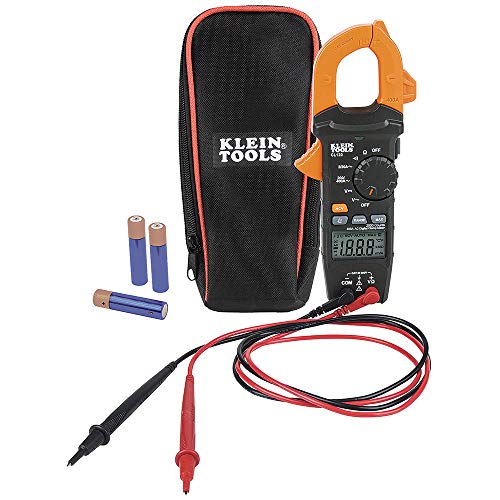
- Use a clamp meter and a plug-in tester to check what exists, without opening anything.
For the rest of the build, read how to set up a workshop in a garage. For a smaller shop or a 120V-only start, look at the beginner woodshop setup.
Sizing numbers on this page are planning figures. They do not replace an NEC load calculation, a permit or a licensed electrician.
Get the garage shop planning checklist
One printable page: measure the bay, count the circuits, list the machines, check the floor. Plus a few short emails, then a couple a month at most.
Unsubscribe anytime. You can also just read the checklist on this site.Frequently asked questions
How many amps does a garage workshop need?
A one-person shop usually needs a 60 A subpanel. Shops with a welder, a 60 gallon compressor or a 3 HP collector plus a cabinet saw on 240V need 100 A. Each big machine gets its own circuit. A licensed electrician confirms what your service can carry.
Can I run a table saw on a 15 amp circuit?
A 15 A saw wants a dedicated 20 A circuit, because a motor circuit is sized at 125 percent of running current. A shared 15 A garage circuit with lights and an opener will trip.
What size subpanel for a woodshop in a garage?
The layout engine suggests 60 A for the woodshop packages in 12 x 20 through 22 x 22 ft garages and 100 A for 24 x 24 and 32 x 24 ft, where a 3 HP cyclone and a cabinet saw run on 240V.
Do I need 100 amps in my garage?
Only for welding, a large compressor or a big 240V woodshop. Our welding and auto packages at 22 x 22 ft suggest 100 A; woodshop, machine-shop and mixed packages suggest 60 A.
How many circuits does a garage workshop need?
A dedicated circuit for each big motor, one or two shared 20 A bench circuits, a lighting circuit, and a 240V circuit for any heater, welder or large compressor. The 22 x 22 ft woodshop package has seven machine circuits.
This page is researched guidance, not professional electrical, engineering or safety advice. Circuits, loads and clearances depend on your house, your service and your town: have a licensed electrician confirm any wiring, and check local code and each manufacturer's manual before you act.
