
Guides
240V in a garage, explained
A 240V circuit carries the same power at half the current of a 120V circuit, which is why motors over about 2 HP, big heaters and welders want it. A 3 HP motor draws 34 A at 115V but 17 A at 230V (NEC Table 430.248): a 25 A breaker and 10 AWG copper instead of an impossible 120V circuit. Have a licensed electrician confirm and install it.
What 240V actually is
A house is fed with two hot legs that are each 120V from the neutral and 240V from each other. A 120V circuit uses one hot leg and the neutral. A 240V circuit uses both hot legs. Power is volts times amps, so the same machine at 240V draws half the amps. Less current means thinner wire for the same run, less heat in the wire and less voltage lost over a long run. That is the entire reason a shop wants it.
The cost is a different breaker (a double-pole), a different receptacle (a NEMA 6-series, with no neutral, or a 14-series with one) and a circuit that has to be run from the panel. A machine "prewired for 120V" is usually switchable: the Grizzly G0771Z hybrid saw lists 15 A at 120V or 7.5 A at 240V, and the G0555 bandsaw lists 11 A at 120V or 5.5 A at 220V. A machine that is only offered at 240V, like the Grizzly G1023RL cabinet saw (14 A) or the G0441 collector (22 A), needs the circuit before it arrives.
Reading the motor table
The code does not size a motor circuit by the horsepower or by the nameplate. It sizes it from NEC Table 430.248, full-load current for single-phase motors, then applies the 125 percent rule for the conductor (NEC 430.22). The table below uses 10 ft to 30 ft runs; longer runs may need a thicker wire for voltage drop.
| Motor | Amps at 115V | Amps at 230V | 240V breaker | Wire (60 C copper) |
|---|---|---|---|---|
| 1 HP | 16 | 8 | 15 A | 14 AWG |
| 1-1/2 HP | 20 | 10 | 15 A | 14 AWG |
| 2 HP | 24 | 12 | 15 A | 14 AWG |
| 3 HP | 34 | 17 | 25 A | 10 AWG |
| 5 HP | 56 | 28 | 35 A | 8 AWG |
| 7-1/2 HP | 80 | 40 | 50 A | 6 AWG |
| 10 HP | 100 | 50 | 70 A | 4 AWG |
Two notes. First, the rule gives the minimum safe breaker; the code allows a larger breaker for motor starting, but the wire still has to match, so we show the conservative choice. Second, a 2 HP motor at 230V needs only a 15 A breaker by this method but many electricians run 20 A circuits everywhere in a shop for flexibility: that is a judgment call for them, not a number we can give you. The 240V circuit calculator runs any horsepower and run length, and the per-motor pages work the common cases: 3 HP, 5 HP.
Receptacles, subpanels and testers
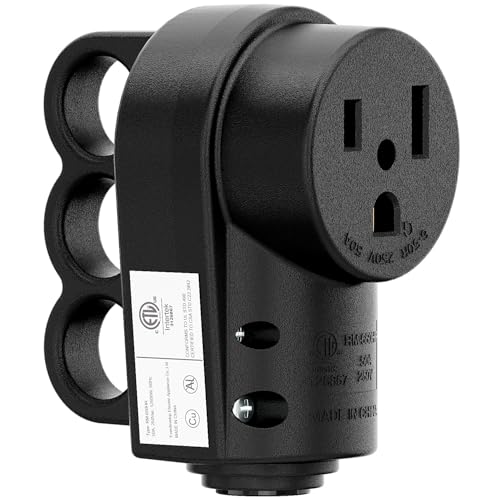


Prices change often; the button shows today's price on Amazon.
Receptacles and plugs
The receptacle follows the breaker. A 15 A, 240V circuit uses a NEMA 6-15; 20 A uses a 6-20; 30 A uses a 6-30; 50 A uses a 6-50, the welder receptacle. A NEMA 14-50 is a 50 A receptacle with a neutral, the one used for ranges, RVs and electric vehicle chargers. Its slots for the neutral are not used by a motor-only machine, but it works, and people choose it because it gives a flexible 50 A outlet in the garage. Whichever you choose, the machine's plug has to match, and a motor over 30 A or a hard-wired heater is usually wired through a disconnect rather than a plug. A heavy duty 14-50 receptacle and a 6-50 welder receptacle are the two most common choices.
Subpanels, runs and voltage drop
If the garage is far from the main panel or you need four or five circuits, an electrician will usually install a subpanel in the garage fed by one larger breaker in the main panel. The size depends on your machines and your service. The workshop amps calculator estimates the demand: a one-person woodshop with a 3 HP saw, a 1-1/2 HP collector and a few benchtop tools lands near 29 A and a 40 A subpanel. A shop with a welder or a large heater lands at 60 A or more. Whether your service can carry that is the electrician's call.
Distance matters. Voltage drop is 2 x 12.9 x amps x one-way feet divided by the wire's circular mils; keep it under 3 percent. A 17 A motor on 10 AWG drops 2.6 percent at 150 ft; at 180 ft it needs 8 AWG. The voltage drop calculator shows your run.
What it costs: a cost model, not a number
We do not publish a price for an electrician in your town, because no honest number exists without a quote. The pieces that drive the quote are the length of the run, whether the panel has space, whether the wall is finished, the permit and the hourly rate. The 240V outlet install cost calculator adds the pieces from the quotes you enter. Get at least two written quotes, and ask each electrician whether your service can carry the load before they start.
DIY or electrician?
Many places allow homeowner electrical work with a permit and inspection, and many do not. The dangerous parts are the connection inside the panel and the decisions about conductor size, breaker type and grounding. Even a confident DIYer should have a licensed electrician at least review the plan and connect the panel end. The point of this page and the calculators is to make you a better customer: to know the breaker, the wire and the receptacle before the electrician arrives, so the quote is for the right job.
Never work inside a live panel. Turn off the main, test that it is dead with a tester you trust, and if you are not sure, stop.
Sharing 240V with a car charger or a heater
A garage that already has a 14-50 outlet for an electric vehicle is a head start, but an outlet is not a circuit for the whole shop: a charger runs at a high continuous load for hours. A heater is also a continuous load (breaker and wire at 125 percent of running current). Do not share one 240V circuit between a charger, a heater and a motor. Plan separate circuits and ask the electrician to check that the subpanel can carry them together.
Which of your machines are 120V, 240V or either
Many shop machines are dual-voltage, and the nameplate or listing tells you the current at each voltage. From the Grizzly briefs on this site:
| Machine (Grizzly) | At 120V | At 240V | Notes |
|---|---|---|---|
| G0771Z 2 HP hybrid table saw | 15 A | 7.5 A | Either voltage |
| G0962 2 HP open-stand saw | 15 A | 7.5 A | Either voltage |
| G0555 1 HP 14 in bandsaw | 11 A | 5.5 A (220V) | Either voltage |
| G1028Z2 1-1/2 HP collector | 12 A | 6 A | Either voltage |
| G0860 1-1/2 HP cyclone | 15 A | - | 120V |
| G1023RL 3 HP cabinet saw | - | 14 A | 240V only |
| G0441 3 HP cyclone | - | 22 A | 240V only |
| G0408 10 HP wide-belt | - | 50 A (220V) | Needs a dedicated service-class circuit |
The pattern is clear. A dual-voltage machine halves its current at 240V, so the same wire carries more machines or runs farther. A 120V-only machine at 15 A needs its own 20 A circuit. A 240V-only machine needs the circuit before it arrives. The listing figures are nameplate currents; the NEC motor table gives different, conservative numbers (for example 17 A for a 3 HP motor at 230V) that an electrician uses with the nameplate to choose the breaker. When the two disagree, the electrician decides, and this table is for planning only.
Planning three machines on 240V: a worked example
Take a woodshop with a G1023RL cabinet saw (3 HP, 14 A at 240V on the listing), a G0441 collector (3 HP, 22 A at 240V) and a 120V bench for hand tools and lights. Using NEC Table 430.248 and the 125 percent rule for conductors (NEC 430.22) for the motors, then NEC Table 310.16 (copper, 60 C column) for the wire:
- Cabinet saw circuit. A 3 HP single-phase motor is 17 A at 230V in the table. 17 x 1.25 = 21.3 A, so the conductor must carry 21.3 A. 10 AWG copper (30 A at the 60 C column) is sufficient, and a 25 A breaker is the next standard size at or above 21.3 A. Receptacle: a NEMA 6-30 or a hard-wired disconnect, as the electrician decides.
- Collector circuit. The same table gives the same 17 A for a 3 HP motor, but the listing shows 22 A on the nameplate, so the electrician sizes to the nameplate and the code together. A 22 A nameplate x 1.25 = 27.5 A of conductor, which points to 10 AWG and a 30 A breaker (NEC 240.6(A)). This is a case where you ask, because a higher nameplate than the table needs a closer look.
- Bench and lights. Two 120V circuits, 20 A on 12 AWG for the bench and 15 A for the lights.
That gives four circuits: two 240V (25 A and 30 A) and two 120V. If you run the saw and the collector together, the 240V demand is 14 + 22 = 36 A from the listings, which is why our subpanel sizing for a 22 x 22 ft woodshop package asks about a 60 A subpanel. See the woodshop sizing page and the G1023RL fit sheet and G0441 fit sheet. Every number above is for planning, and a licensed electrician confirms the breakers, wire and receptacles.
Questions to ask an electrician
A good quote starts with a good brief. Bring a floor plan, the machine list with nameplate amps and voltages, and the output of the calculators, then ask:
- Does my main service have room for the shop load, and can you show the load calculation?
- Do I need a subpanel in the garage, and what size feeder and breaker would it use?
- Which receptacle types do you recommend for each circuit, and are any hard-wired through a disconnect?
- What GFCI protection is required for the garage circuits under the code edition adopted here?
- Is the run in cable, conduit or surface raceway, and why?
- Will you pull a permit, and when is the inspection?
- Is there spare capacity, or a spare conduit, for a machine I buy later or an EV charger? See EV charger and workshop 240V sharing.
- What is not included (patching drywall, trenching, painting)?
Get two written quotes. The cheaper one is not always the cheaper job if it leaves out the permit or the panel work. For how outlets are laid out around the bench and machines, see how to run outlets in a garage shop and workbench with power outlets.
Wire, cable and conduit: how the run is built
The circuit has to get from the panel to the machine, and how it travels affects cost and code. The three common ways in a garage:
- NM-B cable (nonmetallic sheathed). The cable in most house walls. It is rated on the 60 C column of NEC Table 310.16, which is why the table above uses that column. It is allowed inside walls and framing in many places, and generally not exposed on a garage wall where it can be damaged. The Southwire 6/3 NM-B 125 ft roll is an example for 50 A circuits.
- Conduit with individual wires. Metal or plastic conduit protects the wires on an exposed wall and lets you pull more conductors later. Individual THHN wires are typically rated on a higher column, which can change the wire size; your electrician decides.
- Surface raceway. A channel on the wall for finished garages where you cannot open the wall. Neat and easy to extend.
Whichever, the electrician chooses it with the code edition and the inspector in mind, and a 240V run in an attached garage may pass through fire-rated assemblies that need firestopping. Ask about a spare conduit so that a future machine does not need new walls. And keep the receptacle where the machine is: a 240V machine on a short cord lasts longer and trips less than one on a long extension. See how to run outlets in a garage shop for the 120V side.
Get the garage shop planning checklist
One printable page: measure the bay, count the circuits, list the machines, check the floor. Plus a few short emails, then a couple a month at most.
Unsubscribe anytime. You can also just read the checklist on this site.Frequently asked questions
Do I need 240V in my garage?
Only for motors over about 2 HP, big heaters and most welders. A beginner shop of 120V machines does not need it.
What size breaker for a 3 HP motor?
17 A at 230V times 1.25 is 21.3 A, so the next standard breaker is 25 A with 10 AWG copper. A 30 A breaker is also common; an electrician decides.
Can I run a 240V tool from a dryer outlet?
Do not adapt one receptacle to another. A dryer circuit is sized for the dryer, and the plug on your machine has to match the receptacle for the breaker. Have the correct circuit installed.
What is a NEMA 6-50 outlet?
A 50 A, 250V receptacle with two hots and a ground, the common welder outlet. A 14-50 adds a neutral for 120V loads.
How far can I run a 240V circuit?
As far as the voltage drop allows. Keep it under 3 percent: a 17 A load on 10 AWG is fine to about 150 ft, then it needs a thicker wire.
This page is researched guidance, not professional electrical, engineering or safety advice. Circuits, loads and clearances depend on your house, your service and your town: have a licensed electrician confirm any wiring, and check local code and each manufacturer's manual before you act.
