
Guides
How to store an air compressor in a garage
To store an air compressor in a garage, switch it off and unplug it, bleed the tank to zero pressure, open the drain valve until no water comes out, leave the drain open, wind the hose onto a reel and keep the unit on a dry, level, enclosed shelf or cart away from the car and any fuel. Drain after every use and before any cold snap, because water left in a steel tank rusts it from the inside.
What is the safe way to store a compressor?
The safe way is to store it empty of pressure and empty of water. A compressor tank is a pressure vessel, and every time it fills, the compressed air condenses moisture inside. That water sits at the bottom of the tank. Over months it rusts the steel from the inside, where you cannot see it, and a weakened tank wall is the failure that matters. The routine below takes two minutes and is the single most important habit with a compressor.
- Switch off and unplug. Turn the pressure switch to off, then unplug the cord. Do not drain a tank with the unit live.
- Bleed the pressure. Pull the safety valve ring briefly or open the tank drain a little at a time until the gauge reads zero. Wear safety glasses; the first air out is loud and carries water and rust particles.
- Drain the water. Open the petcock or drain valve at the bottom of the tank fully and let it run until it spits only air. Tilt a pancake unit if the manual says so, so water can reach the drain.
- Leave the drain open in storage so any remaining moisture can escape and air can circulate. Close it before you run it again.
- Disconnect the hose and tools and store them separately so no pressure is trapped in the line.
Everything above is general guidance. Your manual wins on the details, including the drain location and any oil or filter service. If the tank shows rust flaking from the drain, or a rusted pressure vessel at the weld seams, do not run it; replace the unit. Do not weld or drill a pressure tank to repair it.
Where in the garage should it live?
A compressor makes noise, heat and vibration, and a garage shop gives you three poor places and one good one. The poor places are against the shared wall with the house (the noise carries), under a workbench with no ventilation (the motor overheats) and next to the car (a car can bump it, and exhaust and fuel vapors add risk). The good place is a corner of the bay, away from the door, with at least a hand's breadth of air around the motor and the cooling fins.
Floor space is the constraint in a small bay. A 6 gallon pancake compressor, such as the CRAFTSMAN 6 gallon pancake or the Metabo HPT EC914S, is small enough to sit on a shelf or a shop cart. A 20 gallon unit like the Klutch 20-gallon or the California Air Tools 20020 needs a floor spot of its own, and a 60 gallon vertical like the Campbell Hausfeld 60-gallon or the DEWALT 60-gallon wants a corner and a 240V circuit. The listings give the footprint and weight; read them before you plan the spot. The Grizzly T32337 is a 20 gallon oil-free quiet series unit that fills the same role as the 20 gallon units above.
In a 12 x 20 ft bay with a sedan parked, the free floor is the strip behind the front bumper (about 3 ft) and the 30 in beside the car. A 20 gallon tank can live in the front corner of that strip, behind a short plywood baffle, with the hose reel mounted on the wall above it. In a two-car bay, put it in the far corner of the shop side so the noise has the whole room to dissipate into. Our full auto shop compressor sizing page shows what a heavy-use compressor needs in circuit and space.
Does a compressor need to be kept off a cold slab?
Yes. A compressor sitting on bare concrete wicks cold and moisture. Put it on a shop cart, a pair of wood runners or a mobile base, a few inches off the floor, so air moves under it and a leak does not pool. A mobile base is also practical: you can roll the unit out to the apron before running it, which moves most of the noise outside. The WEN 500 lb mobile base and VEVOR 1,500 lb base both list capacities well above the weight of a 20 gallon unit, but check the compressor weight on its own listing and keep a margin.
Level the unit. Oil-lubricated compressors need to be level to splash oil correctly, and any tank drains better when the drain is the lowest point. Garage slabs slope toward the door, so shim the low side.
Cold is a second reason to drain. Condensate left in a tank can freeze and, in a drain valve or a pressure switch tube, crack parts or block safety paths. If the garage is unheated, drain the tank completely before every cold night, store the drain open and move the unit somewhere above freezing if the temperature will fall far below it. If it has been stored cold, let it warm to room temperature before you start it; thick oil and cold seals are hard on a motor, and an oil-free pump benefits just as much from a warm start.
Compressors, hose reels and rust protection



Prices change often; the button shows today's price on Amazon.
Amazon and Grizzly, side by side
Each card shows an Amazon pick and a Grizzly Industrial pick for the same job.
20-gallon quiet compressor
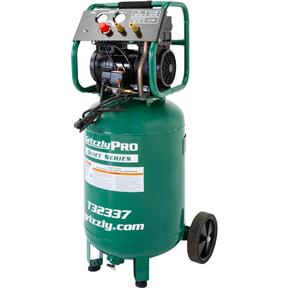
Both are oil-free, quiet-series 20-gallon compressors, so they are tolerable in an attached garage. Pick on the sale, the warranty path and the noise rating you can live with.
Prices change often and Grizzly runs sales, so the buttons show current prices.
Hose, reel and accessories
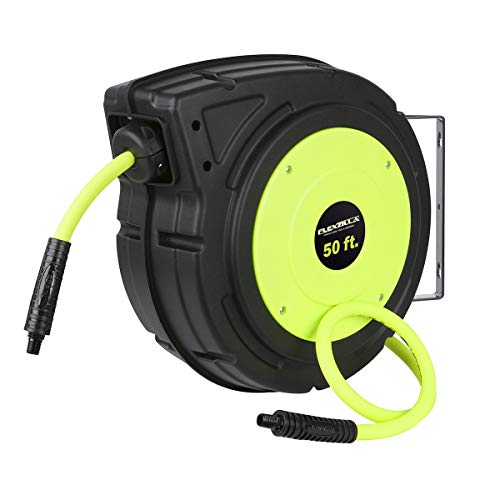
Do not leave the hose connected and pressurized. A pressurized hose on the floor is a trip hazard and a failure waiting for a cold or hot day. A reel keeps the hose off the floor and off the car. The Flexzilla retractable enclosed reel is listed at 3/8 in x 50 ft, and the Goodyear 50 ft x 3/8 in hybrid hose is listed at 300 PSI and kink free. Mount a reel on a stud, not on drywall, and not above the car where a fitting could fall on the paint.
Tools and fittings stay cleaner in a bin or on a pegboard rail. A kit like the VEVOR 71-piece air tool kit is easy to lose in a drawer; give the pieces a labeled case. Keep quick-connect couplers capped, and coil the loose hose in loops no tighter than the minimum bend radius on the hose listing. Wipe oil off the hose before you coil it and look for cracks at the ends, where the hose flexes most.
The metal parts need care. A coat of a rust inhibitor on exposed steel fittings, the drain valve and the pressure gauge face in a humid garage slows corrosion; a product like Boeshield T-9 is sold for tools and machinery. Do not spray any lubricant or inhibitor into the air intake or on the pressure switch contacts, and keep it off the hose where the manufacturer does not allow it.
Power: where it plugs in and what it shares
Small compressors run on 120V and draw a lot at startup. A pancake or 20 gallon unit on a shared 15 A circuit will trip the breaker if a dust collector or heater also runs. Our compressor sizing pages put typical shops in two classes. Trim carpentry with a brad and framing nailer needs about 0.8 CFM at 90 PSI after a 30 percent margin, which a 6 to 20 gallon 120V unit covers. Auto wrench work with an impact, a ratchet and a blow gun needs about 3.1 CFM, still in the 6 to 20 gallon 120V range. Sanding and grinding need about 13 CFM, and spray painting about 11 CFM, and those want a 60 to 80 gallon 240V unit on a 25 to 35 A circuit with 10 or 8 AWG copper (NEC Table 430.248 and Table 310.16; have a licensed electrician confirm). Read what size air compressor for a garage before you buy, because the storage plan follows from the size.
Do not run a compressor on a long, thin extension cord. Voltage drop makes the motor work harder and run hotter. If you must, use the shortest cord of the heaviest gauge you can, and check it in the voltage drop calculator. A 50 ft 10/3 cord is a better choice than a 14 gauge one. Better still, put an outlet within reach of the corner where the unit lives. See how to run outlets in a garage shop.
Noise, heat and fire
A compressor is loud. Quiet-series units list a lower decibel level than a standard pancake, and oil-free pumps are not necessarily quieter, so read the listing for the decibel figure before you buy. In a garage with neighbors, the placement matters more than the product: the farther from a shared wall, the better. A plywood baffle around three sides (with ventilation on the top and rear) cuts the noise reaching you, but never box a compressor in, because the motor needs air and a closed box overheats it. See garage shop noise and neighbors for the full picture.
Heat comes from the motor and the pump head. Keep rags, paper, sawdust and solvent containers off and around the unit. Do not store gasoline cans, propane cylinders or paint thinner next to a compressor, because a motor and pressure switch can produce a spark. Keep a fire extinguisher, such as a Kidde 1-A:10-B:C unit, near the door. For compressors with an automatic start, remember that the motor can start at any time while it is plugged in, so unplug before you service anything, and keep children and pets clear.
Finally, set a schedule. Drain after every use. Check the pressure relief valve a few times a year by pulling the ring briefly with safety glasses on. Check the oil on oil-lubricated pumps, clean or replace the air filter, and wipe off the dust. A compressor that is stored dry and checked on a schedule lasts years longer than one that sits full of water.
A storage checklist you can print
- Switch off, unplug, bleed pressure to zero.
- Open the drain fully, let all the water out, leave it open.
- Disconnect the hose and tools; coil the hose on a reel.
- Wipe dust and oil from the unit; look for rust at the drain and weld seams.
- Put the unit on a dry, level base or shelf, a few inches off the slab, in a ventilated spot away from the car and fuel.
- Keep the fire extinguisher by the door and the manual in a labeled bin.
- Before a cold snap, drain again and move the unit if it will freeze.
For help choosing the unit, see the best garage shop air compressor roundup and 120V versus 240V air compressor for a garage.
Seasonal care and a yearly service list
Storage is more than where the unit sits. A compressor that goes through a hot summer and a cold winter in a garage wants a little seasonal care.
- Before winter. Drain fully, check the drain valve opens and closes cleanly, change the oil on a lubricated pump per the manual, and move the unit off the slab if it stands directly on it.
- Before summer. Clean the intake filter, because dust and heat clog it quickly, wipe the cooling fins and make sure the unit has room around it for air. A compressor that runs hot loses output and shortens its life.
- Yearly. Test the safety valve, inspect the hose and fittings, check the pressure gauge and regulator for accuracy against a known gauge, tighten the bolts that vibrate loose and look at the tank for rust, especially at the bottom and the welds.
- After a long idle. Check the oil level on a lubricated pump, run the unit empty-handed for a minute with the drain open, then close it and let it fill, watching the gauge.
Keep the manual in a labeled bin near the unit and write the service dates on a card. A compressor with a service card gets serviced; one without gets forgotten. If the manual gives intervals, follow it, and where it gives none, treat this list as a starting point and check with the maker.
Get the garage shop planning checklist
One printable page: measure the bay, count the circuits, list the machines, check the floor. Plus a few short emails, then a couple a month at most.
Unsubscribe anytime. You can also just read the checklist on this site.Frequently asked questions
Should I leave air in my compressor tank when storing it?
No. Bleed the tank to zero pressure, drain the water, and leave the drain valve open. A tank left under pressure and full of condensate rusts from the inside and holds stored energy.
Can I store an air compressor in a cold garage?
Yes, if the tank is drained dry first. Water left in the tank or the drain valve can freeze and crack parts. Let a cold unit warm to room temperature before you start it.
How often should I drain a garage air compressor?
After every use. Compressed air condenses moisture inside the tank, and a humid garage makes more. A weekly drain is the minimum for a unit that runs occasionally.
Where is the best place for a compressor in a garage?
In a ventilated corner away from the shared house wall, the car and fuel, on a dry level base a few inches off the slab. Never enclose it fully, because the motor needs air.
Do I need to unplug a compressor when not using it?
Yes. An automatic pressure switch can start the motor at any time while it is plugged in, so unplug it before you service it or leave it for the day.
This page is researched guidance, not professional electrical, engineering or safety advice. Circuits, loads and clearances depend on your house, your service and your town: have a licensed electrician confirm any wiring, and check local code and each manufacturer's manual before you act.
