
Guides
Garage shop noise and neighbors
A garage workshop is allowed in most places only if the noise stays inside local limits, so check your noise ordinance and HOA rules first, then cut sound at the source: quiet-series compressors, a collector placed away from shared walls, a sealed and insulated garage door and work hours that respect your neighbors. The garage door is the biggest leak, and sealing it costs less than any machine. This is general information; check local rules.
Can I run a workshop in my garage without bothering the neighbors?
Usually yes, if you control when the loud tools run and where the sound goes. Noise complaints rarely come from the existence of a shop. They come from a few loud tools at the wrong hour, a door left open and a compressor or dust collector humming through a shared wall. Fix those three and most garage shops are unremarkable from outside. Two things set the tone: the rules where you live, and your neighbors' experience of you.
The rules differ and this page cannot tell you yours. Many cities set noise limits in decibels or by hours (for example quiet hours at night, or limits on power tools on certain days). Many homeowner associations add rules about hours, garage doors left open and commercial activity. Some jurisdictions restrict home businesses that create noise or traffic; see can I open a shop in my garage for the zoning and permit side. Read your municipal code and HOA covenants, ask the code office when in doubt and keep any answer in writing. This is general information, not legal advice; check local rules.
The second thing is relationship. A neighbor who knows what you are building and when you work is far less likely to call a code officer than one who hears an unexplained racket. Tell the adjacent neighbors, give them a way to reach you, and promise a schedule you can keep.
Which garage tools are loudest, and for how long?
Loudness depends on the machine, the material and the room, so treat any figure as approximate and read the decibel rating on the listing where one exists. In general, the loud tools in a garage shop fall into three groups.
- Short and sharp. Impact wrenches, nailers, hammering and chiseling. They are loud but brief, and the main fix is timing.
- Loud and continuous. Table saws cutting hardwood, planers, routers, dust collectors, shop compressors and angle grinders. They set the noise floor for the neighborhood while they run.
- Low rumble. Dust collectors, compressors and big motors. The low frequencies pass through walls and floors more easily than the high ones and are the hardest to block.
Use the listings. The Grizzly G0860 collector lists 78 dB. Quiet-series compressors list a noise rating on the listing; the California Air Tools 20020 is sold as ultra quiet and oil-free, and the Grizzly T32337 is a 20 gallon oil-free quiet series unit. A standard pancake compressor, such as the CRAFTSMAN 6 gallon or the Metabo HPT EC914S, is a different category from a quiet-series one, so check the decibel figure before you buy. The collector and the compressor are the two machines worth buying quiet, because they run the longest. Ear protection for you is separate from noise control for the neighbors: the DECIBEL DEFENSE 37 dB NRR muffs protect your hearing, and every loud tool in the shop should be used with them.
Where does sound actually escape?
Sound leaves a garage the way heat does: through the weakest, thinnest and leakiest parts first. In a typical attached garage, rank them like this.
- The overhead door. A big thin panel with gaps at the bottom, sides and top. It is the largest single path. A sealed and insulated door cuts the sound that leaves it.
- Windows and side doors. Single-pane glass and hollow doors with gaps.
- The shared wall with the house or a neighbor. Often one layer of drywall on studs with open cavities. Sound and vibration pass through it.
- Vents and openings. Eave vents, gable vents, pipe and wire penetrations.
- The slab and the floor. Machine vibration moves through a concrete slab and appears as a rumble in a nearby room.
Fix the door first. A reflective foam door kit such as the NASA TECH two-car kit (18 ft wide) or the Reach Barrier single-door 8 x 8 kit covers panels and adds some mass and damping. It is sold for temperature, not sound, so expect a modest gain and do not count on a silent shop. Replacing a worn bottom seal and adding side and top seals gives more benefit for less money, because it closes the gaps that sound passes through. For the same reason, the same work helps with dust and heat; see dust control with a car in the shop.
Door insulation, quiet compressors and ear protection
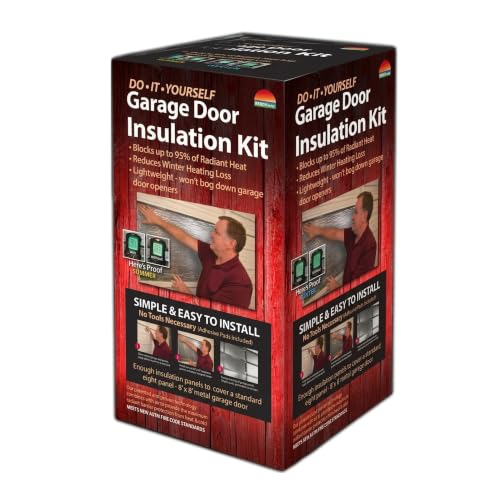


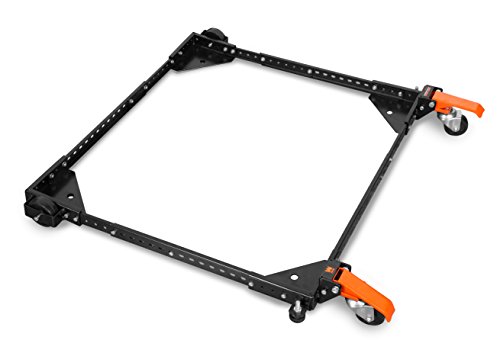
Prices change often; the button shows today's price on Amazon.
Amazon and Grizzly, side by side
Each card shows an Amazon pick and a Grizzly Industrial pick for the same job.
20-gallon quiet compressor
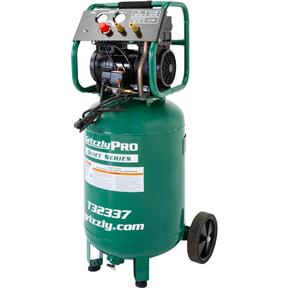
Both are oil-free, quiet-series 20-gallon compressors, so they are tolerable in an attached garage. Pick on the sale, the warranty path and the noise rating you can live with.
Cyclone dust collector for a one-man shop

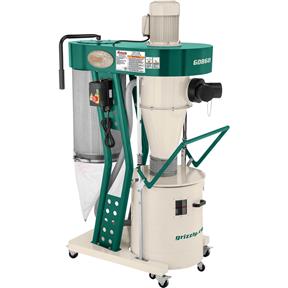
The Grizzly G0860 is a two-stage cyclone on 120V with a 1 micron canister; the Amazon pick is a bag-style 1 HP machine. The cyclone costs more and keeps the filter clean far longer.
Prices change often and Grizzly runs sales, so the buttons show current prices.
Cut noise at the source
Source treatment beats wall treatment, because it works whichever way the sound travels. Four habits matter.
- Isolate vibration. A table saw or planer on a hollow stand rings like a drum. Dense rubber pads under feet, a heavy mobile base with good casters, and a solid bench cut the transmitted vibration. A base like the WEN 500 lb universal base is for mobility, not isolation, so lock it and consider a pad under the foot when the machine runs.
- Keep blades and cutters sharp. A dull blade screams and a sharp one hums. This is free.
- Use the right speed. A router bit at too high a speed, a planer feeding too fast and a table saw with the wrong blade all raise the noise.
- Move the loud thing. A compressor in a corner, a dust collector on the far side of the room and a hose run give a few more feet of distance, and distance is the cheapest sound barrier. Never fully enclose a compressor or a collector motor; it needs air. A baffle that blocks line of sight, with open top and rear for airflow, is the safe version.
If you can, put the collector and the compressor on the wall furthest from the neighbor. Where the only wall is shared, put the machine on a rubber pad, a few inches off the wall, and put a shelf or cabinet between it and the wall to add mass. See how to store an air compressor in a garage for placement and dust collection setup for the collector.
Treat the shared wall
A shared wall between the garage and a house or neighbor is a candidate for a few upgrades, listed from cheap to costly. Adding insulation in the stud cavities cuts airborne sound inside the wall. A second layer of drywall adds mass. Sealing the gaps at the top and bottom of the wall and around outlets prevents flanking paths. Resilient channels or a staggered stud wall decouple the layers, but they are building projects that depend on the wall construction and local fire code, so check the code before changing a fire-rated wall between a garage and a house. Many jurisdictions require a fire-rated separation there, and punching holes in it or removing a layer can break the rating.
Because of that, work on the garage side, add layers rather than removing them, and keep any door between the garage and the house a tight-fitting, self-closing one if your code requires it. For dust and fumes, the same door and wall matter: you do not want the shop's dust and fumes in the house. Ask the local code office before altering the wall.
Hanging mass on the wall helps a little: a heavy shelf of tools or a cabinet breaks up the wall and absorbs some sound. Soft materials on the inside of the shop (moving blankets, acoustic panels) reduce echo and make the shop quieter for you but block little sound leaving the building. Treat them as comfort, not as soundproofing.
Schedule and neighbors: the part that works fastest
You can cut more complaints with a schedule than with a wall. Decide on three tiers of work.
- Loud work (planing, routing, grinding, sanding with a collector, compressor use): mid-morning to late afternoon on weekdays and Saturdays, within local hours.
- Medium work (table saw cuts, drilling, hand sanding with a vacuum): the same hours, with breaks.
- Quiet work (assembly, hand planing, finishing, layout): any hour the law permits.
Batch the loud work. Spending one afternoon milling all the lumber for a project is far kinder than milling a little every day for a week, because the neighbors hear a single block of noise and then peace. Keep the door closed when machines run, and keep a fan or an open window out of the picture, since an open door erases whatever you did to seal it. Pick up after yourself outside, too: a driveway full of sawdust and offcuts is what neighbors notice.
Finally, be a neighbor. Offer a heads up before a big project. If someone complains, treat it as information. Ask what time and which tool bothered them, and see if you can shift. A neighbor who feels heard is the best insurance you can buy. If your shop becomes a business with customers, deliveries or employees, the rules change; the zoning page covers that.
A noise plan by garage size
12 x 20 or 12 x 22 ft one-car, attached. Seal the door, buy a quiet compressor, put the cyclone and vacuum on a rubber pad away from the shared wall, batch loud work in daytime hours and run the filter after. With the car parked, the free floor is the strip behind the bumper, so the machines sit close to the walls; use pads.
20 x 20 or 22 x 22 ft two-car. Put the loud machines on the far side from the neighbor, the car on the shared-wall side as a sound buffer, and the collector in the corner farthest from the house.
Detached or 24 x 24 ft and up. More distance helps. Check the setbacks and hours. A 3 HP, 240V collector in a three-car bay is a lot of low-frequency sound, so keep it off the wall nearest the street.
Compare layouts in the 22 x 22 mixed layout and read best garage shop air compressor for the quiet-unit options. The full planning list is in the garage shop planning checklist.
Measuring the noise before you spend
It helps to know how loud the shop is before you spend money to quiet it. A sound level meter app on a phone gives a rough reading, good for comparing before and after, though not a calibrated measurement. Stand where your neighbor stands, outside their wall or at the property line, and have a friend run each tool in turn with the door closed and then open. Write down which tools register and by how much. The pattern usually points to one or two culprits, often the compressor or the dust collector, and the door.
Repeat after each change. Seal the door and measure again. Move the collector and measure again. This stops you spending on wall treatments when the leak is the door, and stops you hanging foam on walls that do nothing for sound leaving the building. Keep in mind that your ears and your neighbor's ears hear different things: a low rumble that your phone barely registers carries through walls and is the part that annoys. If a local limit is stated in decibels, ask the code office how and where it is measured, because the method differs by place.
Use the same discipline with hours. Keep a simple log for a few weeks of when loud work happened. If you ever get a complaint, a log shows you are working within hours, and it shows you where to cut back. For the equipment side, see best garage shop air compressor and best dust collector for a garage shop.
Get the garage shop planning checklist
One printable page: measure the bay, count the circuits, list the machines, check the floor. Plus a few short emails, then a couple a month at most.
Unsubscribe anytime. You can also just read the checklist on this site.Frequently asked questions
Is it legal to run power tools in my garage?
Usually yes during daytime hours, as long as you stay within your local noise ordinance and any HOA rules. Limits vary by city, so read your municipal code and covenants. This is general information; check local rules.
How do I soundproof a garage workshop?
Seal and insulate the overhead door first, then place loud machines away from shared walls, put vibrating tools on rubber pads, buy a quiet compressor and add insulation and mass to a shared wall. Check fire-rating rules before altering a house-garage wall.
What is the loudest tool in a garage shop?
It depends on the tool and material. Planers, routers, shop compressors, dust collectors and angle grinders are loud and continuous; impact wrenches and nailers are loud but short. Check the decibel rating on the listing.
Does insulating a garage door reduce noise?
A little. Insulation kits add mass and damping to the panels, but they are sold for temperature. New seals at the bottom, sides and top close the gaps that carry most of the sound.
What hours can I use power tools in my garage?
Local ordinances and HOA rules set the hours, often with quiet hours at night and on some days. Look up your municipal code and keep loud work in the middle of the day.
This page is researched guidance, not professional electrical, engineering or safety advice. Circuits, loads and clearances depend on your house, your service and your town: have a licensed electrician confirm any wiring, and check local code and each manufacturer's manual before you act.
