Guides
Single car garage workshop ideas and layouts
A single car garage is about 12 x 20 or 12 x 22 ft clear, and the car decides everything. With the car out, a 12 x 20 ft bay holds a hybrid table saw, 14 in bandsaw, cyclone collector, rolling tool bench, 6 ft workbench and a 20 gallon compressor with about 176 sq ft of floor left (our layout engine).
With a sedan parked inside, only a shop vac with a cyclone, a benchtop jointer, a drill press and a grinder fit alone in a 12 x 20 ft bay, while a 12 x 22 ft bay also takes a jobsite saw, an open-stand saw, a bandsaw and a planer. Build the shop on mobile bases against the long walls.
What a single car garage really gives you
Builders call it a one-car garage; the clear interior is about 12 ft wide and 20 to 22 ft deep, behind a 9 ft overhead door. That is 240 to 264 sq ft, minus the door tracks, the water heater, the electrical panel and everything the house stores in it. A mid-size sedan is about 16 ft long and 6.2 ft wide. Keep 12 in clear of the door, and in a 12 x 20 ft bay the sedan leaves only 3 ft behind its front bumper. In a 12 x 22 ft bay it leaves 5 ft. Beside the car you need about 30 in on the driver's side, which takes most of a 12 ft width. So a single car garage is either a small shop with no car or a smaller shop that goes away when the car comes in.
Pick which shop you want before you choose a single tool. The park-the-car calculator turns your bay and your vehicle into the free strip behind the nose and the deepest bench that still fits. Then use the layout calculator to test machines against that space.
Idea 1: The car-out woodshop on the long walls
If the car lives in the driveway or on the street, the whole bay is yours. Put the table saw along one long wall, with the stock lane running along the length of the bay. For 8 ft boards the lane is the machine depth plus 1.5 times the board: about 15.4 ft for a hybrid saw and 15.9 ft for a cabinet saw, 14.25 ft for an open-stand saw and 14.2 ft for a jobsite saw. A 12 x 20 ft bay can hold the lane with room to spare, and with the overhead door open, a full 8 ft sheet is possible. Put the bench on the opposite long wall, the bandsaw near the door, the cyclone beside the saw and the compressor in the back corner.
The layout engine's one-car woodshop package is a hybrid table saw (64 x 40.5 in), a 14 in bandsaw (24.5 x 17.5 in), a portable cyclone (27.5 x 44 in), a rolling tool bench carrying the jointer, planer and drill press, a 6 ft workbench (72 x 24 in) and a 20 gallon compressor (28 x 20 in). In a 12 x 20 ft bay that leaves about 176 sq ft open and drops the miter station and the steel shelving. A 12 x 22 ft bay adds the miter station and leaves about 180 sq ft. See the 12 x 20 woodshop and the 12 x 22 woodshop.
Idea 2: The car-in "mixed" shop that rolls
Most people with a one-car garage still park a car in it. Then the shop has to be small, light and mobile. The engine's mixed package keeps one fewer vehicle in the bay than there are bays, so in a one-car garage it plans for a parked sedan. Here is what actually fits alone, with the sedan in the 12 x 20 ft bay:
| Machine | Size (in) | 12 x 20 car in | 12 x 22 car in |
|---|---|---|---|
| Shop vac with cyclone separator | 18 x 18 | Fits | Fits |
| 6 in benchtop jointer | 30 x 9.5 | Fits | Fits |
| Drill press (benchtop) | 19.5 x 12 | Fits | Fits |
| 8 in bench grinder | 18 x 10 | Fits | Fits |
| 14 in bandsaw | 24.5 x 17.5 | Stored against the wall only | Fits |
| Jobsite table saw on a stand | 32 x 26 | No | Fits |
| Open-stand hybrid saw | 40.25 x 27 | No | Fits |
| Hybrid table saw | 64 x 40.5 | No | Stored only |
| 13 in planer | 24 x 20 | No | Fits |
| Cyclone collector (G0860 class) | 27.5 x 44 | No | Fits |
Fits means it fits next to the parked sedan with a working zone around it. Stored means it fits against a wall with no working space, so it has to roll out before you use it. The takeaway is plain: in a 12 x 20 ft bay with a car in it, you can do hand-tool work, drill-press work, grinding and small jointing. You cannot cut sheet goods. A 12 x 22 ft bay adds the two feet that bring a jobsite saw and a planer into reach. See the 12 x 22 mixed layout and the beginner mixed setup, which lists the machines and a budget total.
Idea 3: Everything on wheels, with a parking routine
The way to make a one-car garage work is a routine you repeat every day: car out, shop rolls out to the middle; car in, shop rolls back to the walls. Make it take under five minutes or you will stop doing it.
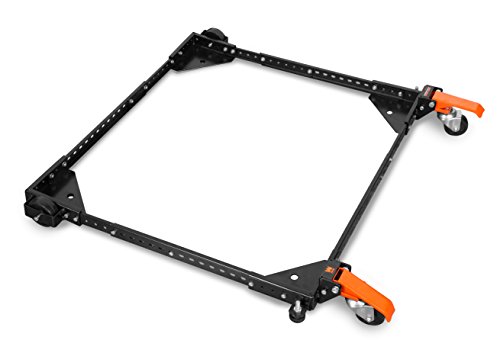
- Locking casters on everything heavy. A WEN 500 lb universal base suits a planer cart or a bandsaw; a BORA PM-2500 suits a typical table saw; a PM-3550 takes a heavier one. See the best mobile base for a table saw and the mobile base sizing calculator.
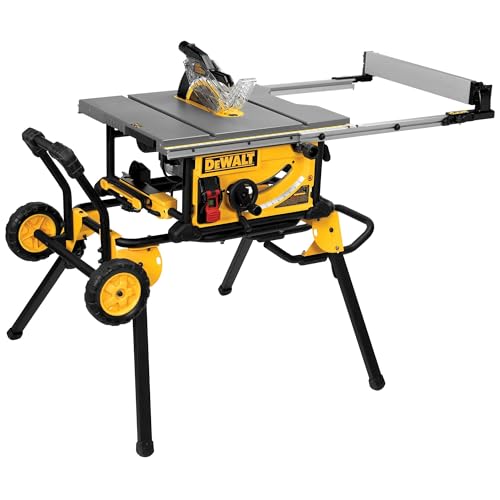
- A foldable or open-stand saw. The DEWALT 10 in jobsite saw with rolling stand and the Grizzly G0962 open-stand hybrid (its own built-in mobile base) both roll. Compare them on jobsite saw vs hybrid saw.
- Floor marks. Tape the "shop" and the "car" positions on the slab so the machines go back to the same place, near the outlets.
- Outlets on the walls, not the floor. Machines roll to the wall to plug in. Put 20 A outlets above bench height every 4 to 6 ft on the work walls.
Idea 4: Use the walls and the ceiling
In a one-car garage, the floor is the scarce resource and the wall and ceiling are free. Cover a 12 ft wall with plywood and French cleats, put a 48 in workbench against it, and hang tools above. A CAMMOO 48 in adjustable bench or the Grizzly T34010 4 ft fits the width. Add a metal pegboard four-pack, a locking wall cabinet and a 47.7 in deep 5-tier shelving unit (listed depth, so check the footprint) along the end wall. Store sheet goods vertically against the wall. An overhead rack above the car's hood is useful if you can clear the garage door track, and it is the one place the car never conflicts with the shop. See best garage workbench and workbench size for a one-car garage.
Idea 5: The bandsaw-and-router-table shop
If a table saw does not fit, there is a way to work around it. A 14 in bandsaw, a router table, a drill press and a sander can build almost anything a table saw can, in much less space and with no stock lane. The WEN BA1411 or the Grizzly G0555, a BOSCH RA1181 router table, a WEN 12 in drill press and a Ridgid oscillating sander cover it. All run on 120V. Add a track saw or a circular saw and a guide for sheet goods. This is the route to take in a bay where the car stays and the saw lane is not available.
Machines and storage that suit a one-car bay



Prices change often; the button shows today's price on Amazon.
Amazon and Grizzly, side by side
Each card shows an Amazon pick and a Grizzly Industrial pick for the same job.
Benchtop table saw
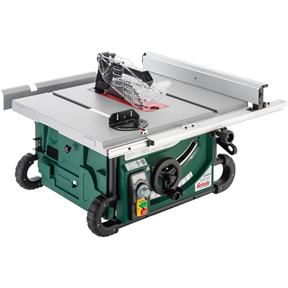
The Amazon pick is a jobsite saw with a folding rolling stand you can stow against a wall; the Grizzly saw is a heavier variable-speed benchtop that stays on its bench.
Open-stand hybrid saw on its own mobile base
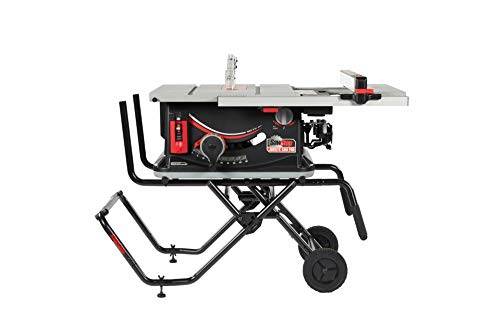
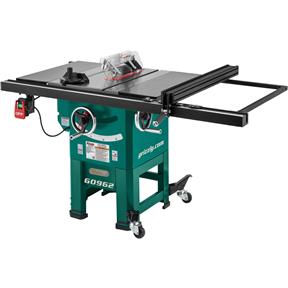
The Amazon pick is a 120V jobsite saw on a mobile cart; the Grizzly saw has a built-in mobile base under a cast-iron table. Both roll away so a car can come back in.
14 in bandsaw

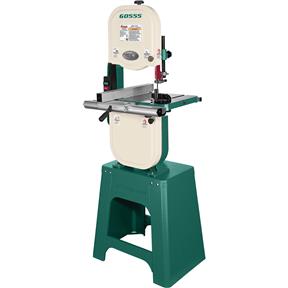
Both are 14 in, 1 HP saws that run on 120V. The Grizzly saw is the established cast-iron-table pick; the Amazon pick is dual-voltage and ships to your door.
4 ft adjustable workbench
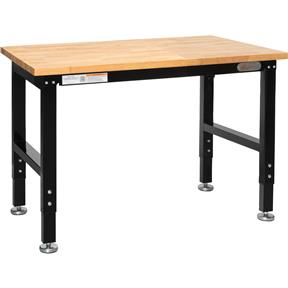
Pick the Amazon bench for the lowest entry cost; pick the Grizzly bench if you want outlets built into the bench and a direct parts line.
Prices change often and Grizzly runs sales, so the buttons show current prices.
Power for a one-car shop
A one-car garage often has a single 15 or 20 A circuit shared with the lights and the opener. That is not enough for a saw, a collector and a compressor together. The engine's one-car woodshop package carries 76 A of connected 120V load across its machines and suggests a 60 A subpanel; the mixed package carries 23 A in a 12 x 20 ft bay and 53 A in a 12 x 22 ft bay and suggests a 30 A subpanel. These are planning figures built from the machine amps, with a diversity factor: you will not run everything at once. The workshop amps calculator lets you enter your own list.
The practical rule: a dedicated 20 A circuit for the table saw, one for the collector, and one or two 20 A outlet circuits for the bench and the rest. Motors over about 2 HP want 240V. NEC Table 430.248 lists a 1-1/2 HP motor at 20 A on 115V or 10 A on 230V, and the conductor is sized at 125 percent (NEC 430.22). Have a licensed electrician confirm the work. See 240V in a garage explained and how many amps for a garage workshop.
Heat, dust and light in a small box
A small box heats and cools fast, which is the good news. Using the site's convention (R-13 walls, bare ceiling, steel door, 55F inside, 10F outside), a 12 x 20 ft garage needs about 8,500 BTU per hour, a 2.5 kW electric heater at 240V on a 15 A breaker and 14 AWG copper; a 12 x 22 ft bay needs 9,000 BTU, 3.0 kW, 20 A and 12 AWG. With R-19 walls, an R-30 ceiling and an insulated door the load drops to 4,000 and 4,500 BTU per hour. Read is a garage heater worth it and the heater sizing for a 12 x 20 garage.
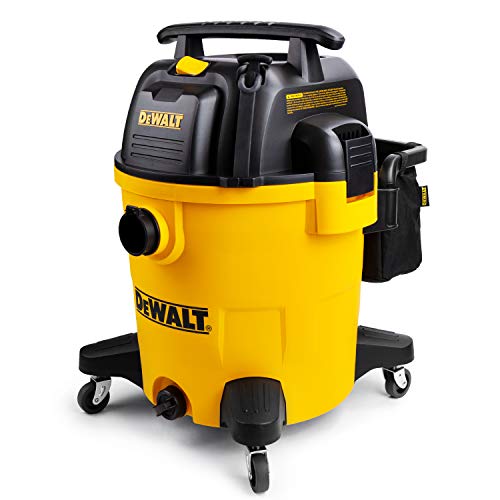
Dust: a portable cyclone is the best choice with the car out; with the car in, a shop vac with a Dust Deputy separator and a 12 gal vac rolls away. Hang the air filter from the ceiling, where it takes no floor. Light: a 240 sq ft bay needs about 23,500 lumens for general work, six fixtures of the 4,400 lumen class. See dust collection in a garage shop and the best garage shop lights.
When a single car garage is not enough
If the list of machines you want keeps getting longer, check the numbers honestly. A cabinet saw (66 x 47 in) with its 15.9 ft lane does not fit a 12 ft wide bay with a car. A wide-belt sander (42 x 50 in) does not fit with a car in a 12 x 22 ft bay. A metal lathe and mill fit a 12 x 20 ft bay with the car out (a 10 x 22 lathe, a 7 x 27 mill, a bench, a tool bench, a roller chest, shelving and a compressor all place), but heavy machines need a slab that can carry them. For a car and a full shop you need a two-car garage; see two car garage workshop ideas and layout and 2 car garage with workshop dimensions. Until then, make the one-car shop better rather than bigger, using the setup pages.
Get the garage shop planning checklist
One printable page: measure the bay, count the circuits, list the machines, check the floor. Plus a few short emails, then a couple a month at most.
Unsubscribe anytime. You can also just read the checklist on this site.Frequently asked questions
Can you fit a workshop in a single car garage?
Yes. With the car out, a 12 x 20 ft bay holds a hybrid saw, bandsaw, cyclone, tool bench, 6 ft workbench and compressor. With the car in, you need machines on mobile bases and a shop that is small enough to roll aside.
Can I park my car in a one car garage workshop?
A sedan fits a 12 x 20 ft bay with only 3 ft behind the bumper, so machines have to roll out. A 12 x 22 ft bay leaves 5 ft and takes a jobsite saw, a bandsaw and a planer beside the car.
What table saw fits in a one car garage?
A jobsite or open-stand saw needs about 14 ft of stock lane for 8 ft boards. A hybrid needs about 15.4 ft and a cabinet saw about 15.9 ft. Only the jobsite and open-stand fit a 12 x 22 ft bay with a car parked.
What is the best layout for a one car garage workshop?
Machines on the two long walls, the stock lane along the length, the bench opposite the saw, and everything heavy on locking mobile bases. Use the layout calculator for your exact bay.
Do I need 240V in a one car garage workshop?
Not to start. Benchtop and hybrid machines run on 120V. Add 240V only for a motor over about 2 HP, a big heater or a large compressor, and have a licensed electrician size the circuit.
This page is researched guidance, not professional electrical, engineering or safety advice. Circuits, loads and clearances depend on your house, your service and your town: have a licensed electrician confirm any wiring, and check local code and each manufacturer's manual before you act.
