
Guides
Is a garage heater worth it?
A garage heater is worth it if you work in the garage for hours at a time through the cold months, or if cold ruins glue, finish, batteries or your hands.
A typical 22 x 22 ft garage (R-13 walls, bare ceiling, steel door) needs about 15,500 BTU per hour to hold 55F when it is 10F outside, which is 4.5 kWh of electricity for every hour the heater runs flat out; with R-19 walls, an R-30 ceiling and an insulated door it needs about 7,500. Insulate first, size the heater to the load, and multiply the kilowatt-hours by your own electric rate. The heater is not worth it for a quick weekend job; it is for a shop you actually use.
The question behind the question
People ask "is a garage heater worth it?" when they mean one of four different things. Is it worth the purchase and install? Is it worth the running cost? Is it worth it compared with a mini-split, a propane unit or just a warm jacket? And is it worth it for a garage that is half insulation and half hole? The answers are different, and this page takes them one at a time with numbers from the site's calculators. We do not type a price for electricity or for a heater, because yours depends on your rate and your region; we give the energy numbers you multiply by your own rate.
The short version of the decision: a heater is worth it when the hours you would use the shop at a comfortable temperature, times the value of those hours to you, exceed the cost of the equipment and the energy. For a hobby shop used on weekends, the answer is often "a small radiant heater near the bench". For a shop where you cut, glue and finish all winter, it is "yes, after you insulate".
Step 1: How much heat does your garage lose?
A heater only has to replace the heat the garage loses. The site's calculator models the walls, ceiling, door and air leakage using convention values (U-values in BTU per hour per square foot per degree F: an uninsulated wall 0.25, R-13 0.09, R-19 0.06; an uninsulated ceiling 0.25, R-30 0.035, R-38 0.026; a steel door 0.7, an insulated door 0.25; air changes per hour of 0.5, 1 or 2 for tight, average or leaky). For a shop held at 55F with 10F outside:
| Garage | Typical shell BTU/h | kWh per hour | Upgraded BTU/h | kWh per hour |
|---|---|---|---|---|
| 12 x 20 ft | 8,500 | 2.5 | 4,000 | 1.2 |
| 12 x 22 ft | 9,000 | 2.6 | 4,500 | 1.3 |
| 20 x 20 ft | 13,000 | 3.8 | 6,000 | 1.8 |
| 22 x 22 ft | 15,500 | 4.5 | 7,500 | 2.2 |
| 24 x 24 ft | 17,500 | 5.1 | 8,500 | 2.5 |
| 32 x 24 ft | 24,500 | 7.2 | 11,500 | 3.4 |
Typical means R-13 walls, a bare ceiling, a steel door and average leakage. Upgraded means R-19 walls, an R-30 ceiling and an insulated door. kWh per hour is the BTU load divided by 3.412 BTU per watt-hour, the energy an electric resistance heater uses to replace the loss when it runs continuously. These are convention values and the slab edge loss is ignored on purpose, so treat them as a planning range and use the heater calculator to change every input. The sizing pages do it for each bay: 12 x 20, 22 x 22, 32 x 24.
Step 2: What it costs to run, as a formula you can fill in
Electric resistance heat converts every watt into 3.412 BTU, so the running cost per hour is the kWh in the table times your electric rate per kWh. Look up your rate on your electric bill and multiply:
- Cost per hour at full output = kWh per hour x your rate per kWh.
- Cost per winter = cost per hour x the hours the heater actually runs. A thermostat cycles the heater, so it runs less than the hours you are in the shop. In a well-insulated garage it may run a half or a third of the time at design temperature and far less in mild weather.
An example in energy, not dollars: a 22 x 22 ft garage with the typical shell at design conditions uses about 4.5 kWh per hour of heating, so a four-hour shop session uses about 18 kWh if the heater runs continuously. The upgraded shell uses about 2.2 kWh per hour, or 9 kWh for the same session. The insulation saves about half of the energy for every hour you ever heat the garage. That is why the standard advice is to insulate before you choose a heater, and why a door insulation kit (two-car or one-car) is a better first purchase than a bigger heater.
Keep the setpoint low. Holding 55F and going to 65F only while you work is a lot cheaper than holding 65F all the time, because the loss scales with the temperature difference. The thermostat is a bigger lever than the heater.
Step 3: Pick the heater type, then check the circuit
Four types suit a garage, and they do not cost the same to run or to put in:
- Hard-wired or 240V plug-in electric. The Comfort Zone 7,500 W ceiling unit and the InoKraft 7,500 W with a 14-50 plug are the large ones; the Dura Heat 3,750 W, 12,800 BTU is the small one. No combustion, no vent, no fuel. The cost is the circuit: a 7.5 kW heater at 240V draws 31.3 A, so the continuous-load rule (125 percent) gives a 40 A breaker and 8 AWG copper in the site's table; a 3.75 kW unit draws 15.6 A, a 20 A breaker and 12 AWG. Have a licensed electrician confirm. See 240V in a garage explained.
- Forced-air gas or propane unit heater. The Mr. Heater 50,000 BTU and 80,000 BTU are the common ones. A unit heater needs a gas supply or a tank, a vent to the outside and combustion air, installed to code and the maker's manual. At 80 percent efficiency, the input needed for the typical 22 x 22 ft load is about 20,000 BTU per hour, so the 50,000 BTU unit is oversized for most garages; an oversized unit short-cycles.
- Radiant propane spot heater. The Mr. Heater Buddy 9,000 BTU is for ventilated spaces and spot warming. It is not for a closed garage bay, and the maker's manual says why.
- 120V space heater. A 1,500 W unit such as the DAHTEC 1500W makes about 5,100 BTU per hour. That holds a small, tight bay or warms you at the bench, and it will not keep up with a 15,500 BTU load. It also takes a whole 15 A circuit.
The comparison page is the best garage workshop heater, and if you want heating and cooling in one machine, the best mini-split for a garage shop and the mini-split cooling calculator are the places to look. A heat pump delivers more heat per unit of electricity than a resistance heater, as its listing ratings show, but it costs more to buy and install.
Step 4: Is it worth it for you? Six honest tests
- How many hours a week do you work when it is cold? Under about two, a spot heater and a jacket is probably the answer. Over ten, a proper heater is almost certainly worth it.
- What does cold break? Wood glue and many finishes have minimum temperatures on the label. Epoxy and paint cure slowly or fail. A cold shop can cost you a project, not just comfort.
- Can the garage hold heat? A leaky, uninsulated garage at -10F needs about 20,000 BTU in a 12 x 22 ft bay and 34,500 in a 22 x 22 ft one by the site's convention. If you cannot insulate, the heater will always be running, and the answer shifts toward a spot heater.
- Does the car live there? A heated garage with a car in it is more comfortable and keeps the battery happier, but a car with a gas smell and a gas flame in the same room is the wrong combination. This points to electric.
- Do you have the circuit? A 240V heater needs a dedicated circuit; if the panel cannot carry it, the cost goes up. See cost to install a 240V outlet in a garage.
- Is the moisture a problem? A warm garage with cold iron rusts tools. A dehumidifier belongs with the heater; see best dehumidifier.
If you answer yes to the first two and can insulate, a heater is worth it. If you answer no to all, buy a jacket and a small bench heater.
Step 5: Insulate in this order
The cheapest heat is the heat you do not lose. The order that pays back fastest is: seal the air leaks (the sill plate, the door perimeter, penetrations), insulate and weatherstrip the overhead door, insulate the ceiling if there is no living space above it or if code allows, then insulate the walls. The upgraded column in the table above assumes R-19 walls, an R-30 ceiling and an insulated door; you can capture much of the benefit with only the door and the ceiling. See how to build a workshop in a garage for the sequence. For hanging and mounting, read how to hang a garage heater.
Heaters and the door kit that makes them smaller


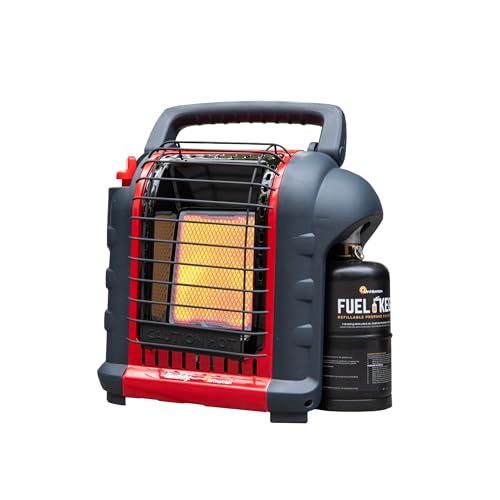

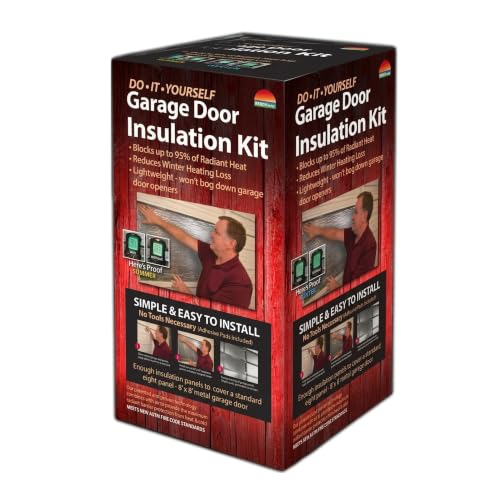
Prices change often; the button shows today's price on Amazon.
Safety: heaters, cars and shops
A heater in a garage sits near fuel, dust and solvents. Keep these rules:
- Keep combustibles and flammable vapors away from any flame or hot element. Many codes require fuel-burning heaters in garages to be installed with the burner raised above the floor; ask your building department and follow the manual.
- Fuel-burning appliances need venting and combustion air, and a carbon monoxide alarm nearby.
- Do not run a combustion heater in a closed garage without proper venting, and never run an unvented radiant propane heater in a closed bay.
- Keep sawdust off the heater. A heater above a table saw is a fire risk if it collects dust.
- Have a fire extinguisher by the exit.
This is general information; follow the maker's manual and your local code.
Get the garage shop planning checklist
One printable page: measure the bay, count the circuits, list the machines, check the floor. Plus a few short emails, then a couple a month at most.
Unsubscribe anytime. You can also just read the checklist on this site.Frequently asked questions
Is a garage heater worth it?
Yes if you work in the garage for hours in the cold months, or if cold damages glue, finish or tools. Insulate the door and ceiling first, size the heater to the heat load, and multiply the kWh by your own electric rate. For short jobs a small spot heater is enough.
How much does it cost to run a garage heater?
Multiply the kilowatt-hours by your rate per kWh. A 22 x 22 ft garage needs about 4.5 kWh per hour at 10F outside with typical insulation, or about 2.2 kWh per hour with better insulation, when the heater runs continuously. A thermostat cycles it.
What size heater do I need for a garage?
A 22 x 22 ft garage needs about 15,500 BTU per hour (4.5 kW) with typical insulation at 10F outside; a 12 x 20 ft garage needs about 8,500 BTU (2.5 kW). Better insulation roughly halves it. Use the heater calculator for yours.
Should I insulate my garage before buying a heater?
Yes. Insulating the door and ceiling cuts the load by about half in our convention, which shrinks the heater, the circuit and the running cost. The door is the best single place to start.
Is an electric or gas garage heater better?
Electric has no fuel, flame or exhaust and suits a closed bay with a car; it needs a 240V circuit for larger sizes. Gas unit heaters give a lot of heat but need venting, combustion air and a gas supply. Check your local code.
This page is researched guidance, not professional electrical, engineering or safety advice. Circuits, loads and clearances depend on your house, your service and your town: have a licensed electrician confirm any wiring, and check local code and each manufacturer's manual before you act.
