Best picks · three tiers
Best garage shop lights
For most garage shops, 4 ft LED strip lights are the best value: the hykolity 4 ft, 42W, 4400 lumen, 5000K is the benchmark, and the BBOUNDER 4-pack and ELEKICO 6-pack cover a bay at a lower cost per light. Plan on roughly 50 lumens per square foot as a working figure: three 4400-lumen strips for a 12 x 20 ft bay, six for a 22 x 22 ft bay.
| Tier | Amazon pick | Budget | Grizzly option |
|---|---|---|---|
| Beginner | hykolity 4FT LED Shop Light | Under $50 | Amazon only |
| Intermediate | BBOUNDER 4Pack 4FT LED Shop Light | Under $50 | Amazon only |
| Expert | POLARPRA Garage Lights | Under $50 | Amazon only |
How many lumens does a garage shop need?
Lumens are the output; lumens per square foot is the target. Workshop standards run well above a living room, and the figure you pick depends on the work. A woodshop doing rough cuts can live with less; a bench for layout, soldering or finish work wants much more. The shop lighting calculator lets you set the target and returns the fixture count. Every constant on that page is labelled CONVENTION so you can see what was assumed and change it.
As a worked example, take 50 lumens per square foot, a working figure, not a rule. A 12 x 20 ft one-car bay is 240 sq ft, so 12,000 lumens, which is three 4400-lumen strips (13,200). A 22 x 22 ft two-car bay is 484 sq ft, so about 24,200 lumens, six strips (26,400). A 32 x 24 ft three-car bay is 768 sq ft and needs about 38,400 lumens, nine strips (39,600). For your exact bay, use the sizing pages: 12 x 20, 12 x 22, 20 x 20, 22 x 22, 24 x 24 and 32 x 24.
This roundup was researched from manufacturer listings, published specifications and owner reviews, not a light-meter test. The wattage and lumen figures are those printed on the listings, and where a listing is unclear we say so.
Picks by budget: beginner, intermediate and expert
hykolity 4FT LED Shop Light

Under $50
Who it is for: A one-car garage owner replacing a single bare bulb who wants real light over a bench without running new wire.
The hykolity 4 ft LED shop light is 42W, 4400 lumens and 5000K, sold as a ready-to-hang fixture. Three of them in a 12 x 20 ft bay give about 13,200 lumens, about 55 lumens per square foot. Hang one over the bench, one over the center and one near the door. At 42W each, three lights draw about 126W together, around 1 A at 120V, so a household lighting circuit carries them easily.
Skip it if: You do fine finish work or metal layout and need very bright, even light on the bench. Add task light or step up a tier.
Check price on AmazonBBOUNDER 4Pack 4FT LED Shop Light

Under $50
Who it is for: A two-car garage owner who wants a full ceiling grid and a single plug.
The BBOUNDER 4-pack of 4 ft LED lights is listed as 40W each and linkable, which means one fixture feeds the next and one plug serves the row. The ELEKICO 6-pack of 60W lights lists 9000 lumens and 5000K on the title; read the listing to see whether the lumen figure is per fixture or per pack before you do the math. Linkable fixtures save outlets and cord runs, which matters in a shop with a car and a few machines.
Skip it if: You want to plug each light into its own outlet. Linkable strips chain, so one failed connector can darken a row.
Check price on AmazonPOLARPRA Garage Lights

Under $50
Who it is for: A two- or three-car garage owner with a high ceiling who wants a few very bright fixtures instead of a grid of strips.
The POLARPRA garage ceiling lights list 32000 lumens and 6500K daylight. That is a lot of output from a few fixtures, which suits a high ceiling or a large bay where a grid of 4 ft strips would be a chore to hang. The tradeoff is glare and shadow: a few point sources throw harder shadows than a row of long strips. Use them with wall-mounted strips or a task light at the bench.
Skip it if: You have a low ceiling or you spend all day at a bench. A few intense fixtures create glare and sharp shadows at close range.
Check price on AmazonWhere do you put the fixtures in a shared bay?
A garage with a car has two jobs for light: the floor in front of and around the car, and the bench and machines on the side. A single row down the center lights the car roof and leaves the bench in shadow. Better is two rows, one on each side of the car lane, or a row over the bench and a row over the machines.
Think in terms of shadows. A machine blocks light from behind you, so you want light from two sides: ceiling fixtures on both sides of the operator. For a table saw, put a row over the saw and a second row beside the stock lane. For a drill press or bandsaw, add a clamp-on task light for the line you are working.
Mind the garage door. A door that rolls up on tracks leaves a clear ceiling in the middle but often hides the tracks and the opener across the first two feet. Hang fixtures behind the door travel, not under it. If the opener takes a bulb socket, see the note on the electrical side below.
What color temperature is best?
Garage shop lights come in 4000K, 5000K and 6500K. Lower numbers look warmer, higher numbers look bluer. The hykolity and ELEKICO strips list 5000K daylight, which is the common choice for a shop: neutral, good for seeing grain and color, and not harsh. The POLARPRA ceiling lights list 6500K, a cooler, bluer white that reads as very bright and is easier on the eye in a large, high bay than at a close bench.
Mix with care. A shop that has some 5000K and some 6500K fixtures shows a patchwork on the ceiling. Pick one temperature for the whole bay. The BBOUNDER listing gives a color temperature figure that looks like a typo on the title, so read its spec table before you rely on it. If you do finish work, buy a sample fixture first and hold a piece of wood under it.
CRI (color rendering) matters if you match stain or paint. Many budget shop lights do not state it on the title; check the listing before you buy for color work.
How do you wire and hang them?
There are three ways to power a row of lights. Plug-in fixtures hang on chain and plug into an outlet or a ceiling receptacle, which suits a renter or a quick job. Linkable fixtures connect end to end and take one plug for the row, up to the limit stated on the listing. Hard-wired fixtures connect to a lighting circuit and are switched from a wall switch, which is the neatest and the one that wants an electrician.
Keep the lighting on its own circuit when you can. Garage lights on the same circuit as a table saw or a vacuum make for a dark bay at the worst moment. Lighting wants a 15 A circuit; the draw is small. For example, six 42W strips draw about 252W, or 2.1 A at 120V. Test your outlets with the Klein outlet tester before you plug in anything that matters, and read the garage workshop guide for the wiring basics.
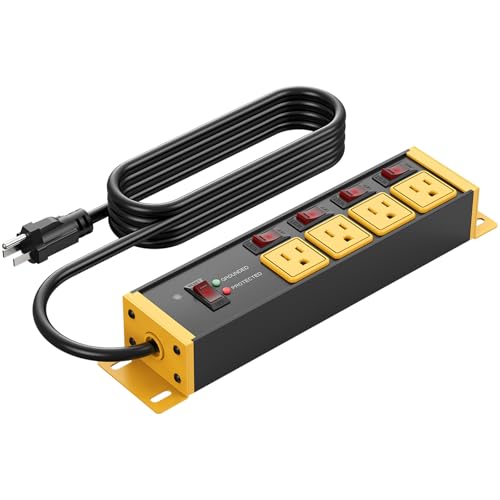
If you need power at the bench, a heavy 12 gauge power strip gives you outlets at the work spot. Do not daisy-chain light strings or cheap power strips. Local code controls what you can wire yourself; have a licensed electrician confirm any new circuit or switch.
Are cheap LED shop lights good enough?
For a garage, usually yes. LED shop lights have low heat, long life and instant start, even in the cold, which was the weakness of the old fluorescent tube. The things that vary between brands are the real output against the claim, the flicker, the connector and the mounting hardware. Read owner reviews for those, and compare lumens per watt: the hykolity lists 4400 lumens for 42W, about 105 lumens per watt, which is a good figure for a shop strip.
A few cautions. Lumen claims on multi-packs are easy to misread. Equivalent-wattage claims such as "250W equivalent" are marketing; use lumens. Cold weather can slow some drivers, so check the listed operating temperature if your garage drops below freezing. And fixtures that look alike can have very different housings, so look at the mounting hardware in the photos.
The buy-it-at-a-big-box-store route is real: many shoppers walk into a home center and pick the strip that is on the shelf. The same rules apply there. Check lumens, watts, color temperature, whether it is linkable and the operating temperature range on the box, and compare the cost per lumen with the listings here.
How do lights fit with dust, welding and paint?
Dust settles on fixtures and cuts output, so wipe them down at the start of each season. In a woodshop, sealed fixtures with a plain lens stay cleaner than open-tube strips. Welding throws bright flash and spatter; keep fixtures out of the weld zone or use a cover. Paint and finish vapors are flammable; use fixtures rated for the conditions and keep an eye on the manual.
Add air filtration if you sand. A hanging filter like the POWERTEC AF4001E clears the haze that makes bright lights look dim; the air filtration page covers the sizes. And keep a fire extinguisher in reach of the door.
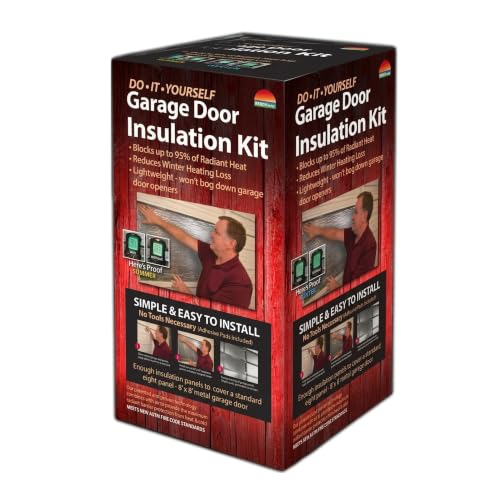
Finally, insulate the door and the ceiling if you plan to heat the bay; a lit, heated, sealed bay is a real shop, and lighting is the cheapest place to start. See the heater roundup for the next step.
Also worth a look



Prices change often; the button shows today's price on Amazon.
More roundups
Email me the full garage shop buy list
These picks plus the rest of a complete build at three budgets, as one list. A few short emails follow, then a couple a month at most.
Unsubscribe anytime. You can also just read the checklist on this site.Frequently asked questions
How many lights do I need in a one-car garage?
About three 4 ft LED strips of roughly 4400 lumens each gives about 13,200 lumens for a 12 x 20 ft bay, around 55 lumens per square foot. Add a task light at the bench if you do detailed work.
How many lumens for a two-car garage workshop?
At a working figure of 50 lumens per square foot, a 22 x 22 ft bay needs about 24,200 lumens, which is six 4400-lumen strips. Use the shop lighting calculator to set your own target.
What color temperature is best for a garage shop?
5000K daylight is the common choice: neutral and good for seeing grain and color. 6500K reads bluer and brighter. Pick one temperature for the whole bay so the ceiling looks even.
Are linkable shop lights safe to chain?
Yes, up to the limit on the listing. Linkable fixtures pass power from one to the next, so check the maximum number in a chain and the circuit rating before you add more.
Can I put shop lights on the same circuit as my tools?
It is better not to. A saw or vacuum can trip the breaker and leave you in the dark. Lights draw little power, so a separate 15 A circuit for lighting is easy to justify.
Are cheap LED shop lights worth it?
For a garage, mostly yes. They start instantly in the cold, run cool and last long. Compare lumens and lumens per watt rather than the equivalent-wattage claim, and read owner reviews for flicker and mounting hardware.
This page is researched guidance, not professional electrical, engineering or safety advice. Circuits, loads and clearances depend on your house, your service and your town: have a licensed electrician confirm any wiring, and check local code and each manufacturer's manual before you act.
