Guides
Can I use my garage as a workshop?
Yes. Whether your garage works as a workshop is decided by six things: floor space once the car is counted (a 16 ft sedan leaves only 3 ft behind the bumper in a 12 x 20 ft bay), power (most machines run on 120V, motors over about 2 HP want 240V), heat and moisture, dust and fumes, noise, and the rules of your insurer, HOA and town. Pass those and a garage is the best shop most people will ever have.
Test 1: Is there floor once the car is counted?
The garage is a parking space first. A mid-size sedan is about 16 ft long and 6.2 ft wide; an SUV is about 16.5 ft; a crew-cab truck is about 21 ft. Take away the 12 in gap you need so the overhead door closes, and a one-car garage that is 20 ft deep leaves 4 ft, of which 3 ft is behind the front bumper and the rest is the door gap. Beside the car you need about 30 in on each side to open the doors, which is most of the width of a 12 ft bay.
That is why the first question is not "what tools?" but "what happens to the car?" There are three honest answers:
- The car leaves. The garage is a shop. A 12 x 20 ft bay holds a hybrid saw, a bandsaw, a collector, a drill press, a bench and a compressor with room to stand: see the 12 x 20 woodshop layout.
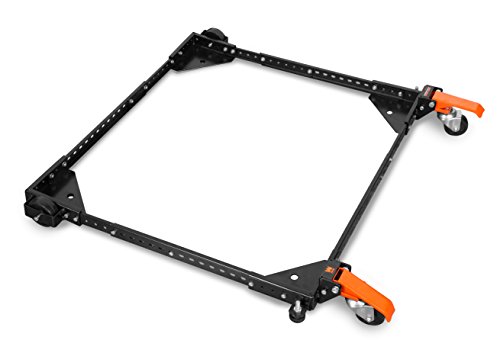
- The car stays and the shop rolls. Machines on mobile bases live against the walls and roll out when the car leaves. This is the mixed shop: the 12 x 22 mixed layout shows it.
- There are two bays. One for the car, one for the shop. This is the arrangement that works every day: the 22 x 22 layout.
Run the park-the-car calculator with your bay and your vehicle. It reports the strip behind the nose, the gap beside the doors and the deepest bench that still fits.
Test 2: Is there enough power?
Most garages have one or two 15 or 20 A circuits shared with the lights and the door opener. That is enough for a drill and a router. It is not enough for a table saw, a dust collector and a compressor at once. A shop needs dedicated circuits: a 15 A tool wants a 20 A circuit to itself, a motor over about 2 HP wants 240V. Half the current in the same wire, less voltage drop, a smaller breaker.
The numbers come from the NEC tables: a 2 HP single-phase motor draws 24 A at 115V and 12 A at 230V; a 3 HP draws 34 A and 17 A. The 240V circuit calculator turns that into a breaker, a wire gauge and a receptacle, and the workshop amps calculator sizes a subpanel. Read 240V in a garage explained before you call an electrician, and have a licensed electrician confirm the work.
Do not run a table saw and a shop vacuum from the same extension cord. A 15 A saw on a 50 ft, 14 gauge cord loses almost 4 percent of its voltage; see the voltage drop calculator.
Four things almost every garage shop needs


Prices change often; the button shows today's price on Amazon.
Amazon and Grizzly, side by side
Each card shows an Amazon pick and a Grizzly Industrial pick for the same job.
4 ft adjustable workbench

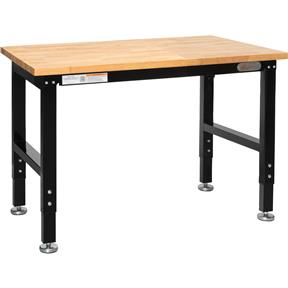
Pick the Amazon bench for the lowest entry cost; pick the Grizzly bench if you want outlets built into the bench and a direct parts line.
Top tool chest

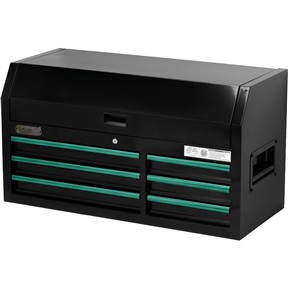
Pick the Amazon cart if you want one rolling unit; pick the Grizzly 42 in top chest if it will sit on a bench or on the matching roller cabinet.
Prices change often and Grizzly runs sales, so the buttons show current prices.
Test 3: Heat, cold and moisture
A garage is the least insulated room in most houses, and it swings from freezing to hot. Cold makes glue and finish fail and numbs your hands. Heat is a problem for everything with a motor and for you. Moisture is the quiet killer: a cast-iron table rusts overnight when warm humid air meets cold iron. Three tools help:
- Insulation first. A ceiling and a garage door kit cut the heat load more than a larger heater: the heater calculator shows by how much. A 22 x 22 ft garage with R-13 walls and a bare ceiling needs about 12,000 BTU per hour at 20F.
- A heater sized to the load. An electric ceiling heater avoids combustion in a room with a car and fuel. A vented gas unit needs combustion air and a carbon monoxide alarm. An unvented radiant heater does not belong in a closed bay.
- Moisture control. A 50 pint dehumidifier in a closed garage and a wax or rust protectant on every cast-iron table.
For cooling, the mini-split calculator adds the heat that your tools make: every watt becomes 3.412 BTU per hour.
Test 4: Dust, fumes and fire
A garage shares air with a house when it is attached, and with a car all the time. Fine dust, solvent vapor, welding fumes and engine exhaust are not things to share. Four rules:
- Capture at the machine. A table saw wants about 350 CFM at the hood. A collector sized with the dust collector calculator does that; a hanging air filter cleans what is left.
- Never run a combustion engine in a closed garage with the door shut, and fit a carbon monoxide alarm.
- Keep fuel, solvents and finish rags away from sparks. A grinder, a welder and a gas water heater are all ignition sources.
- Have a fire extinguisher by the door and another near the finishing area.
If the garage is attached, close the door between the garage and the house while you work and seal the gaps. Fine dust finds every crack.
Test 5: Noise, neighbors and hours
A dust collector at 78 dB (the Grizzly G0860 listing) and a table saw cutting are loud enough for neighbors on the other side of a wall. Plan quiet hours, hang a heavy moving blanket on shared walls if you have to, and use hearing protection yourself: ear muffs cost less than any machine in the shop. A quiet, oil-free compressor is worth its premium in an attached garage.
Test 6: The rules that apply to you
Three rule-makers can say no, and none of them can be answered by a web page, including this one. Ask them:
- Your insurer. Some policies treat a garage workshop, especially one with welding or a business, differently from a garage. Ask in writing.
- Your HOA or landlord. Covenants may limit noise, hours and what you can run from a garage.
- Your town. New circuits usually need a permit and an inspection; running a business from a garage may need a license.
We are not a lawyer and this is not legal advice. It is a list of three phone calls to make before the money goes out.
What to do next
Measure the clear interior (not the slab size), the vehicle and the overhead door. Run the layout calculator with your bay and the machines you want. Open the layout for your garage size and read what had to be left out. Print the planning checklist. Then buy the first two machines and wire for all of them. If you want to size every system by garage, the sizing pages compute the heater, dust collector, lights and air filter for each bay.
A one-hour audit with a tape measure
Before you buy anything, spend an hour on the garage itself. You need a tape measure, a notepad, a flashlight and a receptacle tester such as the Klein RT210. Work through this list and write down every answer.
- Measure the clear interior wall to wall and floor to lowest overhead object, in three places. Typical clear sizes are 12 x 20 or 12 x 22 ft for one car, 20 x 20 to 24 x 24 ft for two and 32 x 24 ft for three.
- Park the car and measure again. Note the space behind the front bumper (3 ft for a sedan in 12 x 20 ft, 5 ft in 12 x 22 ft), the walk-around beside the car (30 in is our rule) and the apron at the door (24 in).
- Find the panel and note its size, how many spaces are open and whether it has a 240V double-pole slot free. Do not open the panel. Read the label on the door and the main breaker rating.
- Test every receptacle and write down what circuit each is on by flipping breakers (one at a time, with someone watching the tester). Most garages turn out to have one or two circuits, often shared with the opener and a lamp.
- Check the walls and ceiling for insulation, open studs, drywall and where the joists run. Open studs mean cheap additions; finished walls mean surface raceway.
- Look at the floor for cracks, slope toward the door and stains. Put a level on it.
- Look for water after a rain: puddles at the door, stains at the base of the wall, white powder on the slab.
- Note heat sources (water heater, furnace, dryer vent) and fuel storage. Fuel appliances need clearance from sparks and dust.
- Stand outside at the property line while a friend runs a loud tool, and see what you hear.
The result is a one-page profile of your garage, which is what every calculator on this site asks for. Enter it in the layout calculator, the workshop amps calculator and the heater calculator.
What each trade asks of the garage
The six tests weigh differently depending on what you plan to build. A short summary of what each trade leans on:
| Trade | Floor | Power | Biggest risk |
|---|---|---|---|
| Woodworking | A stock lane of 14 to 16 ft for a table saw, or a mobile base | A 60 A subpanel for a 22 x 22 ft package (7 circuits, 1 at 240V) | Dust, noise |
| Machine shop | Heavy benches; a lathe is 294 to 432 lb | 5 circuits, none 240V, 60 A subpanel | Chips, oil, rust, weight |
| Welding and fab | Clear hot-work zone | 3 circuits (1 at 240V), 100 A subpanel | Fire, fumes |
| Auto and mechanic | The car stays in the bay | Compressor and lights, 100 A subpanel for a full shop | Fuel, fumes, floor spills |
| Mixed with a car | Mobile bases, fold-down bench | 5 circuits, 60 A subpanel | Space |
Each row links to a deeper page: how to lay out a garage shop for the floor, how to run outlets for the power, garage shop fire safety for the fire side, dust control with a car in the shop for dust, garage shop noise and neighbors for sound and moisture and rust for damp. The numbers for the subpanel come from the sizing pages; an electrician confirms.
Deal-breakers, and what fixes them
- The car must stay and the bay is 12 x 20 ft. Only 3 ft remains behind the bumper. Fix: a wall-hung shop, a fold-down bench and tools on mobile bases. See fold-down workbench and single car garage workshop ideas.
- Only one 15 A circuit. Fix: add dedicated 20 A circuits, which is electrician work in many places, or limit yourself to hand tools and one benchtop machine at a time.
- The garage floods or is always damp. Fix the water first (gutters, grading, a sump if the building has one), then a dehumidifier. A shop in a wet space is a rust factory.
- A shared wall with a bedroom. Fix: schedule, isolation pads, a quiet compressor and a sealed door. If the noise is still a problem, limit loud tools to the daytime.
- An HOA or lease that bans it. Fix: read the actual language. Hobby use is usually treated differently from a business, and a written answer from the HOA is worth getting.
- A fuel appliance in the same room. Fix: clearance, a barrier and a no-sparks rule while it burns; ask the code office. Finishing and welding may have to wait for a different space.
Most garages pass most tests. The point of the audit is to find the one that does not, while it is cheap to fix. For the zoning side if you want to sell what you make, see can I open a shop in my garage, and for the full build sequence read how to set up a workshop in a garage.
Get the garage shop planning checklist
One printable page: measure the bay, count the circuits, list the machines, check the floor. Plus a few short emails, then a couple a month at most.
Unsubscribe anytime. You can also just read the checklist on this site.Frequently asked questions
Can I turn my garage into a workshop and still park a car?
In a two-car garage, yes: one bay for the car and one for the shop. In a one-car garage you need machines on mobile bases that roll out when the car leaves, and a bay at least 22 ft deep to leave room.
Do I need 240V for a garage workshop?
Not to start. Most benchtop machines run on 120V. Motors over about 2 HP, a large compressor or a big heater are happier on 240V.
Is a garage workshop safe?
It can be, with dust capture, a fire extinguisher, a carbon monoxide alarm, circuits sized to the machines and no combustion heater in a closed bay.
Do I need a permit to wire a garage shop?
New circuits and subpanels usually need a permit and inspection. Ask your building department; a licensed electrician pulls it for you.
How much space does a garage workshop need?
A one-car garage holds a small woodshop with no car. A 22 x 22 two-car garage holds a full shop and a parked car.
This page is researched guidance, not professional electrical, engineering or safety advice. Circuits, loads and clearances depend on your house, your service and your town: have a licensed electrician confirm any wiring, and check local code and each manufacturer's manual before you act.
