
Guides
How to run outlets in a garage shop
Plan garage shop outlets as dedicated 20 A circuits: one for the bench, one for each big stationary machine and one for lights, with receptacles every 4 to 6 ft along bench walls and a ceiling drop or cord reel for machines in the middle of the floor. A 22 x 22 ft woodshop works out to 7 circuits and about a 60 A subpanel to ask an electrician about.
Adding circuits is licensed electrical work in many places, and GFCI rules apply to garage receptacles.
How do you plan outlets for a garage workshop?
Plan outlets from the loads and the layout, not from the wall. Start with a list of what runs, and for each item its volts and amps. Then place the machines on a floor plan, and put the power where the machines are. A typical garage has one or two receptacles on a single 15 or 20 A circuit shared with the lights and the opener, which is fine for a drill and a battery charger and not for a shop. The standard plan is to treat the shop as its own set of circuits, each with a purpose.
Our subpanel sizing page for the woodshop that fits a 22 x 22 ft garage lists 7 circuits, one of them 240V, with about 40 A of demand and a 60 A subpanel to ask your electrician about. The same package for a machine shop is 5 circuits and none at 240V. The woodshop, machine shop and welding pages break the circuits out, and the workshop amps calculator builds the list for your own machines. For the load side, read how many amps for a garage workshop.
Work in this order: the load list, the floor plan, the circuit list, the receptacle positions, then the electrician. Bring the plan to the electrician and your quote will be for the right job.
A circuit plan that works
- Bench circuit (120V, 20 A). The whole bench wall on its own circuit, with receptacles every 4 to 6 ft above the bench. This feeds chargers, a vacuum and hand tools. See workbench with power outlets.
- Table saw or biggest machine (120V 20 A or 240V). Its own circuit, with the receptacle near the machine's cord. The Grizzly G0771Z lists 15 A at 120V or 7.5 A at 240V; the G1023RL is 14 A at 240V.
- Dust collector (120V 20 A or 240V). Its own circuit, so the saw and the collector can run together. The G0860 lists 15 A at 120V; the G0441 lists 22 A at 240V.
- Second machine circuit (120V 20 A). For the bandsaw, planer, jointer or drill press, which you rarely run at the same time as the table saw. A 20 A circuit with 12 AWG copper is the usual choice.
- Lights (120V 15 A). Lights on a circuit that feeds nothing else; see how to hang lights.
- Air compressor or heater (240V when large). Larger compressors and electric heaters are 240V loads; see what size air compressor.
- Spare. A spare conduit or a spare breaker space for the machine you have not bought yet.
Source: wire ratings in NEC Table 310.16 (copper, 60 C column) are 14 AWG 15 A, 12 AWG 20 A, 10 AWG 30 A and 8 AWG 40 A; motor currents come from NEC Table 430.248; have a licensed electrician confirm all of it. The 240V circuit calculator works the motors. Plan each circuit's wire and breaker together, because the breaker protects the wire.
15 A or 20 A, and why 20 A is the shop standard
A 15 A, 120V circuit uses 14 AWG wire and supports 1,800 W; a 20 A circuit uses 12 AWG and supports 2,400 W. Continuous loads are limited to 80 percent of the breaker, but motors have their own rules (starting current allowed by NEC Article 430). A 1 HP motor draws 16 A at 115V and 1-1/2 HP draws 20 A (NEC Table 430.248), which is already more than a 15 A breaker. A 20 A circuit is the practical minimum for a shop machine on 120V, and any machine over 1-1/2 HP is a candidate for 240V, where the same horsepower draws half the current. An electrician decides the breaker by the motor nameplate and the code; see 240V in a garage explained.
A 20 A circuit can feed 15 A or 20 A duplex receptacles, depending on the number of outlets and the code. The point is that a shop circuit with a 12 AWG wire gives you room to grow. The extra cost of 12 AWG over 14 AWG is small and the cost of re-running a circuit is large. If you can, run 12 AWG for every 120V circuit and 10 AWG for the 240V ones up to 30 A, and let the breaker set the limit. If the wall is open, run a conduit; wire can be pulled later.
Voltage drop adds to the picture. A long run with a thin wire starves a motor. The rule of thumb is to keep it under 3 percent; the formula is 2 x 12.9 x amps x one-way feet divided by the wire's circular mils. The voltage drop calculator shows your run.
Testers, cord reels and power strips


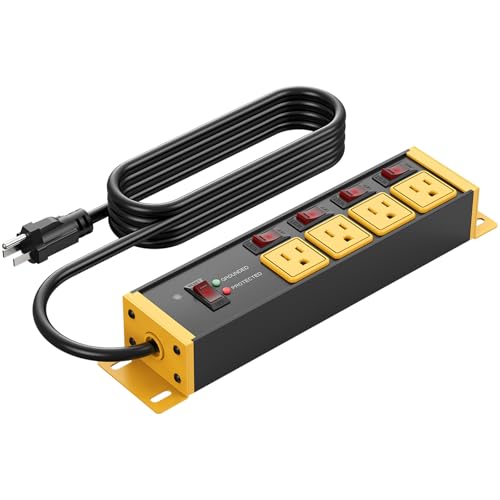

Prices change often; the button shows today's price on Amazon.
Where do the receptacles go?
Put them where cords would otherwise cross a walkway. The rules of thumb that work in a garage shop:
- Along the bench wall: every 4 to 6 ft, at 40 to 48 in off the floor (above the bench top, below the shelf), so cords do not drape over the work. Mount them in metal or plastic boxes on the wall, and use covers that are rated for the environment.
- Each wall: at least one receptacle on every wall of the garage, at 18 in or 48 in height, for general use. The 18 in height is vulnerable to a car bumper and a hose; the 48 in height clears them.
- Ceiling: a ceiling drop or an overhead receptacle for the garage door opener and for machines in the middle of the floor. A drop with a retractable reel reaches a table saw without a cord on the floor.
- Machine-side: a receptacle within the cord length of each stationary machine, placed where the cord does not cross the infeed or outfeed path. A table saw's stock lane runs 14 to 16 ft for 8 ft boards, so the receptacle belongs on the side, not on the lane.
- Near the car: a weatherproof or protected receptacle for a vacuum, a battery charger or a plug-in EV charger. See EV charger and workshop 240V sharing.
Keep the car in the plan. A receptacle at 18 in on the car side wall can end up behind a car door or under a bumper. Check with the car parked, using the park-the-car calculator, and see the 22 x 22 woodshop layout for where machines and wall power meet.
GFCI, outlets and code basics
Garage receptacles are required to have ground-fault circuit-interrupter (GFCI) protection in the NEC editions most places have adopted, and recent editions extend GFCI to more outlets and to 240V receptacles in garages. The details depend on the edition and your local amendments, so ask your electrician or your building department what applies. Use a GFCI breaker or a GFCI receptacle, test it monthly, and expect nuisance trips with some older motors; if a machine trips a GFCI, have it looked at rather than bypassing the protection.
Other basics worth knowing, with the caveat that your local code and inspector decide:
- Permits and inspections are required for new circuits in most places. The permit is the thing that makes your insurer, a buyer and the next owner trust the work.
- Box fill, cable protection and support rules apply. Exposed cable in a garage needs protection from damage in many cases, which is why conduit or surface raceway is common on garage walls.
- Do not daisy-chain power strips. A power strip is for small loads; a heavy-gauge strip such as the CCCEI 12-gauge surge protector is for chargers and small tools, not for a saw.
- Label the panel. A shop with six circuits and no labels turns a problem into a puzzle.
Do-it-yourself work depends on where you live. Some places allow homeowner electrical work with a permit and inspection; many require a licensed electrician. The dangerous parts are inside the panel and the choices of wire size, breaker type and grounding. Even a confident DIYer benefits from an electrician reviewing the plan. Never work inside a live panel.
Cords, reels and temporary power
Extension cords are tools, not wiring. If you must use one, use the right gauge and the shortest length. A 12/3 cord such as the 50 ft heavy duty 12/3 cord suits a 15 A load; a 50 ft 10/3 cord is heavier for long runs and bigger loads. A cord reel such as the DEWENWILS 40 ft retractable reel, 12 AWG, 15 A stores the cord and keeps it off the floor, but unwind a reel fully before you use a high load, because a coiled cord under load heats up. Never daisy-chain cords or use a cord as permanent wiring, and never run a cord under a rug, through a door or across a driveway.
A cord's length matters for voltage drop. A motor on a 100 ft thin cord loses voltage and runs hot. Use the calculator to check, and when in doubt, move the machine closer to the outlet, or add an outlet. Cords with damaged jackets, exposed conductors or a missing ground pin go in the trash.
Test what you plug into. A receptacle tester such as the Klein RT210 checks for correct wiring, open ground and reversed polarity, and tests a GFCI. Run it on every outlet when you move in and again after any electrical work. A clamp meter such as the Klein CL120 reads the real current in a cord, which tells you whether a machine draws what you think it does.
Subpanel or not
If the garage has no spare breaker slots, if the main panel is far away, or if you need four or more shop circuits, an electrician will often install a subpanel in the garage fed by one larger breaker in the main panel. A subpanel puts the breakers where you work, which is safer in an emergency and convenient for resets. A main lug load center such as the View-Pak Siemens E0204ML1060SU is the type used. The feeder size comes from the load calculation. For a woodshop that works out near 40 A of demand, a 60 A subpanel is a starting point to ask about, and welding or auto packages near 100 A. See how to install a 240V outlet in a garage and the install cost calculator.
The decision turns on your service: whether your main panel can carry the added load. That is the electrician's calculation. Ask for it in writing.
A walkthrough: planning outlets for a 22 x 22 ft woodshop
To make the plan concrete, take the woodshop package that fits a 22 x 22 ft garage. Our sizing page lists 7 circuits, one at 240V, about 40 A of demand and a 60 A subpanel to ask about. A reasonable outlet plan, to bring to an electrician as a starting point:
- Back wall bench: one 20 A, 120V circuit, three duplex receptacles at 48 in over a 6 ft bench.
- Table saw wall: one 20 A, 120V circuit (or a 240V circuit if you buy a 240V saw) with a receptacle on the wall beside the saw, not in the stock lane.
- Dust collector: its own circuit at the collector's corner, 120V for a 1-1/2 HP unit or 240V for a 3 HP unit.
- Second machine circuit: a 20 A circuit for the bandsaw, jointer and planer wall, with receptacles every 6 ft.
- Air filter and lights: a 15 A circuit with the lights, and the hanging filter on a ceiling receptacle.
- Car side: a GFCI receptacle at 48 in for a vacuum and a charger.
- Spare: a conduit stub and two spare breaker spaces.
That plan lands near the seven circuits the sizing page counts, and a 60 A subpanel gives room to add. It is a planning sketch, not a design: the electrician checks the service, the load calculation, the wire and the code. Compare with the 22 x 22 woodshop layout, which shows where the machines sit, and adjust receptacle positions to match yours.
Get the garage shop planning checklist
One printable page: measure the bay, count the circuits, list the machines, check the floor. Plus a few short emails, then a couple a month at most.
Unsubscribe anytime. You can also just read the checklist on this site.Frequently asked questions
How many outlets should a garage workshop have?
Receptacles every 4 to 6 ft along the bench wall, at least one on every wall, a ceiling drop for the middle of the floor and a receptacle within cord reach of each stationary machine. Our woodshop package needs 7 circuits.
Should garage shop circuits be 15 A or 20 A?
Use 20 A circuits on 12 AWG copper for 120V shop machines. NEC Table 430.248 puts a 1-1/2 HP motor at 20 A at 115V, which is more than a 15 A circuit. Machines over about 2 HP are candidates for 240V.
Do garage outlets need to be GFCI?
In the NEC editions most places have adopted, yes, with the scope depending on the edition and local amendments. Ask your electrician or building department which applies, and test GFCIs monthly.
Can I run an extension cord to a table saw?
For temporary use, with a heavy enough gauge such as 12/3 or 10/3 and the shortest length possible. A permanent shop needs a receptacle near the machine, because voltage drop starves motors on long thin cords.
Do I need a permit to add outlets in my garage?
In most places, yes, for new circuits. Rules about who may do the work differ. Ask your local building department and have a licensed electrician confirm the plan.
This page is researched guidance, not professional electrical, engineering or safety advice. Circuits, loads and clearances depend on your house, your service and your town: have a licensed electrician confirm any wiring, and check local code and each manufacturer's manual before you act.
