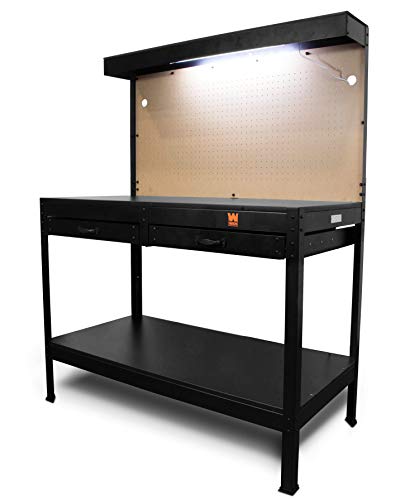
Workbench
Workbench with power outlets for a garage
A workbench with built-in outlets keeps cords off the floor, but a built-in strip is one circuit: 15 A at 120V is 1,800 W, or about 1,440 W continuous. Do not run a vacuum, a sander and a charger through it together. For a working bench, add a dedicated 20 A circuit on 12 AWG with receptacles every 4 to 6 ft at 40 to 48 in, GFCI protected, and have a licensed electrician do the circuit.
Is a workbench with built-in outlets enough power?
For hand tools, chargers and one tool at a time, yes. For a shop where you run two tools together, no, because every outlet on the bench shares the circuit that feeds the bench. A 15 A, 120V circuit supplies 1,800 W at most, and the code treats loads that run for three hours or more as continuous, limited to 80 percent, which is 1,440 W. A 20 A circuit supplies 2,400 W and 1,920 W continuous. A bench with six outlets is still one circuit, and the circuit decides what you can do at once, not the number of holes.
Look at what the bench listing offers. The WEN WB4723T 48 in workbench lists power outlets and a light. The CAMMOO 48 in adjustable bench and CAMMOO 48 x 24 in bench with storage list a pegboard and a power strip. The Grizzly T34010 (4 ft) and T34011 (6 ft) are adjustable heavy-duty benches with outlets. Each of those is convenient, and each is plugged into one wall receptacle by a cord. Check the amp rating on the listing; if it is a 15 A strip, treat it as a 15 A circuit, and if the cord is thin, treat it as the weak point.
What a bench actually draws
Loads at the bench vary. Some figures are in our Grizzly briefs: the T34608 benchtop drill press lists 5.3 A, the G4000 lathe 9 A, the G0704 mill/drill 12 A, the G0602 lathe 13.6 A and the G0945 jointer 10 A. Hand power tools, sanders, soldering irons, a shop vacuum and chargers have ratings on their nameplates; read them, since we do not have a figure for those. A rule for planning: add the nameplate amps of whatever might run at the same moment, and compare with 12 A on a 15 A circuit or 16 A on a 20 A circuit (80 percent for sustained loads).
| Combination at the bench | Amps (listing) | On a 15 A circuit | On a 20 A circuit |
|---|---|---|---|
| Drill press (T34608) alone | 5.3 | Fine | Fine |
| Drill press + jointer (G0945) | 15.3 | Over the breaker | Under 20 A, over 16 A sustained |
| Lathe (G4000) alone | 9 | Fine, little room | Fine |
| Mill/drill (G0704) alone | 12 | At the 80 percent line | Fine |
| Lathe (G0602) alone | 13.6 | Close to the breaker | Fine |
These are motor nameplate figures; starting current is higher briefly, and breakers allow for it. Whether a particular circuit is adequate is the electrician's judgment under NEC Article 430 and Table 430.248; the workshop amps calculator adds a list of machines. Our sizing for the machine shop that fits a 22 x 22 ft garage is 5 circuits, none 240V, about 22 A of demand, and a 60 A subpanel to ask about; see that page.
Give the bench its own circuit
The upgrade that matters most is a dedicated 20 A, 120V circuit for the bench wall. It uses 12 AWG copper (NEC Table 310.16, 60 C column: 14 AWG 15 A, 12 AWG 20 A, 10 AWG 30 A) and a 20 A breaker. It feeds receptacles along the wall, and nothing else, so the bench does not compete with the lights or the opener. If you are building a shop, plan this circuit before you buy the bench; a bench with a built-in strip then plugs into a receptacle that can supply it.
Why not simply use a bigger strip? Because the strip is not the limit; the circuit is. A heavy-gauge strip like the CCCEI 12-gauge 6 ft surge protector is a good strip, and it is still limited by the breaker on the wall. Do not daisy-chain strips, do not run a strip into an extension cord into a strip, and do not use a power strip for a table saw, a heater or a compressor.
A second circuit helps for a two-person bench or a bench with a machine. Split the bench wall into two 20 A circuits, alternating receptacles, so the vacuum and the sander are on different breakers. This is the same logic as the kitchen counter. Ask your electrician about it, and see how to run outlets in a garage shop for the whole-shop plan and 240V in a garage explained for when a 240V receptacle at the bench makes sense.
Benches with outlets, strips and testers


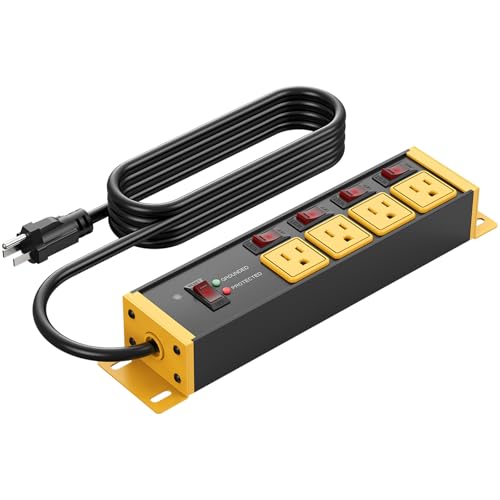


Prices change often; the button shows today's price on Amazon.
Amazon and Grizzly, side by side
Each card shows an Amazon pick and a Grizzly Industrial pick for the same job.
4 ft adjustable workbench
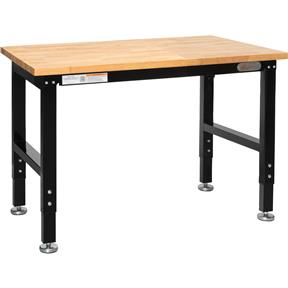
Pick the Amazon bench for the lowest entry cost; pick the Grizzly bench if you want outlets built into the bench and a direct parts line.
6 ft adjustable workbench

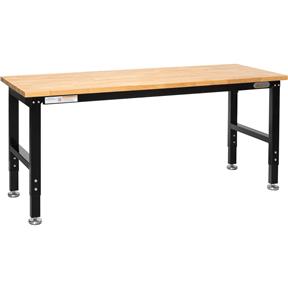
Choose the Amazon bench to keep spending down; choose the Grizzly bench when you run power tools on it every weekend and want the built-in outlets.
Prices change often and Grizzly runs sales, so the buttons show current prices.
Where the receptacles go on a bench wall
- Height. 40 to 48 in off the floor, above the bench top, so cords do not run across the work and the box is clear of the clamps and the vise. If the bench is adjustable, mount the receptacles above the highest top position, or on the bench itself.
- Spacing. Every 4 to 6 ft, or at least one pair per 4 ft bench. More outlets, fewer strips.
- Ends. A receptacle at each end of the bench for chargers and for a tool that stays plugged in.
- Overhead. A ceiling drop above the bench for a hanging cord reel, so cords come down from above instead of across the work.
- Light. The fixture over the bench is on the lighting circuit, not the bench circuit. See how to hang lights.
In a garage with a car, check the receptacle height against the car. An outlet at 18 in on the side wall can sit behind a car door; at 48 in it is clear of the car's body. A bench on a wall beside the car's nose can have receptacles on the back wall, and the car's front bumper can hit the lower ones. Use the park-the-car calculator, and see garage workbench and storage.
GFCI, wiring and what to leave to a pro
Garage receptacles require ground-fault circuit-interrupter protection in the NEC editions most places have adopted; the scope depends on the edition and local amendments. The usual solution is a GFCI breaker on the circuit or a GFCI receptacle first on the circuit, with the rest downstream. A GFCI protects you from a ground fault through your body and trips at a low leakage current. Test it monthly and replace it if it fails. A receptacle tester such as the Klein RT210 checks wiring and the GFCI trip.
New circuits are electrician work in many places, and a permit and inspection are normal. The dangerous parts are inside the panel and the choices of wire size, breaker, grounding and box fill. A good division of work: you plan the layout and run the surface boxes and conduit where the code allows; the electrician connects the panel and signs off. Never work in a live panel. Source for the numbers on this page: NEC Table 310.16, Table 430.248 and the general rule that continuous loads are limited to 80 percent of the breaker; have a licensed electrician confirm what applies to your garage.
Surface raceway on a finished wall is a clean way to add outlets to a garage without opening the wall. A metal or plastic channel carries the cable up the wall to boxes at the bench. The wall can stay intact, and a later change is easy. Check what is allowed in your jurisdiction.
Cord reels, extension cords and voltage drop
When the bench rolls, or the receptacle is far away, a cord supplies the power. Cord length costs voltage. The drop in volts over a run is 2 x 12.9 x amps x one-way feet divided by the wire's circular mils (NEC Chapter 9 Table 8: 14 AWG 4,110, 12 AWG 6,530, 10 AWG 10,380). At 15 A over 50 ft that is 4.7 V for 14 AWG (3.9 percent of 120V), 3.0 V for 12 AWG (2.5 percent) and 1.9 V for 10 AWG (1.6 percent). The guideline is under 3 percent, so a 14 AWG cord at 15 A and 50 ft misses it and a 12 AWG cord meets it. Motors run hot on a starved supply. The voltage drop calculator runs your length.
Pick the cord for the load. A 50 ft 12/3 heavy duty cord suits 15 A at that length; a 50 ft 10/3 SJTW cord is heavier for long runs and bigger loads. A retractable reel such as the DEWENWILS 40 ft 12 AWG, 15 A reel stores the cord on a ceiling bracket above the bench and drops it where needed. Unwind a reel fully under load, because a coiled cord under load heats up. Do not use a cord as permanent wiring, do not run it through a door or under a mat and replace any cord with a damaged jacket or missing ground.
For a rolling bench, see rolling workbench for a garage: a ceiling reel and a short bench cord follow it without dragging a long cord across the floor.
A power plan by bench
4 ft bench in a one-car garage. One dedicated 20 A circuit on the bench wall with two duplex receptacles at 48 in, a bench with a built-in strip plugged into it, and a clip light. Keep the vacuum on a different circuit.
6 ft adjustable bench in a two-car garage. Two 20 A circuits alternating along the wall, a ceiling drop for a cord reel and a 4 ft fixture overhead. See best garage workbench.
Machine bench. A 20 A circuit per machine or per pair, based on the nameplate amps in the table above. See metalworking bench for a garage machine shop.
Fold-down bench. A receptacle on the wall above the folded top, switched strip on the wall, nothing on the top that gets crushed. See fold-down workbench.
What to ask for when you plan the bench circuit
If you are working with an electrician, a clear brief gets a better quote. For the bench wall, bring:
- A drawing of the bench wall with the bench length, the pegboard and shelf positions and the car's parking spot.
- A list of what will plug in at the bench: tools with nameplate amps, chargers, a vacuum, a radio, a light.
- Your preferred height for the receptacles (40 to 48 in) and the spacing (every 4 to 6 ft).
- Whether you want one or two 20 A circuits, and a ceiling drop for a cord reel.
- Your question about GFCI: breaker or receptacle, and what the local code requires.
- Whether the wall is finished, and whether you prefer concealed cable, conduit or surface raceway.
Ask for the receptacle type and amp rating to be stated on the quote, and for the circuit to be labeled at the panel. Keep a photo of the wiring before the wall closes. Source for planning numbers: NEC Table 310.16 for wire and NEC Table 430.248 for motors; the electrician confirms with the code adopted in your area and handles the permit. The install cost calculator adds the quote pieces if you want a budget before you call.
Get the garage shop planning checklist
One printable page: measure the bay, count the circuits, list the machines, check the floor. Plus a few short emails, then a couple a month at most.
Unsubscribe anytime. You can also just read the checklist on this site.Frequently asked questions
Is a workbench with built-in outlets worth it?
Yes for convenience: cords stay off the floor. But the built-in strip is a single circuit, usually 15 A, so it does not let you run several tools at once. Add a dedicated 20 A circuit for real work.
How many outlets should a garage workbench have?
A duplex receptacle every 4 to 6 ft along the bench wall, at least one pair at each end of the bench, and an overhead drop for a cord reel, on one or two dedicated 20 A circuits.
How high should outlets be above a workbench?
About 40 to 48 in off the floor, above the bench top and clear of the vise and clamps. If the bench height adjusts, mount above the highest position.
Do I need GFCI outlets at my garage workbench?
In the NEC editions most places have adopted, garage receptacles require GFCI protection. The scope depends on your local edition, so ask your electrician or building department, and test the GFCI monthly.
Can I run a table saw off a bench power strip?
No. A strip is for chargers and small tools. A table saw needs its own circuit; a 2 HP saw lists 15 A at 120V or 7.5 A at 240V on the Grizzly G0771Z, more than a 15 A strip circuit can share.
This page is researched guidance, not professional electrical, engineering or safety advice. Circuits, loads and clearances depend on your house, your service and your town: have a licensed electrician confirm any wiring, and check local code and each manufacturer's manual before you act.
