
Workbench
Assembly table vs workbench for a garage
Buy the workbench first. A workbench holds the work at elbow height with a vise and storage; an assembly table is a lower, flatter, bigger surface (often 4 x 8 ft) for glue-ups, panels and big projects. A 4 x 8 ft table needs about 10 x 14 ft of floor with 36 in aisles, so it belongs in a two-car bay or on casters. In a one-car garage, use the table on wheels as an outfeed table and bench in one.
What is the difference between an assembly table and a workbench?
A workbench is a tool for holding work while you cut, shape and fit it. It is solid, heavy, set at a height that suits hand-tool work (about 33 in for heavy work and 37 in for general work at 5 ft 10 in), has a vise, dog holes or clamping points and usually has storage close at hand. An assembly table is a surface for putting things together: a large, flat, stable top at a lower height (commonly 28 to 34 in), clear of vises and drawers, where a cabinet, a panel glue-up or a door can sit flat and be reached from all four sides. The workbench is a work holder. The assembly table is a platform.
They overlap, and in a small garage one surface often does both jobs. The distinction matters because the two ask for opposite things: a workbench wants to be rigid, anchored and close to the wall; an assembly table wants to be flat, accessible from every side and often mobile. Knowing which job you have most often tells you what to buy. For the bench side, see best garage workbench and garage workbench ideas.
| Feature | Workbench | Assembly table |
|---|---|---|
| Main job | Hold work for hand and power tools | Support and assemble large pieces |
| Height | 33 to 43 in by work (at 5 ft 10 in) | About 28 to 34 in |
| Size | 4 to 6 ft x 24 to 30 in | 3 x 6 to 4 x 8 ft |
| Vise | Yes | No |
| Storage | Drawers, pegboard, shelf | Open or shelf below |
| Position | Against a wall | Free-standing, access on 4 sides |
| Mobile? | Often fixed | Often on casters |
| Floor use | Bench + aisle in front | Table + aisle on all sides |
Floor space: the number that decides it
An assembly table needs access on all four sides. With a 36 in working aisle all around, the floor is the table plus 6 ft in each direction.
| Table | Top area | Floor with 36 in aisles all round |
|---|---|---|
| 2 x 4 ft | 8 sq ft | 8 x 10 ft = 80 sq ft |
| 3 x 5 ft | 15 sq ft | 9 x 11 ft = 99 sq ft |
| 3 x 6 ft | 18 sq ft | 9 x 12 ft = 108 sq ft |
| 4 x 8 ft | 32 sq ft | 10 x 14 ft = 140 sq ft |
Compare with the bays: a 12 x 20 ft one-car bay is 240 sq ft and a sedan takes about 100 sq ft of floor with its walk-around, so even a 3 x 5 ft table with full aisles (99 sq ft) does not fit with a car in. A 20 x 20 ft two-car bay is 400 sq ft; a sedan on one side leaves a shop strip about 9 to 11 ft wide, so a 4 x 8 ft table with aisles (10 ft wide) is tight, and a 3 x 6 ft table fits. A 22 x 22 ft bay (484 sq ft) holds a 4 x 8 ft table next to a car. A 24 x 24 ft or 32 x 24 ft bay holds one comfortably. The widths are rough; run yours in the garage shop layout calculator.
The way out of the arithmetic is to push the table against a wall when you do not need all four sides. A 4 x 8 ft table against a wall needs only three aisles, 4 x 8 plus 3 ft on three sides: 7 x 11 ft = 77 sq ft. Put it on casters and it takes the full floor only for the glue-up; see rolling workbench for a garage.
The table saw outfeed trick
In a garage, the best assembly table is also the outfeed table for the table saw. The saw's own table height is listed: the Grizzly G0771Z lists 35-3/8 in and the G1023RL 34 in. A table set a hair below the saw table height supports a long board coming off the blade, and on other days it is the assembly surface. To do this, the assembly table height needs to match the saw, which is a few inches higher than a typical assembly table; compromise by building the table to the saw height and using a mat or a sheet on top for lower work, or build the table adjustable.
Check the stock lane: for an 8 ft board, the lane is the machine depth plus 1.5 times the stock, about 14 to 16 ft, so the table sits in line with the saw in the lane's outfeed half. In a two-car bay with the saw on one wall, the table goes in the outfeed zone, on locking casters, and rolls out of the way when you assemble. A bench on casters with a smooth top and no vise doubles as the outfeed. The Betterhood 70 in adjustable-height bench and the VEVOR 72 in adjustable bench lists adjustable height, which lets you match the saw table; check each listing for the height range and the load. See workbench height and best table saw for a garage shop.
Benches, bases and clamps


Prices change often; the button shows today's price on Amazon.
Amazon and Grizzly, side by side
Each card shows an Amazon pick and a Grizzly Industrial pick for the same job.
6 ft adjustable workbench
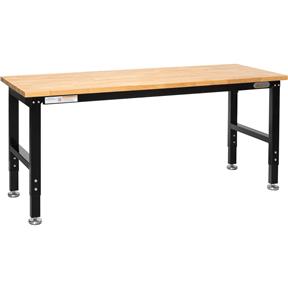
Choose the Amazon bench to keep spending down; choose the Grizzly bench when you run power tools on it every weekend and want the built-in outlets.
Hardwood-top workbench
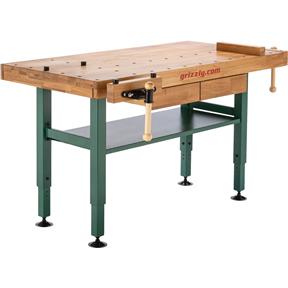
The Amazon bench is a height-adjustable hardwood top; the Grizzly bench is a fixed heavy-duty oak top on steel legs for a bench that never moves.
Prices change often and Grizzly runs sales, so the buttons show current prices.
Flat, rigid and mobile: what an assembly table needs
Flat. A glue-up on a twisted surface comes out twisted. Check the top with a straightedge and shim the legs until the top is flat, not just level. A torsion-box top (two skins of thin plywood over a grid) is very flat and light; a laminated plywood top on a braced frame is simple. A solid core door is a cheap flat top. See garage workbench top ideas.
Rigid. The frame must not rack when you clamp and lift. Braces and a plywood back or lower shelf keep it square. An assembly table does not need the weight of a machine bench, but it does need to not wobble.
Mobile, usually. In a garage the table earns its place by rolling. Casters need total locks and a rating of twice the load; a 4 x 8 ft sheet-goods table with a cabinet on it can weigh several hundred pounds. The VEVOR 1,500 lb mobile base lists an adjustable footprint of 18 x 24 in to 26.5 x 31.5 in, which suits a pair under a table end; check the listing for the wheels and whether you need four. A base rated for 1,500 lb gives margin for most assembly tables, but weigh the table honestly. The mobile base sizing calculator helps.
Clamp-friendly. An open edge with no apron lets clamps grab the top. Add a grid of holes if you want dogs and stops. Keep it clear: an assembly table that becomes a storage shelf stops being a table.
Which should you buy first?
The workbench. A workbench with a vise and storage supports the daily jobs, and a plain top on sawhorses or a 4 x 8 sheet of plywood on two horses handles occasional assembly for almost nothing. Buy or build the assembly table when you find yourself doing big glue-ups, building cabinets or door frames and needing the flat surface and the room all around it.
- 12 x 20 ft one-car: a fold-down or rolling bench. Use a sheet of plywood on horses for assembly outside, or on the apron with the car out.
- 12 x 22 ft one-car: a 4 ft wall bench; assembly on a 2 x 4 ft rolling table that doubles as a cart.
- 20 x 20 and 22 x 22 ft two-car: a 6 ft adjustable-height bench on the shop wall and a 3 x 6 ft assembly table on casters. See the 22 x 22 woodshop layout.
- 24 x 24 and 32 x 24 ft: both, plus a dedicated outfeed table. A 4 x 8 ft assembly table fits comfortably.
A third option is an adjustable-height bench that works as both: set low for assembly, mid for general work. The Grizzly T34011 is a 6 ft adjustable heavy-duty bench with outlets, and the T10157 is an oak bench for the fixed role. Clamps make assembly work; the JORGENSEN 36 in parallel bar clamps and the BESSEY K Body REVO kit are the sort used for glue-ups. See vises and clamps for a garage workbench.
Making one table do both jobs
If you cannot have two surfaces, make one that does a reasonable job of both. Choose an adjustable-height bench of 6 ft by 24 to 30 in with a flat top, no front vise, and a clamp-on vise you can remove for assembly. Put it on locking casters or a mobile base rated well above its weight and park it against the wall for bench work and in the middle for assembly. Add a pull-out or drop-leaf extension to widen it when needed. Use a mat on the top for protection, and a sacrificial hardboard skin.
The compromise is worth making in a one-car garage. The fixed versus mobile workbench page covers the trade-offs, and workbench size for a one-car garage covers what fits behind the car. A 6 ft by 24 in bench on casters, with no vise, a smooth top and a height matched to your saw, is a surface that is an outfeed table, an assembly table and a bench in a garage that has room for none of them separately. Lock the wheels, keep the floor clear and leave the 36 in aisle.
Building an assembly table that earns its floor space
If you decide to build one, a simple, flat, mobile table is a weekend project. A workable design for a garage:
- Size. 3 x 6 ft for most garages, 4 x 8 ft if you have a 22 x 22 ft bay or larger and build with sheet goods.
- Frame. A perimeter of 2 x 4 lumber on edge with cross members every 16 in, and four to six legs of 4 x 4 or doubled 2 x 4, with diagonal braces or a plywood lower shelf to stop racking.
- Top. A 3/4 in plywood sheet screwed to the frame, with a second sheet or a hardboard skin on top. Do not glue the skin down, so you can replace it. A torsion box makes a lighter, flatter top if you want to build one.
- Height. Set it by the job: 28 to 34 in for assembly; match your saw table if the table doubles as outfeed (35-3/8 in for the Grizzly G0771Z, 34 in for the G1023RL).
- Casters. Four total-lock casters, rated at twice the loaded weight, with the frame sized for the height they add.
- Edges and extras. Round the corners, leave the edges free of an apron so clamps can grab, and add a shelf below for clamps and glue.
Keep it clear. An assembly table works only when the top is empty, so give the clutter somewhere else to live; see garage workbench and storage. For top material, see garage workbench top ideas, and for the clamps that make assembly work, vises and clamps.
Get the garage shop planning checklist
One printable page: measure the bay, count the circuits, list the machines, check the floor. Plus a few short emails, then a couple a month at most.
Unsubscribe anytime. You can also just read the checklist on this site.Frequently asked questions
What is the difference between a workbench and an assembly table?
A workbench holds work at elbow height with a vise and storage, close to a wall. An assembly table is a lower, flatter, larger surface reached from all sides for glue-ups and big projects, often on casters.
How big should an assembly table be for a garage?
A 3 x 6 ft table fits a 22 x 22 ft bay beside a car with 36 in aisles; a 4 x 8 ft table needs about 10 x 14 ft of floor with aisles on all sides. In a one-car garage, use a 2 x 4 ft rolling table.
How high should an assembly table be?
About 28 to 34 in, lower than a bench for general work, so large pieces sit at a comfortable height. If it doubles as a table saw outfeed table, match the saw height: 35-3/8 in for the Grizzly G0771Z.
Can a workbench be used as an assembly table?
Yes, if it is flat, large enough and reachable from enough sides. A rolling, adjustable-height bench with a removable vise does both jobs in a small garage.
Do I need an assembly table in a one-car garage?
Rarely. A 12 x 20 ft garage with a car has no floor for one. Use a sheet of plywood on sawhorses, or a rolling table that doubles as the bench, and assemble with the car out.
This page is researched guidance, not professional electrical, engineering or safety advice. Circuits, loads and clearances depend on your house, your service and your town: have a licensed electrician confirm any wiring, and check local code and each manufacturer's manual before you act.
