
Workbench
Garage workbench top ideas
For most garage benches, laminate two layers of 3/4 in plywood into a 1-1/2 in top and cover it with a replaceable hardboard skin. Choose hardwood for a bench that does vise and hand-tool work, steel only for welding and heavy metalwork, and avoid bare MDF where moisture or oil is present. A top is only as flat as its frame, so check the legs and the slab before you blame the material.
What is the best material for a garage workbench top?
The best top is the one that matches the work and survives the garage. A garage is harder on a bench than an indoor shop: the humidity swings, the slab is damp, the temperature moves and oil, glue and solvent end up on the surface. That leans the choice toward materials that stay flat when the air changes, can be cleaned or replaced, and carry the weight of the work. Five materials cover nearly every garage bench.
| Top | Good for | Weak at | Garage verdict |
|---|---|---|---|
| Hardwood (maple, oak, beech) | Vise work, hand tools, a bench for life | Cost, movement with humidity | Best for woodworking benches; seal it |
| Laminated plywood (2 x 3/4 in) | General work, all-round | Edge chipping | Best value; the default pick |
| MDF or hardboard skin | A flat, replaceable surface | Moisture, impact, edges | Use as a sacrificial layer, not the structure |
| Steel plate or sheet over a frame | Welding, heavy metalwork, magnets | Rust, cold, noise, dents tools | Best for fab; not for fine woodwork |
| Laminate or melamine | Clean assembly, electronics, finishing | Chips, heat, poor grip | Fine over a sturdy core, easy to wipe |
The pre-built benches in our catalog span these. The VEVOR 72 in bench lists an adjustable height and a hardwood worktop, and the Grizzly T10157 is a heavy-duty oak bench on steel legs. The Betterhood 70 in and CAMMOO 48 in benches list 2,000 lb maximum loads; check each listing for what the top is made of and its thickness, since the material is a detail we do not have in our own data.
Thickness: why 1-1/2 inches is the number
A thick top resists sagging, dents and the hum of a vibrating tool. A single 3/4 in sheet of plywood flexes between legs and rings when you hammer it. Two layers glued and screwed together make 1-1/2 in, which is the usual target for a general bench. Hardwood tops are commonly 1-1/2 to 3 in thick in a traditional woodworking bench, and a heavy machine bench benefits from the extra mass. The flex of a top over a span goes down rapidly with thickness and with support spacing, so a top over a frame with a stretcher every 24 to 30 in can be thinner than one over four legs.
A 4 x 8 ft sheet of plywood covers 32 sq ft. Two 2 x 6 ft benches use one sheet if you cut them from the same stock, and the offcuts make shelves. Edges matter: a hardwood edge strip on the front of a plywood top protects the edge, takes clamp pressure and hides the plies. Round or chamfer the corners so a hip does not bruise.
Weight is a feature. A heavy top keeps a bench from creeping across the slab under a plane or a saw. If the bench has to move, use locking casters and accept some movement; see rolling workbench for a garage. If it does not have to move, a heavy top and bolting the frame to a wall stud is the stable option.
Hardwood: the bench for a life of work
Hardwood is the traditional top for a bench that sees planing, chopping and vise work. Maple, beech and oak are common. A laminated top of 1-1/2 to 2-1/2 in strips glued edge to edge is stable, flat when milled well and repairable by planing. It also holds dog holes, vise hardware and holdfasts.
The cautions are cost and movement. Solid wood changes size across the grain as humidity changes; a garage that swings from dry to damp will move a wide hardwood top, which is why laminated strips and an oil or varnish finish matter. Seal all surfaces, including the underside, and keep the bench off a wet slab. Do not use hardwood where you weld or grind sparks; a spark can scorch it and slag will burn it. Pair a hardwood top with a vise: the Grizzly H7788 cabinetmaker's vise or the IRWIN 6-1/2 in woodworker's vise, or a metal vise for general work. See vises and clamps for a garage workbench.
If you buy rather than build, the Grizzly T10157 (oak top on steel legs) and the VEVOR 72 in are the hardwood choices in our data. Compare them in best garage workbench.
Benches with ready-made tops


Prices change often; the button shows today's price on Amazon.
Amazon and Grizzly, side by side
Each card shows an Amazon pick and a Grizzly Industrial pick for the same job.
Hardwood-top workbench
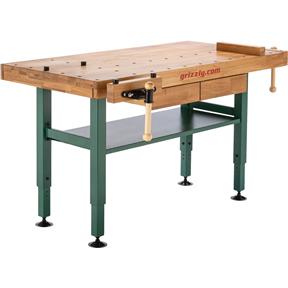
The Amazon bench is a height-adjustable hardwood top; the Grizzly bench is a fixed heavy-duty oak top on steel legs for a bench that never moves.
6 ft adjustable workbench
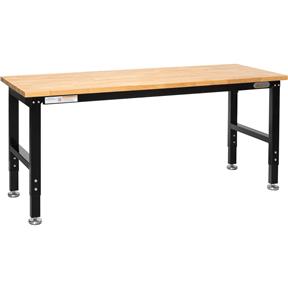
Choose the Amazon bench to keep spending down; choose the Grizzly bench when you run power tools on it every weekend and want the built-in outlets.
Prices change often and Grizzly runs sales, so the buttons show current prices.
Plywood and MDF: the practical choices
Laminated plywood. Two layers of 3/4 in plywood, glued and screwed from below, give a flat 1-1/2 in top at a fraction of hardwood cost. Birch or maple plywood is smoother and stronger than construction grades. Band the edges with hardwood. Finish with several coats of a wipe-on varnish or oil so spills do not soak in. It is the best-value garage top.
MDF and hardboard. MDF is very flat and smooth but swells and crumbles when wet, chips at the edges and takes screws poorly. Hardboard (tempered) is thin, smooth and cheap. Both are best as a skin: screw a sheet of hardboard on top of a plywood core, and replace the skin when it is cut up or stained. That way, the working surface is always fresh and the core never gets damaged. Seal the edges of any MDF with paint or varnish, and keep it off a damp slab. Do not use MDF for the structure of a bench that will see weight on the edges.
Solid-core doors. A flat, solid slab door is a classic cheap top that is flat and heavy. Check that it is solid and flat, and note that hollow-core doors are flimsy and dent under a hammer.
All wood tops should be flat when you start. Check with a straightedge across and along, and plane or shim as needed. A top flat to within a small fraction of an inch is enough for most garage work; a top for layout on a precision bench should be flatter. The frame under it must be square and level or the top will rock; see the slope warning in garage woodshop flooring.
Steel and laminate tops
Steel. A steel top is for welding and metalwork. Plate or heavy sheet stays flat under heat when it is thick, holds magnets and clamps, and does not burn. The downsides are rust, cold, noise and the fact that dropped tools dent and ring on it. In a humid garage, wipe the steel and use an inhibitor such as Boeshield T-9, which is sold for tools and machinery; do not apply it to a weld surface or anywhere it will contaminate a joint. A steel top on a cart, such as the YESWELDER 2-tier welding cart with drawers and cylinder slots, is the practical welding bench. See welding table for a garage and garage shop fire safety.
Laminate and melamine. A plastic laminate top over a plywood or particleboard core is smooth, easy to clean and good for finishing, electronics and clean assembly. It resists glue (which pops off cured) and many solvents. It chips at the edges, scratches with abrasive work, burns from a soldering iron or a hot tool, and is slippery for a part you want to stay put. A laminate surface over a solid core is a good second bench for a mixed shop.
Rubber or cork over the top. A mat on the bench surface helps fragile parts and electronics, but it makes the surface less flat. Use it as a working mat on a flat top and not as a replacement.
Finishing and maintenance for a garage top
A bench top finish has to survive spills and be easy to renew. For wood, a penetrating oil or a wipe-on varnish is a good choice, because you can re-coat the worn spots without stripping the whole top. Avoid a slick film finish like a heavy gloss, which makes parts slide. Keep glue off with wax paper and scrape dried glue with a sharp scraper. Do not use a finish that interacts with your work: oil can stain a pale wood project. For a bench that sees only metalwork, bare steel with oil is fine.
Give the bench top a replaceable sacrificial layer where you can. A sheet of hardboard on top of the core catches the cuts, drills and glue, and costs very little to replace. A drill press bench benefits especially: a scrap board under the work protects the top from drill-through. For clean assembly, a flat cutting mat keeps the top intact. Wipe the top after every session, and check it for flatness every year; a top that has cupped from a damp slab can be flattened with a plane or a sander, then sealed on every side.
Anti-fatigue mats at the standing spot, such as the Vergo 15/16 in industrial mat, add to the working height, so factor them in when you set the bench height; see workbench height. The garage workbench ideas page shows the ten bench types that these tops go on.
Choosing by garage and work
- Woodworking, one-car bay: a 4 to 6 ft laminated plywood top, 24 in deep, with a hardwood edge and a hardboard skin, on a wall frame or a rolling base.
- Woodworking, two-car bay: a hardwood bench with a vise on the shop wall and a plywood assembly table.
- Machine shop: a thick hardwood or steel-faced top on a steel frame under the lathe and mill; see metalworking bench.
- Welding and fab: steel top, away from wood and combustibles.
- Mixed shop with a car: a plywood top on a rolling frame with a laminate or hardboard skin, so it moves and wipes clean.
The load rating on a pre-built bench listing is a statement about the bench as a whole. Check what top material and thickness the listing states before you rely on the number, and for a vise or a machine, add support. See how deep should a garage workbench be for the size, and best garage workbench for the products.
Replacing or resurfacing a worn top
A top does not last forever, and replacing it is cheaper than replacing the bench. Signs it is time: deep cuts that catch the work, glue that does not scrape off, a top that has cupped or twisted, soft spots from moisture, or a top that no longer sits flat on the frame.
The options go from light to heavy. For a light fix, scrape and sand, then re-oil or re-varnish. For a medium fix, fasten a new hardboard or plywood skin over the old top, which covers damage without removing anything. For a full fix, unscrew the old top and make a new one. Measure the frame, cut the new top to size, drill pilot holes, and use the same fastener pattern. If the old top was glued on, a heat gun or a patient pry bar will get it off; mind the wiring and outlets underneath.
When you replace, take the chance to improve. Add a hardwood edge, add a lip at the back, upgrade from a single layer to a laminated top, drill a grid of dog holes, or add a flush recess for a power strip. Move the vise hardware while the top is off, and tighten every bolt in the frame. Re-check the height after the new top is on, since a thicker top raises the surface: a 1-1/2 in top replacing a 3/4 in top raises the bench by 3/4 in. See workbench height for what to aim for.
Get the garage shop planning checklist
One printable page: measure the bay, count the circuits, list the machines, check the floor. Plus a few short emails, then a couple a month at most.
Unsubscribe anytime. You can also just read the checklist on this site.Frequently asked questions
What is the best material for a garage workbench top?
Two layers of 3/4 in plywood laminated to 1-1/2 in with a replaceable hardboard skin is the best value. Hardwood suits vise and hand-tool benches, and steel suits welding.
How thick should a workbench top be?
About 1-1/2 in for a general bench. Thinner tops flex and ring, and heavy machine or hand-tool benches benefit from 2 in or more. Support spacing matters as much as thickness.
Is MDF good for a workbench top?
As a replaceable skin over a plywood core, yes. As the structure of a bench in a damp garage, no, because it swells when wet and chips at the edges. Seal the edges.
Can I weld on a wooden workbench?
No. Sparks and slag burn wood. Weld on a steel table or cart, with combustibles cleared, and keep a fire extinguisher close. See our fire safety guide.
How do I keep a garage bench top flat?
Keep it off a damp slab, seal every side including the underside, use laminated strips or plywood rather than a single wide board, and check flatness yearly with a straightedge.
This page is researched guidance, not professional electrical, engineering or safety advice. Circuits, loads and clearances depend on your house, your service and your town: have a licensed electrician confirm any wiring, and check local code and each manufacturer's manual before you act.
