Workbench
Rolling workbench for a garage
A rolling workbench is the right bench for a garage where the car comes and goes, because it parks against the wall and rolls out to work. Add the bench weight, the tools on it and your downward force, then choose casters or a mobile base rated for at least that total, with four locking wheels.
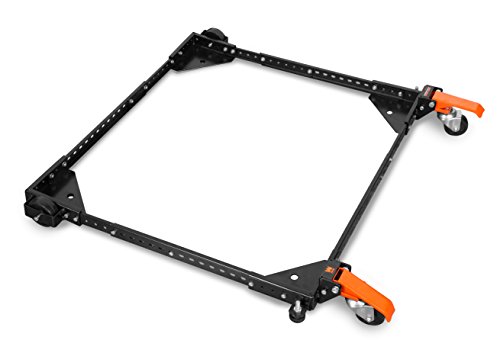
A 48 x 24 in bench on a 500 lb base such as the WEN universal base works for light and medium work; heavy vise work belongs on a fixed bench.
Why does a garage need a rolling workbench?
Because the garage has to be two rooms in one day. A sedan in a 12 x 20 ft bay leaves 3 ft behind the front bumper, and in a 12 x 22 ft bay 5 ft. A fixed bench with a 30 in aisle needs 54 to 66 in of floor, so it fits only the larger bay. A rolling bench takes that floor space only while you work. Roll it out to the middle of the bay or the apron, use it, roll it back against the wall, and park the car. The same logic applies to machines, and the same mobile bases do both jobs; see best mobile base for a table saw.
The trade is rigidity. A rolling bench can move under a plane, a hammer or a vise. That is solvable with locking casters, a heavy build and the right job: assembly, finishing, electronics and layout are good rolling bench work; chopping, heavy vise work and planing a long board are fixed bench work. If you do both, own both: a small fixed bench in the shop corner and a rolling bench that lives under the car's nose when the car is out. See fixed versus mobile workbench for a garage.
Do the load math first
Casters fail when they are under-rated, and the total they carry is bigger than the bench. Add these:
- The bench itself. The listing gives the weight; if it does not, estimate it generously.
- What sits on it. A vise, a benchtop machine (the Grizzly T34608 drill press lists 127 lb), tool boxes, stock.
- Your working force. Leaning, pressing and hammering can add hundreds of pounds momentarily to the top. Plan for a safety factor.
Then compare with the rated capacity of the base or casters. Capacity ratings apply to the set; when four casters share a load on an uneven floor, three may carry most of it, so use a safety factor of 2. A 300 lb bench with 100 lb of tools and a 50 lb machine is 450 lb, and with a safety factor of 2 wants a 900 lb capacity. The WEN universal mobile base is listed at 500 lb, the VEVOR mobile base lists 1,500 lb and adjusts from 18 x 24 in to 26.5 x 31.5 in, and the BORA PM-1100 is a universal kit. Check the listing for the dimensions, the minimum and maximum footprint, and the wheel type. The mobile base sizing calculator checks the footprint and weight together.
Casters: size, material and locking
Caster details decide whether a bench rolls like a cart or like a shopping cart with a bad wheel. Four things matter.
- Diameter. A bigger wheel rolls over cracks, expansion joints and tile edges. Three inches is the practical minimum for a garage slab, and 4 to 5 in is better. Small wheels catch on every crack.
- Material. Hard wheels (nylon, steel) roll easily on a smooth floor and are noisy; soft wheels (rubber, polyurethane) are quiet and grip, and they flatten slightly under a standing load. A rubber or polyurethane wheel is a good compromise for a concrete floor.
- Swivel and rigid. Four swivel casters turn easily but wander; two swivel and two rigid track straight. For a bench moved in short hops, four swivel casters are fine.
- Locks. Every caster should lock both the roll and the swivel (a total-lock caster). Locks that only stop the wheel from turning leave the bench able to pivot. Test the locks under load. A lock that slips on a smooth slab is no lock.
An alternative to four casters is retractable casters or a bench that lifts onto wheels with a foot lever. Those lower the bench onto fixed feet when the bench is in use, so the bench is stable when it is working and mobile when it is not. They cost more and depend on the mechanism, so read the listing for capacity. Another alternative is a hand pallet-style cart that picks up the bench legs; it works for heavy benches and not for frequent moves.
Mobile bases and benches that roll


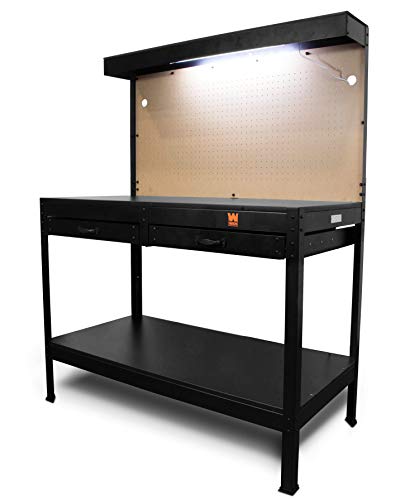

Prices change often; the button shows today's price on Amazon.
Amazon and Grizzly, side by side
Each card shows an Amazon pick and a Grizzly Industrial pick for the same job.
4 ft adjustable workbench
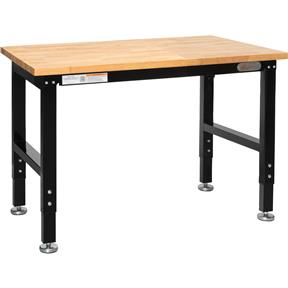
Pick the Amazon bench for the lowest entry cost; pick the Grizzly bench if you want outlets built into the bench and a direct parts line.
6 ft adjustable workbench

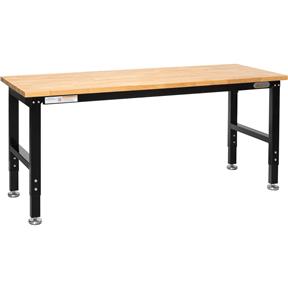
Choose the Amazon bench to keep spending down; choose the Grizzly bench when you run power tools on it every weekend and want the built-in outlets.
Prices change often and Grizzly runs sales, so the buttons show current prices.
Stability: slope, tipping and racking
Garage slabs slope toward the door. A bench on casters will drift downhill if it is unlocked, so lock it, and consider chocks on a steep slope. Test by letting it go on the slab; if it rolls, the slope is more than you think.
Tipping is the second hazard. A tall bench with a heavy shelf or a pegboard above and a vise on one corner is top-heavy. The wider the stance, the stable the bench; a 24 in deep bench with a base narrower than the top is a tipping risk when you load the front edge. Keep heavy items low, keep the center of gravity inside the wheelbase, and do not put a tall shelf on a bench that rolls. Load a drawer cabinet from the bottom up.
Racking is the third. A bench that flexes sideways under a hammer or a planing stroke moves you more than it moves the work. Brace the legs with diagonal members or a plywood back, and fasten the top to the frame. A bench that has to take force can go on a mobile base that sets the bench down on its own feet: a base with lift-and-lock levers does this. When that is not enough, bolt the rolling bench to a wall stud when it is parked, and use a clamp or a dog to hold it to the slab. Never roll a bench with tools piled loosely on it.
Three ways to get a rolling bench
- Put a bench on a mobile base. Take a bench with a stable frame, such as the CAMMOO 48 in adjustable bench or the WEN 48 in bench with outlets and a light, and put it on a base if the dimensions and capacity work. Check that the legs fit the base. Many universal bases adjust to a range; check yours.
- Buy a bench with casters. Many garage workbenches list casters; the listing tells you the rating and the lock type.
- Build one. A frame of 2 x 4 or 2 x 6 lumber, a plywood or hardwood top and four total-lock casters. It is a good first project and it costs little. Make it low and wide for stability.
A rolling chest is the same idea with drawers: a Goplus 5-drawer rolling cabinet with a detachable top box gives a mobile bench top plus storage. See garage workbench and storage. A power cord is the thing that stops a rolling bench: either a cord reel on the ceiling or a bench-mounted strip with a cord long enough to follow it. See workbench with power outlets.
Where does it roll, and where does it park?
The rolling bench needs a parking spot and a working spot. The parking spot is against the back wall or beside the car, out of the 30 in walk-around, ideally under the pegboard and the light it uses. The working spot is the apron in front of the door, or the middle of the bay when the car is out, leaving the 36 in aisle. Mark both on the floor with tape. Mark the lock position, too, so the bench lands in the same place each time and the cord, the light and the pegboard line up.
In a two-car bay with a car in one stall, the rolling bench works in the other stall, and the island layout from garage workbench ideas applies. In a one-car bay, a rolling bench with a fold-down bench behind it is a strong pair: the fold-down is the solid bench and the rolling bench is the flex space. See fold-down workbench for a garage. The 12 x 22 mixed layout shows a bench in the strip behind a car, and the workbench size calculator checks yours.
Do not roll over cords, hoses and offcuts. Keep the path to the door clear, and never leave a rolling bench in front of the house door or a fire exit. Roll slowly; a heavy bench has momentum and your toes are in the way.
Safety checklist for a rolling bench
- Lock all four wheels, and the swivels, every time before you work.
- Do not exceed the rated load, and halve the rating for a safety factor on a slab.
- Keep the load low and centered; never stack a tall tool on a narrow bench.
- Do not use a rolling bench for heavy hammering, long planing strokes or a large vise.
- Check the casters for flat spots, cracks and loose bolts every few months.
- Keep the aisle clear and the cord out of the path.
- Do not use a rolling bench on a steep slope without chocks.
For more on mobile bases and machines, see how to lay out a garage shop. The product list is on best garage workbench.
Buying checklist for a bench that rolls
When you shop for a rolling bench, a base or a set of casters, read the listing for these points before you buy.
- Capacity. Is the rating per caster, per base or for the whole bench? A set of four casters each rated 200 lb carries 800 lb at best, and on an uneven floor three may do the work.
- Wheel diameter and material. Three inches or more for a concrete slab; polyurethane or rubber for grip and quiet.
- Locking. Total-lock (wheel and swivel) on every caster, not just two.
- Footprint range. A universal base lists a minimum and maximum footprint; the VEVOR base lists 18 x 24 in to 26.5 x 31.5 in. Your bench legs must land within it.
- Lift height. The base adds height; subtract it from your target top height.
- Assembly and tools. Bases that bolt to the frame need holes or brackets; check what your bench provides.
- Reviews of the locks. Owner reviews often say whether the locks hold on a smooth slab, which is the thing that matters.
Cost follows capacity. By our catalog bands, the 500 lb WEN base is in the under $100 tier and the 1,500 lb VEVOR base in the under $100 tier. A bench with the casters built in saves the shopping but not the load math. If the bench is for a table saw or other machine, read best mobile base for a table saw and the comparison DIY versus buying a mobile base, which apply the same load logic to machines.
Get the garage shop planning checklist
One printable page: measure the bay, count the circuits, list the machines, check the floor. Plus a few short emails, then a couple a month at most.
Unsubscribe anytime. You can also just read the checklist on this site.Frequently asked questions
Are rolling workbenches stable enough for real work?
For assembly, finishing, electronics and light cutting, yes, with all four casters locked. For heavy hammering, planing a long board or large vise work, use a fixed bench or one bolted to a wall stud.
What load rating do I need for workbench casters?
Add the bench weight, what is on it and a working allowance, then use a safety factor of 2. A 450 lb total wants about a 900 lb rated set. Check the rating per caster or per set on the listing.
What caster size is best for a garage?
Three inches is the minimum for a concrete slab and 4 to 5 inches rolls over cracks better. Soft rubber or polyurethane wheels grip and run quietly; use total-lock casters.
Can I put any bench on a mobile base?
Only if the legs fit the base footprint and the base rating exceeds the total weight with a margin. The VEVOR base adjusts from 18 x 24 in to 26.5 x 31.5 in; check the listing for yours.
How do I stop a rolling bench from moving while I work?
Lock both the roll and the swivel of every caster, work on a level spot, use chocks on a slope and bolt the bench to a wall stud when it is parked if the work is heavy.
This page is researched guidance, not professional electrical, engineering or safety advice. Circuits, loads and clearances depend on your house, your service and your town: have a licensed electrician confirm any wiring, and check local code and each manufacturer's manual before you act.
