
Workbench
How deep should a garage workbench be
A garage workbench should be 24 to 30 inches deep. Comfortable standing reach is about 40 percent of your height, which is 28 in at 5 ft 10 in, and you need a 30 to 36 in aisle in front.
In a 12 x 22 ft bay with a sedan parked, a 24 or 30 in deep bench fits along the back wall; in a 12 x 20 ft bay with the car in, only about 3 ft is left behind the bumper, so a 12 to 18 in deep shelf-bench is the limit.
What is the right depth for a garage workbench?
For most work, 24 to 30 in. Twenty-four inches is the depth where you can reach the back of the bench without leaning over it, a project fits, a vise sits on the front edge and a pegboard or shelf behind it is within arm's length. Thirty inches gives more assembly room and is the comfortable maximum for most adults. Anything deeper turns the back of the bench into a storage shelf you cannot reach, and the thing you need is always at the back.
The depth is also the single biggest decision in a garage, because a bench is only useful if you can stand in front of it. A bench has two depths: the top, and the aisle you need to work at it. Add them, and that is the floor depth the bench takes. A 24 in bench with a 30 in aisle takes 54 in of floor. A 30 in bench with a 36 in aisle takes 66 in. Compare that with the strip your garage actually leaves, and the answer follows.
The reach rule
Standing reach is how far you can comfortably extend your arms forward at the bench without bending at the waist. Human-body data put it at about 40 percent of your height, a convention we use on the site. That works out as follows.
| Your height | Comfortable reach (40 percent) | Practical bench depth |
|---|---|---|
| 5 ft 4 in (64 in) | 25.6 in | 24 in |
| 5 ft 7 in (67 in) | 26.8 in | 24 to 27 in |
| 5 ft 10 in (70 in) | 28.0 in | 24 to 28 in |
| 6 ft 1 in (73 in) | 29.2 in | 24 to 30 in |
| 6 ft 4 in (76 in) | 30.4 in | 24 to 30 in |
Round down to a standard size. If the top is 36 in deep, the back 12 in is out of reach, and a pegboard hung on the wall behind a deep bench is out of reach too. You can reach further with a step stool or by moving along the bench, but not as a habit. The workbench height calculator gives depth with height, and workbench height for a garage shop explains how to set the height.
What does a parked car leave for a bench?
In a garage, the bench is usually against the back wall, in front of the car's nose. Our layout engine parks a mid-size sedan (16 ft long) 12 in from the door and keeps 18 in at the ends and a 30 in walk-around beside. What remains behind the front bumper:
| Garage | Floor behind the nose | 24 in bench + 30 in aisle (54 in) | 30 in bench + 30 in aisle (60 in) | 36 in bench + 30 in aisle (66 in) |
|---|---|---|---|---|
| 12 x 20 one-car | 3 ft (36 in) | No | No | No |
| 12 x 22 one-car | 5 ft (60 in) | Yes | Just | No |
| 20 x 20 two-car | Side bay | Yes | Yes | Yes |
| 22 x 22 and larger | Side bay | Yes | Yes | Yes |
The table says what the bench-size page says in another way: in a 12 x 20 ft garage with the car in, no full bench fits. A 12 in deep wall shelf with a 24 in aisle does (36 in), as does a fold-down bench that is a few inches deep when closed. In a 12 x 22 ft garage, a 24 to 30 in bench fits along the back wall. See workbench size for a one-car garage and fold-down workbench. The truck owner's rule: a 21 ft crew-cab truck does not fit a 20 ft deep bay with the door closed, so no bench fits behind it either. Run your own vehicle in the park-the-car calculator.
Benches in the depths that fit garages

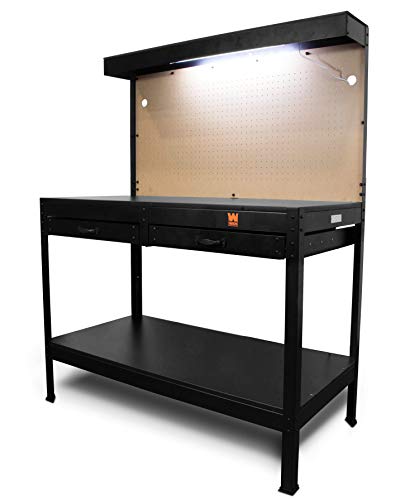


Prices change often; the button shows today's price on Amazon.
Amazon and Grizzly, side by side
Each card shows an Amazon pick and a Grizzly Industrial pick for the same job.
4 ft adjustable workbench
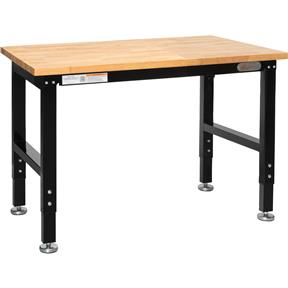
Pick the Amazon bench for the lowest entry cost; pick the Grizzly bench if you want outlets built into the bench and a direct parts line.
6 ft adjustable workbench
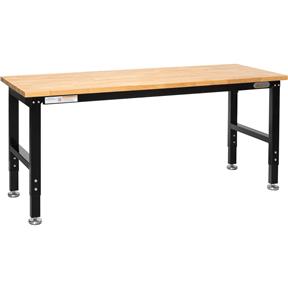
Choose the Amazon bench to keep spending down; choose the Grizzly bench when you run power tools on it every weekend and want the built-in outlets.
Hardwood-top workbench
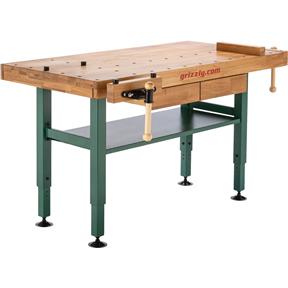
The Amazon bench is a height-adjustable hardwood top; the Grizzly bench is a fixed heavy-duty oak top on steel legs for a bench that never moves.
Prices change often and Grizzly runs sales, so the buttons show current prices.
Depth by the work you do
- Hand-tool woodworking: 20 to 24 in. A narrow bench lets you reach across and clamp work to the near edge. A vise and dog holes work at the front.
- General assembly and repair: 24 to 30 in. Room to spread parts out without losing them behind a back edge.
- Glue-ups and large panels: 30 to 36 in, or a separate assembly table; see assembly table versus workbench.
- Benchtop machines: the machine plus margin. The Grizzly T34608 drill press lists a footprint of 19-1/2 x 12 in; the G0945 jointer 9-1/2 x 19-1/2 in; the G4000 lathe 16 x 37 in; the G0602 lathe 47-1/2 x 12-1/2 in. Add a few inches in front for the operator's elbows and tools. A bench at 24 in is fine for any of them, but check the footprint with the machine's overhang. See metalworking bench for a garage machine shop.
- Electronics and small parts: 20 to 24 in, with good light and a back stop.
When in doubt, choose 24 in with a back lip or pegboard and make the surface longer instead. Length is cheaper to use than depth: a person walks along a bench but cannot walk through one.
Benches in our catalog, and what depth to check
The listings tell you the depth, so check it before you buy. The CAMMOO 48 x 24 in garage bench with pegboard and power strip is 24 in deep by its title. The CAMMOO 48 in adjustable workbench lists a 2,000 lb maximum load, pegboard and a power strip. The WEN WB4723T 48 in bench with power outlets and a light has built-in outlets. The Betterhood 70 in adjustable height workbench lists a 2,000 lb load. The VEVOR 72 in garage workbench has an adjustable height and a hardwood top. Get the depth and the height range from each listing; these are not figures we have in our own data.
On the Grizzly side, the T34010 is a 4 ft adjustable heavy-duty bench with outlets, the T34011 is the 6 ft version, and the T10157 is a heavy-duty oak bench with steel legs. Check the depth on Grizzly's listing. A pegboard or shelf on a bench adds to the depth that reaches into the aisle, so subtract it from the strip you computed.
A bench that is longer than it is deep is the efficient shape for a garage. A 4 ft by 24 in bench takes 8 sq ft of floor, a 6 ft by 24 in bench takes 12. Compare the options in best garage workbench.
Wall benches, island benches and corners
A bench against a wall has one working side and a back stop, and it is the most space-efficient layout. An island bench in the middle of the room has two working sides and is a luxury of a two-car bay or a three-car bay: it needs a 36 in aisle on all four sides, so the floor use is the bench plus 6 ft in each direction. A corner bench, an L along two walls, gains work area at the cost of a deep corner you cannot reach. Fill the corner with a swing-out shelf or leave it as storage.
Think about what stands behind the bench. A wall with a window, a panel or a water heater can limit a bench. Keep 3 ft of clear space in front of an electrical panel, and keep clear of the garage door tracks and the opener. A bench in front of the car also protects the car's bumper from a swinging door, so some people put a bench there on purpose with a rubber bumper between. See how to lay out a garage shop.
Outlets and light decide the usable depth. A bench that is 24 in deep with a back pegboard and a shelf is, in practice, 18 in deep, because of the shelf overhang. If you need a 24 in clear surface, buy a 30 in deep bench with a back stop.
Making an existing bench shallower or deeper
You do not have to replace a bench to change its depth. To go shallower, remove a back board or cut the top back to the first support and re-cap the edge. To go deeper, add a second layer of plywood that overhangs the front or back by 2 to 4 in, or add a fold-up extension flap. A flap at the end of the bench for glue-ups folds away when the car comes in. A drop-leaf on a rolling bench widens it for the project and narrows it for the car.
Whatever you change, re-check the load rating and the anchoring. An overhang of more than a few inches over the legs reduces what the bench can carry at the edge, and a deeper bench is easier to tip when a vise is clamped on the front edge. Bolt a heavy bench to a wall stud where the listing allows it, and see vises and clamps for a garage workbench.
A 15-minute test settles most debates: cut a piece of cardboard to your target size, put it on sawhorses at your working height, and work at it for a project. You will know in an hour whether the depth is right.
A quick way to pick your depth
If you want a number without reading the whole page, use this short decision path.
- Does the car stay in while you work? If yes and your bay is 12 x 20 ft, the answer is a fold-down bench or a 12 to 18 in deep wall shelf. If yes and your bay is 12 x 22 ft, go to step 2. If no, go to step 2.
- What is your height? Multiply by 0.4 and round down to a whole inch (28 in at 5 ft 10 in). That is the deepest top you can use without leaning.
- What goes on the bench? Vise work, hand tools and electronics want 20 to 24 in. General assembly wants 24 to 30 in. Benchtop machines want the machine footprint plus a few inches. Glue-ups want a separate assembly table.
- How much aisle can you spare? Add 30 in (tight) or 36 in (comfortable) to the depth and compare it with the floor you have. If the sum is larger, drop the depth by 6 in or move to a fold-down.
- What goes behind and above? A pegboard, shelf or cabinet that projects forward reduces the usable depth. Hang those on the wall above reach height (about 60 in) rather than directly over the bench top.
Most people land on 24 in. That is not a coincidence: it is the depth where reach, vise work, storage behind and floor space all balance in a garage. Move to 30 in only when you have the aisle and a reason, and go shallower only when the car forces it. Then confirm with tape on the slab and the car parked, and use the workbench size calculator for the final check.
Get the garage shop planning checklist
One printable page: measure the bay, count the circuits, list the machines, check the floor. Plus a few short emails, then a couple a month at most.
Unsubscribe anytime. You can also just read the checklist on this site.Frequently asked questions
How deep should a garage workbench be?
Between 24 and 30 inches for most work. Comfortable reach is about 40 percent of your height, 28 in at 5 ft 10 in, and you need a 30 to 36 in aisle in front.
Is a 36 inch deep workbench too deep?
For most people, yes, because the back 8 to 12 in is out of reach. It suits glue-ups and large panels if you can walk around it, but needs a 66 in strip of floor with a 30 in aisle.
How deep a workbench fits in front of a parked car?
With a sedan, a 12 x 22 ft garage leaves 5 ft, enough for a 24 or 30 in bench and a 30 in aisle. A 12 x 20 ft garage leaves 3 ft, so only a shallow shelf or a fold-down bench fits.
What depth for a workbench with a vise?
Twenty-four inches. The vise sits on the front edge, and a deeper bench just means work hangs off the front. A heavier bench resists racking under a vise.
Should the bench be deeper for a machine like a lathe or drill press?
Check the machine footprint on its listing and add a few inches for the operator. The Grizzly T34608 drill press lists 19-1/2 x 12 in and fits a 24 in bench.
This page is researched guidance, not professional electrical, engineering or safety advice. Circuits, loads and clearances depend on your house, your service and your town: have a licensed electrician confirm any wiring, and check local code and each manufacturer's manual before you act.
