Buy a base

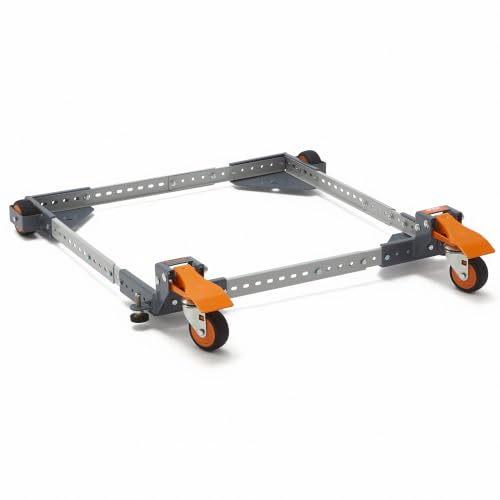
BORA PM-3550 heavy-duty adjustable base for shop equipment and table saws, per the title. The kind of base the cabinet saw page recommends; read the listing for the capacity.
Comparison
Buy the base for any saw over about 300 lb. The BORA PM-3550 or the VEVOR 1500 lb base come with a stated capacity, locks on every caster and a frame that fits; a DIY base moves the engineering to you. A DIY base is reasonable under a benchtop machine or a light saw, with a drill and driver, locking casters rated for the load and a plan.
BORA PM-3550 heavy-duty adjustable base for shop equipment and table saws, per the title. The kind of base the cabinet saw page recommends; read the listing for the capacity.
A DIY base is plywood or lumber, four locking casters rated for the load, and screws or bolts. The one tool to own is a drill and impact driver, such as the DEWALT 20V kit.
| Buy a base | Build your own | |
|---|---|---|
| What you get | A frame with casters and a lock mechanism, made for equipment | A frame you design: box, ladder or torsion frame, with casters you choose |
| Capacity | Stated on the listing | Set by the weakest part: the casters, the screws or the plywood |
| Fit to the saw | Adjustable footprint on the adjustable models | Exactly the footprint you build |
| Your time | Assembly | Design, shopping, cutting, assembly, testing under load |
| Cost | Under $250 for the BORA PM-3550 | Lumber, casters and fasteners; casters carry most of the cost |
| Storage added | None | A box base can hold accessories, and can also add height |
| Heavy cabinet saw (508 lb shipping) | Buy | Not recommended |
| Hybrid saw (324 lb shipping) | Buy, or DIY with proper casters | Possible with care |
| Small benchtop saw | Universal kit | Easy and sensible |
Add up everything that sits on it: the saw, the fence and rails, any extension table, a motor you may upgrade, and the stock on the table when you move it, which you should avoid. Then add a margin. Our sizing rule is the machine weight times 1.3. The shipping weights in our sources are 324 lb for the Grizzly G0771Z hybrid and 508 lb for the G1023RL cabinet saw; shipping weight includes packaging, so the machine is lighter, and the margin covers the rest. That gives about 420 lb and 660 lb.
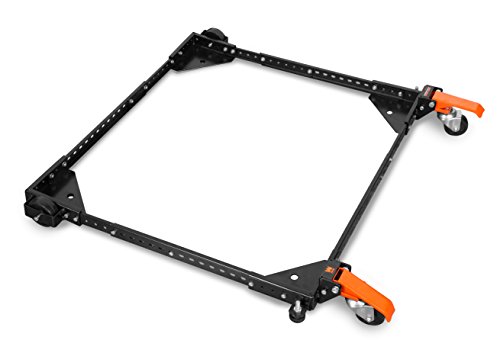
In catalog terms, the WEN 500 lb base clears the 420 lb figure with little margin, and the VEVOR 1500 lb base (adjustable from 18 x 24 in to 26.5 x 31.5 in per the title, with swivel wheels) clears 660 lb comfortably. The mobile base sizing calculator does the same math for your saw. Check the footprint: the G0771Z base footprint is 19-1/2 x 21 in and the G1023RL is 20-1/2 in square, both inside the VEVOR range on the title.
A DIY base has the same question and a harder answer. The casters carry the load, and a caster rating is per caster, at best on a smooth floor. A garage slab is not smooth, and with four casters on an uneven floor, three carry most of the weight at any moment. A common shop rule is to size the casters so that three of them can carry the full weight with the margin on top. That is a guideline from ordinary shop practice, not a code, and it is the reason a DIY base with four casters rated for exactly the saw's weight is under-built.
Four things, in the order they tend to show up. Casters: cheap casters have cheap bearings and swivels that seize under load, and some lock only the wheel, not the swivel, so the saw drifts. Buy casters that lock both, with a stated load rating. Fasteners: a plywood box held by screws loaded in shear is stronger than one loaded in pull-out; the caster plates should bolt through, with washers, and not screw into end grain. Height: a base raises the table, and a saw is set at a working height. A 4 in rise on a base that adds casters can put a table saw's top out of the range you cut at, and out of line with an outfeed table. Stability: a tall, narrow base with the weight high tips. A mobile base must be wider than it is tall.
A bought base has solved some of this. An adjustable frame is built for the weight, the casters match the frame, and the lock is part of the design. It still has limits. Read the listing for the capacity, check whether the locks hold the swivel, and check the height it adds. The mobile base roundup compares the BORA PM-1100, PM-2500 and PM-3550, the WEN and the VEVOR.
A garage slab slopes toward the door so that water runs out. The slope is slight, but a 500 lb machine on four casters does not need much of a slope to start rolling, and it does not stop where you want when it meets one. The same slab has cracks, control joints, a drain or a thickened edge at the door apron. A machine on small wheels hits each of those like a speed bump.
That affects both choices. Locking casters on every corner are not optional, and neither is a method for parking it in the same place each time: tape the work position on the floor. Roll slowly, with the saw empty, with the fence locked and the blade lowered. Put a plywood or hardboard runner along the roll path if the slab is rough. If you move the saw into the driveway for ripping long stock, check the threshold at the door: a ridge that a 500 lb saw hits at an angle is how a saw tips.
For a saw that must also share a bay with a car, see the cabinet saw against hybrid saw page, where the G0771Z and G1023RL are placed in each bay by our layout engine, and the jobsite saw against hybrid saw page for the saw that avoids a base entirely.
We do not type prices, so use the proportions. The cost of a DIY base is mostly casters: four heavy-duty locking casters rated for hundreds of pounds are a real expense, and a bad choice there wipes out the saving on lumber. Plywood or lumber and bolts are cheap. Add your time, which is the cost people leave out, and the cost of redoing a base that fails. A bought universal base such as the BORA PM-1100 is in the under $50 tier, the BORA PM-2500 in under $250, and the VEVOR 1500 lb in under $100. A DIY base for a cabinet saw does not come in far under those once the casters are bought.
A DIY base wins on cost for light machines, where small casters work and the frame is a plywood box. It loses on heavy machines, where the casters and the build quality are what you are paying for. If you build, you need a drill and driver such as the DEWALT 20V MAX kit, a saw to cut the parts, clamps for glue-ups like the JORGENSEN parallel bar clamps and a plan.
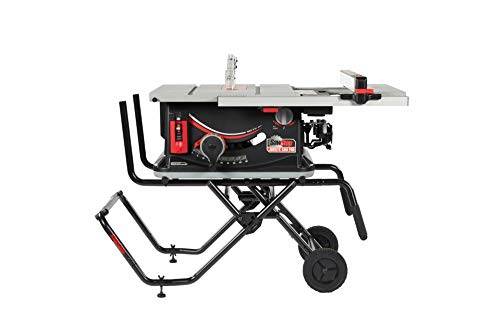
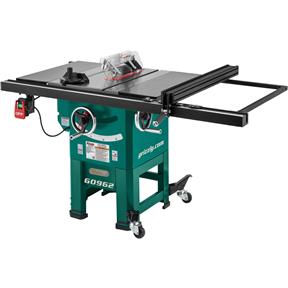
Some saws arrive with the base solved. The Grizzly G0962 is an open-stand hybrid with a built-in mobile base, a 40-1/4 x 27 in table and a 297 lb shipping weight; the listing does not give an overall width with the fence rails. The SawStop Jobsite Saw PRO ships with a mobile cart. A saw built around a base has no mismatch to engineer. The G0962 fit sheet shows how it sits in each bay.
The decision tree is short. Under 100 lb, no base is needed. Between 100 and 300 lb, a universal base, bought or built. Over 300 lb, a bought base with a stated capacity, or a saw that has one built in.
Buy the base for a hybrid or cabinet saw; build one for a light machine. A 324 lb or 508 lb saw deserves a base with a stated capacity and locks on every caster, and the cost is small next to the saw. A DIY base is a good project for a benchtop saw, a planer stand or a drill press, where casters are easy and a failure is cheap. Whatever you roll, lock the casters, roll slowly and mark the park position. The full range of bought options is in the mobile base roundup.
Amazon pick and Grizzly pick for the same job, side by side.
The Amazon pick is a 120V jobsite saw on a mobile cart; the Grizzly saw has a built-in mobile base under a cast-iron table. Both roll away so a car can come back in.
Prices change often and Grizzly runs sales, so the buttons show current prices.



Prices change often; the button shows today's price on Amazon.
One printable page: measure the bay, count the circuits, list the machines, check the floor. Plus a few short emails, then a couple a month at most.
Unsubscribe anytime. You can also just read the checklist on this site.It is possible but not recommended. A saw that ships at 508 lb needs casters and a frame rated well above that, and the caster rating is the part people get wrong. A bought base states its capacity. Use that for a saw over about 300 lb.
Take the machine weight times 1.3, then make sure three casters can carry it on their own, because an uneven slab can lift one. Use locking casters that lock the swivel and the wheel, with the load rating on the package.
The title says 1500 lb, adjustable from 18 x 24 in to 26.5 x 31.5 in, with swivel wheels. Check the listing for how the locks work, and compare the saw base footprint with the range.
It adds height equal to the frame plus the casters. A saw table is set at a working height, and an added few inches can put the table out of line with an outfeed table. Check the base height on the listing against your saw.
Only with locks on every caster and a flat parking spot. Garage slabs slope toward the door, and a heavy machine will drift. Roll it empty and slowly, and mark the work position on the floor.
This page is researched guidance, not professional electrical, engineering or safety advice. Circuits, loads and clearances depend on your house, your service and your town: have a licensed electrician confirm any wiring, and check local code and each manufacturer's manual before you act.