Bag collector

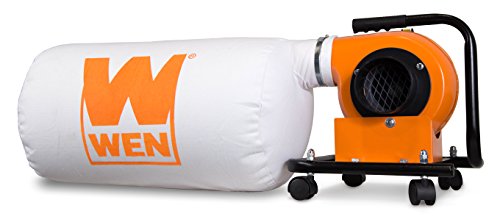
1 HP, 560 CFM portable on casters with 1 micron collector bags, per the listing. The entry price, and the filter that clogs first.
Comparison
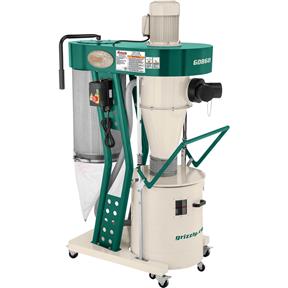
For a small garage shop with a car in it, a cyclone such as the Grizzly G0860 (120V at 15 A, 868 CFM at 1.8 in SP, 1 micron canister, 20 gallon drum) is the best of the three because the filter stays clean and the dust lands in a drum you can see. A bag collector like the POWERTEC 560 CFM portable costs the least and works until the bag clogs. A single-stage canister sits between them.
1 HP, 560 CFM portable on casters with 1 micron collector bags, per the listing. The entry price, and the filter that clogs first.
1-1/2 HP two-stage cyclone on 120V at 15 A, 868 CFM at 1.8 in SP, 6 in intake, 1 micron canister, 20 gallon drum, 78 dB, wireless remote.
| Bag collector | Cyclone collector | |
|---|---|---|
| How it filters | Chips and dust go through the impeller into a bag; air leaves through the bag | A cyclone spins the chips into a drum first; a canister filters what is left |
| Filter life | Short: the bag packs with fine dust and airflow drops | Long: the canister sees little coarse dust |
| Impeller and chips | Chips pass through the impeller (single-stage) | Chips drop out before the impeller |
| Airflow (listing) | 560 CFM (title) | 868 CFM at 1.8 in SP |
| Circuit | 1 HP, read the amp rating on the listing | 120V, 15 A: a dedicated 20 A, 12 AWG circuit |
| Emptying | Tie off or swap a bag | Quick-release 20 gallon drum |
| Footprint | Compact, on casters; see the listing | 27-1/2 x 44 in, 70 in tall, 278 lb shipping |
| Fits 12 x 20 ft with a car? | See the fit sheet for your model | Empty bay only |
| Fits 12 x 22 ft with a car? | Yes (cyclone-class footprint or smaller) | Yes |
| Budget tier | Under $500 | Price at grizzly.com |
All three pull air through a duct with a fan, called an impeller. What happens next is the difference.
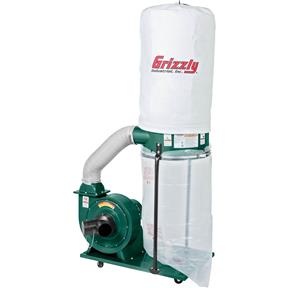
Bag collectors run chips and dust through the impeller and blow the air through a fabric bag. The airflow is good when the bag is new. Fine dust fills the pores of the fabric, and airflow drops. Bags are rated by the particle size they pass; a 1 micron bag, as in the POWERTEC listing, catches fine dust but loads faster than a 5 or 30 micron bag. Our catalog holds the POWERTEC portable, the POWERTEC wall-mount and the WEN 12 gallon, and the Grizzly G1028Z2 is a bag-style portable with a 1300 CFM bag rating, a 6 in inlet Y with two 4 in openings and a 42.6 gallon bag on its listing.
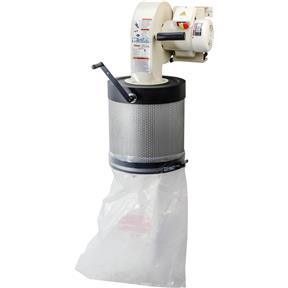
Canister collectors replace the bag with a pleated filter, which has far more surface area and cleans with a crank or a paddle. The Grizzly G0785 is a 1 HP wall-mount with a canister filter and the G0548ZP is a 2 HP canister collector with an aluminum impeller. We do not have more figures on those two than their names; the listings give the CFM and the amps. A canister is still a single-stage design: chips pass through the impeller, so the impeller takes the wear.
Cyclone collectors add a first stage. Air enters a cone and spins, and the heavy chips fall into a drum. Only the fine fraction reaches the impeller and the filter. That is the G0860, a two-stage design. The result is a filter that stays cleaner, a drum that does the work a bag did, and a collector that holds its airflow.
Cyclone, by a clear margin, and the reason is mechanical rather than a matter of brand. A bag or a canister is both the filter and the container. A cyclone separates those jobs. The coarse material is out of the airstream before it gets to the filter, and what remains is the dust that matters for health and for paint.
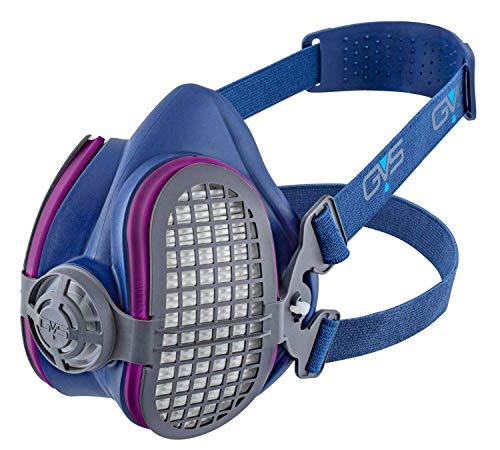
Nothing in this table replaces a respirator. Even a 1 micron filter lets some of the finest dust through, and the dust you breathe is the dust that escapes at the machine. Wear a fitted respirator such as the 3M half facepiece kit or the GVS Elipse P100, and run a hanging filter. The G0738 hanging filter lists 260, 362 and 409 CFM with a 5 micron outer and a 1 micron inner filter; the air filtration calculator sizes one for your bay.
If you work in softwood and cut mostly boards, with a short duct and a collector that you wheel up to the machine, a bag is not a mistake. If you sand or build cabinets from sheet goods, the bag is a regret.
The G0860 is 27-1/2 x 44 in and 70 in tall on its listing. Our layout engine places it in a 12 x 22 ft bay beside a parked sedan and in every larger bay; in the 12 x 20 ft bay it fits only when the car is out. The G0860 sheet shows all six bays.
A cyclone is taller than a bag portable. At 70 in it clears a standard 8 ft garage ceiling, but a door track or an opener rail may sit lower than the ceiling. A wall-mount canister such as the G0785 solves the floor space problem entirely by hanging on a wall stud. Read the listing for its dimensions and plan the wall: a collector vibrates, and a 2x4 stud into a block wall is not the same as a stud in a framed wall.
Weight matters when the unit is portable. The G0860 ships at 278 lb on its listing and the G1028Z2 at 118 lb. Neither is a unit you lift into place alone, and a 118 lb portable on casters is easier to relocate than a 278 lb cyclone.
The G0860 is listed at 15 A at 120V. Taking 125 percent for a continuous load gives 18.8 A, so a dedicated 20 A circuit with 12 AWG copper (NEC Table 310.16, 60 C column). The G1028Z2 lists 12 A at 120V, or 6 A at 240V. A licensed electrician should confirm any circuit.
In a garage the practical question is whether the collector shares a circuit with a saw. It should not. A collector and a saw both draw heavy starting current, and the first time you run both you will trip the breaker. The 240V route, a 6 A draw on the G1028Z2 at 240V, is a legitimate way to remove the problem, since the same motor draws half the current in the same wire. See the 240V explainer and the 1-1/2 HP circuit sheet.
Airflow figures need caution. A bag rating of 1300 CFM, as on the G1028Z2 listing, is free air through the bag, not air at the hood of a machine through a duct. The G0860 lists 868 CFM at 1.8 in of static pressure, which is the more useful kind of figure because it includes the resistance of a duct system. A machine such as a table saw asks for 350 CFM at the hood and a planer 400; a 6 in main carries 785 CFM at 4,000 fpm.
The G0860 lists 78 dB. Bag collectors vary, and the listing is the place to read each number. Because a bag collector runs the chips through the impeller, it also makes a harsher noise when a screw or a knot goes through. Hearing protection is not optional; the Decibel Defense muffs are a 37 dB NRR option.
Maintenance is where the cost of ownership shows. A bag is emptied or replaced; a canister is cleaned with a paddle and replaced eventually; a cyclone drum is emptied and its canister is cleaned less often. If you hate maintenance, the cyclone is the answer. If you hate spending, the bag is the answer, and you accept the chore.
This ranking comes from the published specifications and owner reviews, not from our own testing. For a garage shop with a car in it: cyclone first, canister second, bag third. For a garage shop that is a hobby and a short list of machines on a 120V circuit: bag collector, until the first time you sand a cabinet. The upgrade path from a bag to a cyclone is a sale of the first and a purchase of the second, so the cost of choosing the bag is the resale loss. The dust collector roundup lays out three tiers.
Cyclone if you sand, rout or park a car beside the shop; bag if you cut boards for a few hours a month on a tight budget. The G0860 is the 120V cyclone that fits a one-car garage with a car in it (12 x 22 ft). A canister, such as the wall-mount G0785, is the choice when floor space is the constraint and you accept a single-stage design. For the 240V step up, see the G0860 against G0441 page.
Amazon pick and Grizzly pick for the same job, side by side.
Both are bag-style portables on casters. The Grizzly unit is a 1-1/2 HP machine with a 1300 CFM bag rating; the Amazon unit is a 1 HP class machine at a lower entry cost.
The Grizzly G0860 is a two-stage cyclone on 120V with a 1 micron canister; the Amazon pick is a bag-style 1 HP machine. The cyclone costs more and keeps the filter clean far longer.
Both are 1 HP wall-mount collectors that free the floor. The Grizzly one uses a canister filter; the Amazon one uses filter bags.
Prices change often and Grizzly runs sales, so the buttons show current prices.


Prices change often; the button shows today's price on Amazon.
One printable page: measure the bay, count the circuits, list the machines, check the floor. Plus a few short emails, then a couple a month at most.
Unsubscribe anytime. You can also just read the checklist on this site.For occasional use with coarse chips, yes. The bag clogs on fine dust, and airflow drops with it. If you sand, rout or build cabinets, or a car shares the bay, a cyclone keeps the filter clean and keeps fine dust off the paint.
A canister replaces the bag with a pleated filter but is still single-stage: chips pass through the impeller. A cyclone adds a first stage that drops chips into a drum before the fan, so the filter and impeller see far less material.
It lists 15 A at 120V. At 125 percent that is 18.8 A, so a dedicated 20 A circuit with 12 AWG copper. Do not share it with a saw. A licensed electrician should confirm the circuit.
Separator lids exist for drums and vacs, and the Dust Deputy in our catalog is a cyclone separator for wet/dry vacs. Check each listing for the inlet size and airflow. A separator bolted to a small collector does not turn it into a two-stage cyclone of the G0860 class.
A planer asks for about 400 CFM at the hood in our machine table, and it makes a lot of chips. A cyclone with a 20 gallon drum handles that without clogging a filter. A bag handles it until the bag fills. Either needs a hose of the right size.
This page is researched guidance, not professional electrical, engineering or safety advice. Circuits, loads and clearances depend on your house, your service and your town: have a licensed electrician confirm any wiring, and check local code and each manufacturer's manual before you act.