Hanging air filter

Both are 3-speed ceiling-hung filters in the 300 to 400 CFM class with remotes. The Grizzly unit is owner-rated 4.8 on grizzly.com across 301 reviews.
Best picks · three tiers
For a one- or two-car garage woodshop, a hanging 3-speed filter in the 300 to 400 CFM class is the right size: the POWERTEC AF4001E, the WEN 3410 or the Grizzly G0738 (260, 362 and 409 CFM). On the high speed they turn over a 12 x 20 ft garage about 11 times an hour. For a three-car bay, step up to a 1050/1350 CFM unit like the ALORAIR.
| Tier | Amazon pick | Budget | Grizzly option |
|---|---|---|---|
| Beginner | WEN 3410 3-Speed Remote-Controlled Air Filtration System | Under $250 | Grizzly G0738 3-Speed Hanging Air Filter |
| Intermediate | DEWALT Air Filtration System Dust Collector | Under $500 | Grizzly G0738 3-Speed Hanging Air Filter |
| Expert | ALORAIR 360 Degree Intake Air Filtration System Woodworking | Under $250 | Grizzly G0738 3-Speed Hanging Air Filter |
A dust collector pulls chips and dust from the tool, through a hood, before they reach the air. An air filter cleans what the collector missed, the fine dust that floats in the room for hours after a sanding session. The two do different jobs. Fine dust, under about 10 microns, is the kind that stays airborne and gets into lungs, and most of it comes from sanding, routing and cutting, not from planing.
In a garage, that dust has one more place to go: your car, your tools and the wall between the garage and the house. A door closed to the kitchen helps, but a filter running in the garage helps more. This is why the dust collector page and this page go together: best dust collector for a garage shop covers the source capture, and this one covers the room.
This roundup was researched from manufacturer listings, published specifications and owner reviews, not a particle-counter test. The air-change figures are arithmetic from the CFM on the listing and the room volume you give it, and the air filtration calculator runs the same math for your own bay with its constants labelled.
Under $250
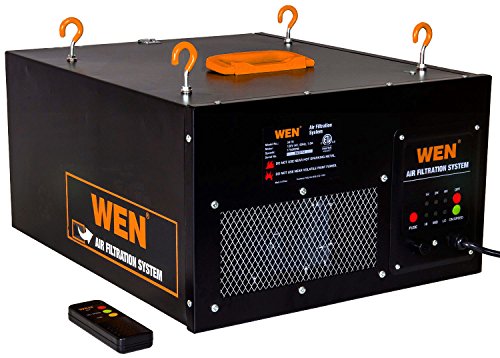
Who it is for: A one-car garage woodworker who sands, cuts and routs in a 12 x 20 or 12 x 22 ft bay and wants cleaner air without a duct system.
The WEN 3410 is a 3-speed, remote-controlled filter at 300, 350 and 400 CFM. In a 12 x 20 ft garage with a 9 ft ceiling (2,160 cubic feet, an assumption you should replace with your own), 400 CFM is about 11 air changes per hour. It hangs on chains, takes no floor and plugs into a normal outlet. Pair it with a collector or a vacuum at the tool; a filter cleans what escapes, not the main dust stream.
Skip it if: You have a large bay and no source collection at all. A filter will not catch chips, and it cannot clear a room that a planer filled.
See on Amazon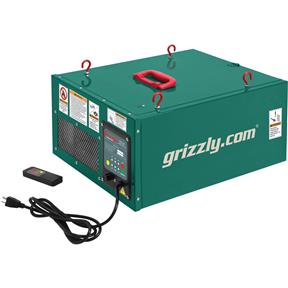
Direct from Grizzly: Grizzly G0738 3-Speed Hanging Air Filter. The G0738 lists 260, 362 and 409 CFM, a 1, 2 or 4 hour timer and a two-stage filter (5 micron outer and 1 micron inner), at 34 lb and 1 A.
Buy direct at Grizzly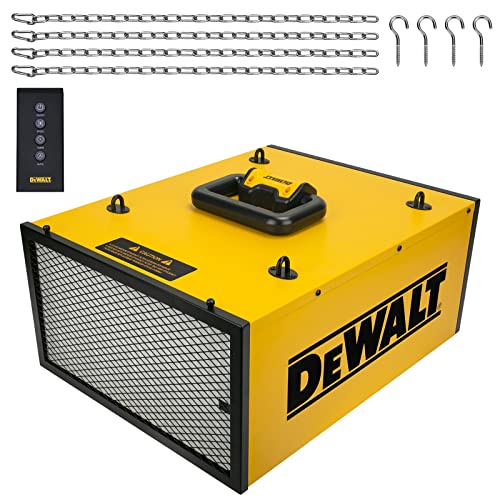
Under $500
Who it is for: A two-car garage woodworker who runs a table saw, a sander and a router and wants a unit with a name-brand filter and warranty.
The DeWalt DWXAF101 is the branded alternative in the catalog, and the POWERTEC AF4001E is the 3-speed remote pick. In a 22 x 22 ft bay with a 9 ft ceiling (4,356 cubic feet), a 409 CFM filter turns the air about 5.6 times an hour, which is on the low side for heavy sanding. That is why a two-car bay with a lot of dust either runs the filter for a long time after work or adds a second unit.
Skip it if: You do dusty work all day. A single 400 CFM unit in a two-car bay cleans slowly; add a second one or step up in size.
See on Amazon Direct from Grizzly: Grizzly G0738 3-Speed Hanging Air Filter. The G0738 has a timer, so it can run for the hours after you quit and shut itself off.
Buy direct at Grizzly
Under $250
Who it is for: A three-car or large two-car garage woodworker who needs to clean a big volume of air after planing or sanding.
The ALORAIR 360 degree intake filter lists 1050 and 1350 CFM. In a 32 x 24 ft three-car bay with a 9 ft ceiling (6,912 cubic feet), 1350 CFM is about 11.7 air changes an hour, which a 400 CFM unit cannot match (about 3.5). The tradeoff is bulk, noise and a bigger electrical draw, so read the listing for the dimensions, the sound level and the amps before you hang one.
Skip it if: You have a one-car bay. A 1350 CFM filter in a 2,160 cubic foot garage turns the air over very fast but is loud and large for the room.
See on Amazon Direct from Grizzly: Grizzly G0738 3-Speed Hanging Air Filter. If you prefer the smaller class, two G0738 units (one at each end of the bay) give broader coverage than one big unit.
Buy direct at GrizzlyThe formula is air changes per hour (ACH) equals CFM times 60 divided by the room volume in cubic feet. Take a bay, multiply length by width by ceiling height, and divide. We use a 9 ft ceiling for the table below because it is a common garage ceiling height; measure yours. The number of air changes you want is a judgment, and values around 6 to 10 per hour are commonly quoted for shop air cleaners; the calculator labels its own target as a CONVENTION so you can change it.
| Garage | Volume at 9 ft | 400 CFM unit | 1350 CFM unit |
|---|---|---|---|
| 12 x 20 one-car | 2,160 cu ft | about 11 ACH | about 37 ACH |
| 22 x 22 two-car | 4,356 cu ft | about 5.5 ACH | about 18.6 ACH |
| 24 x 24 two-car | 5,184 cu ft | about 4.6 ACH | about 15.6 ACH |
| 32 x 24 three-car | 6,912 cu ft | about 3.5 ACH | about 11.7 ACH |
The bay-by-bay sizing pages give the target for each bay: 12 x 20, 12 x 22, 20 x 20, 22 x 22, 24 x 24 and 32 x 24. A filter that runs for two hours after you stop does the same as one that turns the air several times quickly, which is why timers matter.
Hang it from the joists or the ceiling, out of the way of the garage door track and the opener. A hanging unit leaves the floor for the car and the machines. Put it near the dust source and aim the air so it sweeps the room in a loop: intake near the work, exhaust across the bay toward the far wall, rather than blowing straight at the door. Do not hang it where it blows on a sanding surface or a finish. Do not block the intake with a shelf.
The G0738 is a small unit: 20 x 17 x 10 in at 34 lb, with hanging chains included. That is easy to hang from two ceiling hooks into joists. A heavier unit needs proper anchors into framing, and a 1350 CFM filter wants a firm mount. Check the weight on the listing, and use hardware rated for it.
Power is simple. The G0738 lists 1 A, which any 15 A circuit can carry alongside the lights. Run it from an outlet near the ceiling or a short cord, and use the remote or the timer. For the lighting that goes with it, see the shop lights page.
A micron is a millionth of a meter. Sawdust that you can see is bigger than 50 microns, and the dust that hurts lungs is below 10. A filter with a rating of "5 micron" catches particles of about that size and bigger; a "1 micron" filter catches finer ones. The G0738 lists a 5 micron outer filter and a 1 micron inner filter, so it catches the larger dust in the outer stage and the finer dust in the inner stage. The outer filter is the one you wash or replace most often.
Ratings are not a guarantee of room air quality. A filter cleans only the air that passes through it, so the number of air changes matters as much as the micron rating. A great filter at 100 CFM in a big bay cleans slowly. And a filter that is full of dust moves less air than it did when new, so clean it on schedule. Read the manual for the interval and the method, and check the listing for the filter replacement cost before you buy.
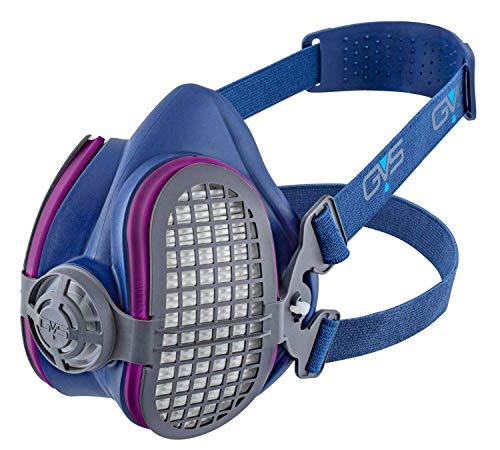
For your lungs, the best protection is still source capture and a respirator: the GVS Elipse P100 or the 3M 6291 half-facepiece kit while you sand. An air filter is a backup for the air, not a substitute for a mask. This is general information, not medical advice.
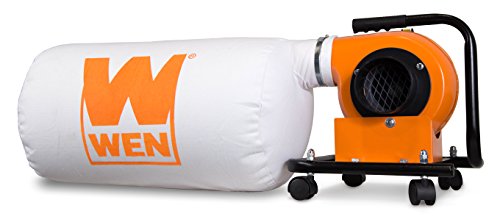
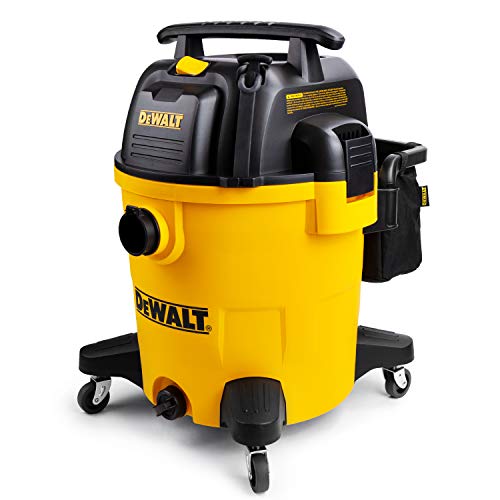
Think in layers. First, catch the dust at the tool with a hood and a hose to a vacuum or collector. A cyclone separator like the Dust Deputy on a 12 gallon vacuum serves a benchtop tool, and a portable collector handles a table saw; the dual cards below show the pairings. Second, run the air filter through the work and for a while after it. Third, wear a respirator for the dustiest jobs. Fourth, clean up with a vacuum, not a broom, because sweeping puts dust back in the air.
The result is a garage that stays cleaner for the car and the house. You will still see dust on the shelves, but a bay with source capture and a filter has far less of it than a bay with neither. And when you open the garage door to the driveway, dust drifts out as well, so fans and doors help in good weather.
If you plan a bigger shop, the garage workshop guide and the dust collector calculator are the next stops.
A hanging filter is quieter than a collector, but it runs for hours, so it is worth a look at the decibel figure on the listing. Many filters list a sound level at the low speed and a higher level at the top speed. A neighbor will notice a loud fan at night, but a filter on low speed during a quiet evening is usually not a problem. Use the timer to run it on high while you work and on low afterward.
Running cost is small. A unit like the G0738 draws about 1 A at 120V, around 120W, so a day on the timer costs pennies. The real cost is the replacement filter, which depends on how dusty your work is. Price the filters before you choose, since a cheap unit with an expensive filter is no bargain. And keep a fire extinguisher by the door; dust-laden filters are fuel.
One card per machine class, with the Amazon pick and the Grizzly pick side by side.
Both are 3-speed ceiling-hung filters in the 300 to 400 CFM class with remotes. The Grizzly unit is owner-rated 4.8 on grizzly.com across 301 reviews.
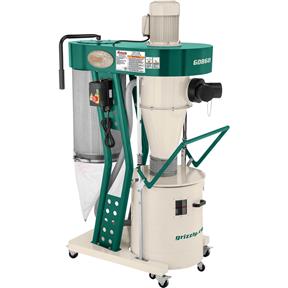
The Grizzly G0860 is a two-stage cyclone on 120V with a 1 micron canister; the Amazon pick is a bag-style 1 HP machine. The cyclone costs more and keeps the filter clean far longer.
Prices change often and Grizzly runs sales, so the buttons show current prices.


Prices change often; the button shows today's price on Amazon.
These picks plus the rest of a complete build at three budgets, as one list. A few short emails follow, then a couple a month at most.
Unsubscribe anytime. You can also just read the checklist on this site.A 300 to 400 CFM unit is plenty. In a 12 x 20 ft bay with a 9 ft ceiling, 400 CFM is about 11 air changes per hour. Hang it from the ceiling so the floor stays clear for the car.
Values around 6 to 10 per hour are commonly quoted for shop air cleaners. The air filtration calculator labels its own target as a convention, so you can change it for your work and your bay.
No. A filter cleans fine dust that floats in the room; it does not catch chips at the tool. Use a collector or a vacuum with a cyclone at the machine and an air filter for the air.
Probably. A 400 CFM unit gives about 3.5 air changes per hour in a 32 x 24 ft bay with a 9 ft ceiling. A 1350 CFM unit gives about 11.7. Two smaller units also work.
On the ceiling or joists, near the dust source, with the airflow sweeping across the room. Keep it clear of the door track and the opener, and use hardware rated for the unit weight.
Amazon carries the WEN, DeWalt, POWERTEC and ALORAIR units. Grizzly sells the G0738 direct, a 3-speed unit at 260, 362 and 409 CFM. Compare the CFM, the filter ratings and the replacement filter cost.
This page is researched guidance, not professional electrical, engineering or safety advice. Circuits, loads and clearances depend on your house, your service and your town: have a licensed electrician confirm any wiring, and check local code and each manufacturer's manual before you act.