Shop vac + cyclone
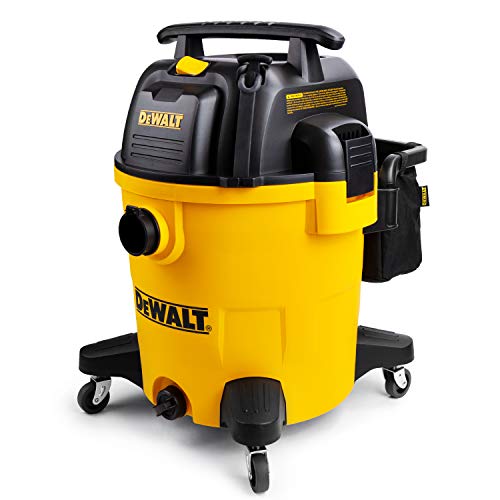
12 gallon wet/dry vacuum with a 5.5 peak HP rating on the listing. Pair it with a cyclone separator so the filter does not clog. Rolls, stores under a bench.
Comparison
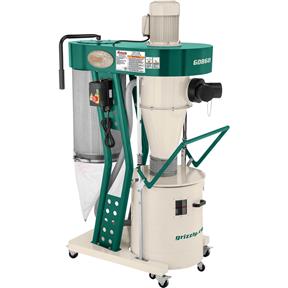
A shop vac with a Dust Deputy cyclone is a good dust collector for one hand tool or one small machine at a time and the only realistic option in a 12 x 20 ft garage with a car in it. A real collector such as the Grizzly G0860 (868 CFM at 1.8 in SP, 6 in intake, 120V at 15 A) is what a table saw, a planer or a jointer needs, because a vac hose cannot carry that volume of air.
12 gallon wet/dry vacuum with a 5.5 peak HP rating on the listing. Pair it with a cyclone separator so the filter does not clog. Rolls, stores under a bench.
1-1/2 HP two-stage cyclone, 120V at 15 A, 868 CFM at 1.8 in SP, 6 in intake, 1 micron canister, 20 gallon drum, 78 dB, wireless remote on the listing.
| Shop vac + cyclone | Cyclone collector | |
|---|---|---|
| Moves air by | High suction through a small hose | High volume through a large duct |
| Hose or duct | Small-diameter vac hose; the listing gives the size | 6 in intake; 4 in branches carry 349 CFM at 4,000 fpm |
| Airflow rating | Rated in peak HP on the listing, not CFM at the hood | 868 CFM at 1.8 in SP (listing) |
| Best at | Handheld sanders, routers, miter saw, benchtop tools | Table saw, bandsaw, jointer, planer, router table |
| Circuit | A standard 120V outlet; read the amp rating on the listing | Own 20 A, 120V circuit, 12 AWG |
| Noise | Loud, high-pitched; ultra-quiet models exist | 78 dB on the listing |
| Floor space | About the size of a bucket; stores under a bench | 27-1/2 x 44 in, 70 in tall, 278 lb shipping |
| Fits 12 x 20 ft with a car? | Yes | Empty bay only |
| Fits 12 x 22 ft with a car? | Yes | Yes |
| Budget tier | Under $250 | Price at grizzly.com |
Yes, with limits, and the limits are about air volume rather than power. Dust is carried away from a cut by a stream of air with enough speed to keep chips moving, about 4,000 feet per minute in a duct. The volume of air at that speed is the cross-section area of the duct times the speed. A 4 in duct at 4,000 fpm is 349 CFM, a 6 in duct is 785 CFM. A shop vac hose is far smaller than a 4 in duct. By the same velocity times area formula, a 2-1/2 in hose carries about 136 CFM at 4,000 fpm. That is below the 350 CFM a table saw hood asks for in our machine table.
A shop vac makes up the difference with suction. It pulls hard through a small opening, which is what you want for a sander port or a router shroud, where the opening is small. The vac works well when the tool's own dust port is the choke and the tool throws fine dust. It works badly on a machine with a big open hood and heavy chips, because there is nothing to hold the chips in the airstream.
We did not test any vac. The figures here are from the manufacturer listings and published formulas; the DEWALT 12 gallon and the Shop-Vac Ultra Quiet 12 gallon both list a 5.5 peak HP rating and nothing else we can compare to a collector's CFM. Peak HP is not an airflow figure.
A vac's filter is its weak point. Fine dust packs the filter in minutes and suction falls away. A cyclone separator such as the Dust Deputy Low-Pro Plus sits between the hose and the vac and drops most of the dust into its own bucket before it reaches the filter. The vac then stays at full suction for much longer, and you empty a bucket instead of cleaning a filter. If you plan to use a vac for dust collection at all, buy the separator first; it is the cheapest upgrade in this comparison.
A separator does not add airflow. It protects the filter. The vac with a separator is still a handheld-tool system, and the right way to think about it is as a mobile station: one hose, one tool, one gate. Our sizing page for tight bays says the same thing, as the fallback when the collector itself will not fit; see the dust collector sheet for a 12 x 20 ft garage.
Our layout engine placed each option alone in each bay, with and without a sedan.
| Bay | Vac with separator | G0860 cyclone |
|---|---|---|
| 12 x 20 ft one-car | Fits with a car | Empty bay only |
| 12 x 22 ft one-car | Fits with a car | Fits with a car |
| 20 x 20 ft two-car and up | Fits with a car | Fits with a car |
The vac's footprint is an allowance of 18 x 18 in in the engine, a planning number rather than a measured one; check the listing for the model you buy. The G0860's footprint is 27-1/2 x 44 in on its listing, 70 in tall, and the sheet for all six bays is the G0860 fit sheet.
The bigger difference for a car is dust control after the cut. A collector with a 1 micron canister keeps fine dust out of the air that settles on paint. A vac with a good filter does the same job at its own scale. Neither replaces a hanging filter: see the air filtration roundup.
A shop vac plugs into any 120V outlet. The G0860 is listed at 15 A at 120V; 125 percent is 18.8 A, so it gets its own 20 A circuit with 12 AWG copper, per NEC Table 310.16. A licensed electrician should confirm the circuit. A vac running on the same circuit as a router and a table saw trips the breaker, so the question for the vac is also how many tools are on the circuit.
Noise is where the vac loses. A vac's motor is a universal motor that turns very fast, and the sound is a high whine that carries through a garage door. The Shop-Vac model in our catalog is marketed as ultra quiet, but the listing is the place to read the number. The G0860 lists 78 dB. Either way, wear hearing protection such as the Decibel Defense 37 dB NRR muffs and shut the door if the neighbors are close.
A collector with a wireless remote, as listed for the G0860, helps in a different way: you do not run it longer than you need to.
A vac and a separator are inexpensive, and the tier of each is in the table above, not a quote. A collector costs more, adds a duct system, and may need a circuit. The cost that matters is the second purchase. A woodworker who starts with a vac and adds a planer buys a collector within the year; one who starts with a collector and never adds a stationary machine spent too much. Decide by the machine list, not by the budget alone. The dust collector calculator turns your machine list into a CFM requirement and tells you whether a vac can serve any of it.
The two can live together. A common arrangement in a two-car garage is a collector on the stationary machines and a vac on the miter saw, the sander and the floor. The vac also serves the car: it is the thing you use to vacuum the shop before the car comes back in.
Fine wood dust is a health hazard, and neither machine is a substitute for a respirator. Wear a respirator rated for fine dust, for example the GVS Elipse P100, when you sand or cut. Dust is also a fire and explosion risk in a closed collector; keep ignition sources such as grinder sparks away from the collection system, and never vacuum hot embers. A shop vac used for wet cleanup should not be used for dry dust without checking the filter type on the listing.
A vac with a separator for handheld tools and a 12 x 20 ft bay; a cyclone collector for any stationary machine. The G0860 is the smallest cyclone in our set that fits a one-car garage with a car in it (the 12 x 22 ft bay), and it runs on a 120V circuit. The vac is the right first purchase for a tool-by-tool workshop. If you plan a table saw, a planer or a jointer, skip the middle step and buy the collector. See the dust collector roundup and the G0860 against G0441 page for the next step up.
Amazon pick and Grizzly pick for the same job, side by side.
The Grizzly G0860 is a two-stage cyclone on 120V with a 1 micron canister; the Amazon pick is a bag-style 1 HP machine. The cyclone costs more and keeps the filter clean far longer.
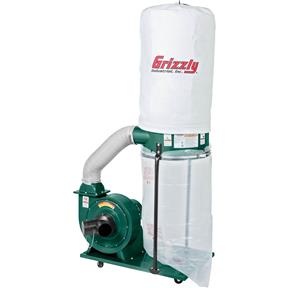
Both are bag-style portables on casters. The Grizzly unit is a 1-1/2 HP machine with a 1300 CFM bag rating; the Amazon unit is a 1 HP class machine at a lower entry cost.
Prices change often and Grizzly runs sales, so the buttons show current prices.



Prices change often; the button shows today's price on Amazon.
One printable page: measure the bay, count the circuits, list the machines, check the floor. Plus a few short emails, then a couple a month at most.
Unsubscribe anytime. You can also just read the checklist on this site.You can connect one, and it will catch the dust that reaches the port. A table saw asks for about 350 CFM at the hood in our machine table, and a vac hose cannot carry that volume. Use a vac for the saw only if the garage has no room for a collector, and add a separator and a hanging filter.
Yes, if you collect fine dust. It drops most of the dust into a bucket before it reaches the vac filter, so suction stays steady and you stop cleaning filters. It does not raise airflow. It is the cheapest upgrade in this comparison.
In our layout engine it fits beside a parked sedan in a 12 x 22 ft bay and anything larger, and it fits the 12 x 20 ft bay only when the car is out. The listing gives 27-1/2 x 44 in and 70 in tall.
Only if the circuit is already loaded. A vac plugs into a 120V outlet, but it adds to whatever else is on that circuit. Use the workshop amps calculator to check the total, and have a licensed electrician confirm any new circuit.
No. A vac or a collector captures dust at the source. A hanging filter cleans the fine dust that escapes into the room, which settles on a parked car. They do different jobs, and a garage with a car in it usually wants both.
This page is researched guidance, not professional electrical, engineering or safety advice. Circuits, loads and clearances depend on your house, your service and your town: have a licensed electrician confirm any wiring, and check local code and each manufacturer's manual before you act.