4 ft LED shop lights

hykolity 4 ft LED shop light, 42 W, 4400 lm, 5000K daylight per the title. Bought singly or in packs, and linked in rows over benches and machines.
Comparison
For a garage shop, linkable 4 ft LED shop lights such as the hykolity 4 ft (42 W, 4400 lm, 5000K) win because you place light over the bench, the saw and the car lane instead of in the middle of the ceiling. An all-in-one garage ceiling light such as the POLARPRA (32000 lm on the title, 6500K) is quicker to install and good for a general wash, and leaves shadows at a table saw or a bench.
hykolity 4 ft LED shop light, 42 W, 4400 lm, 5000K daylight per the title. Bought singly or in packs, and linked in rows over benches and machines.
POLARPRA LED garage ceiling lights, 32000 lm, 6500K daylight per the title. A multi-panel ceiling fixture; the listing explains how it mounts and wires.
| 4 ft LED shop lights | Garage ceiling light | |
|---|---|---|
| Form | Long 4 ft fixtures, placed in rows | Multi-panel ceiling fixture |
| Output (title) | 4400 lm each | 32000 lm (check whether per fixture or per set) |
| Color (title) | 5000K daylight | 6500K daylight |
| Wattage | 42 W each (title) | See the listing |
| Placement | Anywhere along a joist or the wall: over the bench, saw and car lane | Fixed ceiling points, usually the center of a bay |
| Shadows at machines | Fewer: light comes from several rows | More: one bright source overhead |
| Installation | Hang on chains, screw to joists, plug in or hardwire | Mounts to a ceiling point; see the listing |
| Garage door clearance | Rows run beside the door track and opener | A big fixture can collide with the door track or opener |
| Cars and glare | Rows over the bench leave the car lane evenly lit | A bright center can glare off paint |
| Budget tier | Under $50 | Under $50 |
A garage needs more light than a house. Our calculator uses 50 footcandles for general shop work and 100 for detail work, with lumens needed equal to footcandles times area divided by a utilization factor and a light-loss factor. We use 0.6 for average walls, 0.7 for white walls, 0.45 for dark walls and 0.85 for dirt and age. Those are conventions, not code values, and the calculator labels them as such.
On those conventions a 12 x 20 ft bay (240 sq ft) needs about 23,500 lumens for general work with average walls. A 22 x 22 ft bay (484 sq ft) needs about 47,500 lumens. In fixtures at the 4,400 lm rating on the hykolity title, that is 6 fixtures in the one-car bay and 11 in the two-car bay, drawing about 250 W and 460 W at 42 W each. Detail work at 100 footcandles doubles the number. See the 12 x 20 ft sheet and the 22 x 22 ft sheet for the full table, including white and dark walls.
The POLARPRA title says 32000 lm. Marketing lumens are the figure on the box, and a title does not say whether the total is for one fixture or a set. Read the listing before you count it against the target. And remember that lumens are not the same on a bright shop light and on a multi-panel fixture; the light that reaches the bench matters, not the figure in the title.
A table saw, a bandsaw and a workbench all have a person standing at them, and a person standing under a single overhead light casts a shadow on the work. The more sources and the wider they are spread, the softer the shadow. A row of 4 ft fixtures over each machine and bench puts light from both sides. A single ceiling fixture in the middle of the bay is brightest where nobody works.
That is the main reason shop lights win for a shop. A garage ceiling light is a good fixture for a garage that is not a shop. If you want one big fixture, add task lights at the bench, a clamp-on or a strip under a shelf.
Color temperature is a matter of taste and function. Both are daylight-range fixtures, 5000K for the hykolity and 6500K for the POLARPRA per the titles. The 5000K is a neutral white that reads wood and paint color well; 6500K is a cooler, bluer light. For finishing and color matching, the lower number is easier on the eye.
Lights share the ceiling with things that move: the overhead door, its track, the opener and a car with a roof rack or an open hatch. Before you buy, open the door all the way and map where the track and the door panels travel. A 4 ft fixture on a chain between the joists clears more easily than a wide multi-panel fixture. Keep fixtures off the line of the door and a hand's width clear of the opener rail.
The car also reflects light. A glossy hood under a bright center fixture glares and a light-colored floor bounces light up. A row of fixtures along each side of the bay lights the floor without glaring off a car in the middle. Our layout engine puts the car in a lane and the benches along the walls, so the rows follow the walls. The 22 x 22 ft woodshop layout shows that arrangement.
In a one-car bay a parked car shadows the middle of the room. Put a pair of lights over the bay end where the work happens, and keep another row for when the car is out.
LED lighting is a small load, so lights seldom need their own circuit. At 42 W each, 11 fixtures draw about 462 W, or 3.9 A at 120V, and a 15 A lighting circuit loaded to 80 percent carries 12 A. Put the shop lights on one switch for the bay and a second switch for the bench rows. Do not put lights on the same circuit as a saw or a compressor, since a motor starting can flicker the lights and trip the breaker. A licensed electrician should confirm the wiring; the workshop amps calculator adds the lights to the rest of the shop.
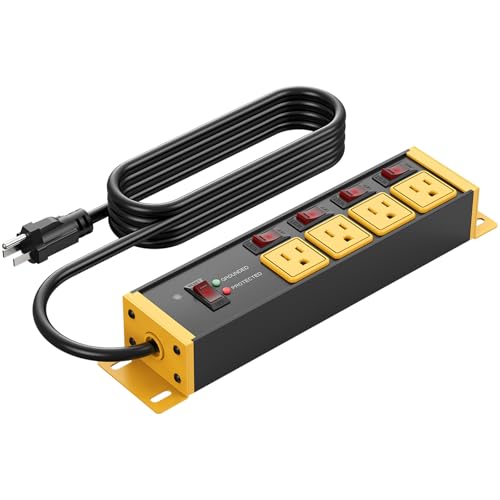
Some shop lights plug in and some hardwire; check each listing, and note that a plug-in light needs an outlet near the ceiling. A surge protector strip such as the CCCEI 12 gauge strip is a bench item and not a ceiling one. Ceiling outlets or a cord drop with a switch are cleaner than extension cords draped across the ceiling.
Light fixtures collect dust and spider webs in a woodshop. Choose fixtures that wipe clean, and clean them. Dust on the lens can cost a fraction of the light.
This comparison comes from product titles, listings and the lighting conventions in our calculator, not from our own measurements. For a garage shop with machines and a bench, linkable 4 ft lights are the better tool because you place the light where the work is. For a garage that is a garage first, the single fixture does the job and costs less labor. The two are not exclusive: a common arrangement is one ceiling fixture for general light and strips over the bench. See the garage shop lights roundup for every pick in our catalog.
4 ft LED shop lights for a shop; a ceiling fixture for a garage that stays a garage. The shop lights cost a little more labor and give you light at the bench, fewer shadows and room to grow. The ceiling fixture is the quick install and the general wash. In a 12 x 20 ft bay the sums come to about 6 shop lights on the convention we use; in a 22 x 22 ft bay about 11. Put the bench rows on their own switch.




Prices change often; the button shows today's price on Amazon.
One printable page: measure the bay, count the circuits, list the machines, check the floor. Plus a few short emails, then a couple a month at most.
Unsubscribe anytime. You can also just read the checklist on this site.On our conventions, a 22 x 22 ft bay with average walls needs about 47,500 lumens for general work, which is 11 fixtures at 4,400 lm each. White walls reduce it; detail work at the bench raises it. The shop lighting calculator does your bay.
Both fixtures here are daylight range: 5000K for the hykolity and 6500K for the POLARPRA per their titles. 5000K is a neutral white that shows wood and paint colors well. 6500K is cooler and bluer. Many people prefer the lower number for finishing.
It can. A wide fixture can hit the door track, the door panels or the opener when they travel. Open the door fully and map the clear areas before you mount anything. Shop lights between joists are easier to place.
Not usually. A dozen fixtures draw under 4 A at 120V. Keep them off a circuit that runs a saw or a compressor, and use a licensed electrician for any new wiring.
It is the figure on the title. It may be the total for several panels or a set. Read the listing for what the number covers, and count the light that reaches the work, not the headline figure.
This page is researched guidance, not professional electrical, engineering or safety advice. Circuits, loads and clearances depend on your house, your service and your town: have a licensed electrician confirm any wiring, and check local code and each manufacturer's manual before you act.

